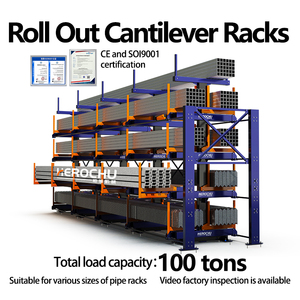
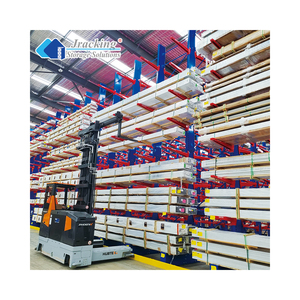
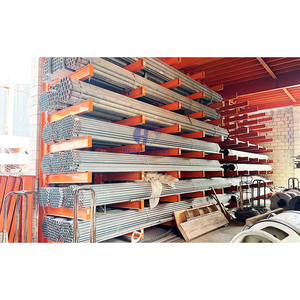
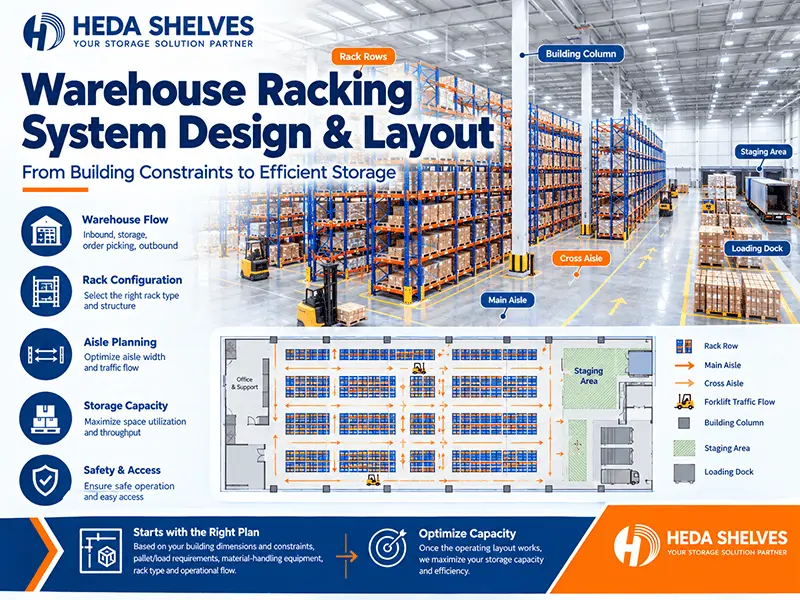
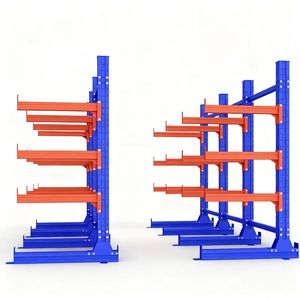
Mracking Heavy Duty Cantilever Rack Adjustable Shelf (Single & Double Side)
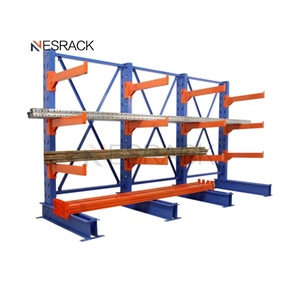
- Application: Extra-long raw stock & lumber
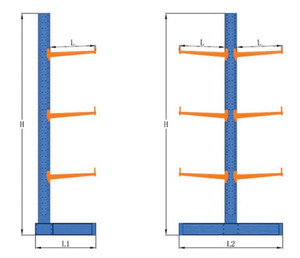
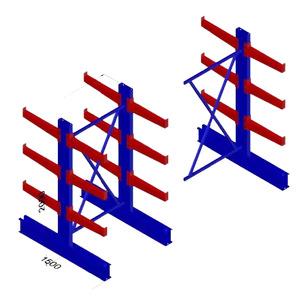
- Config: Unilateral or Bilateral upright columns
- Arm Pitch: 100mm/140mm modular adjustment
Explore our certified structural I-beam and roll-formed cantilever architectures engineered for unconstrained linear loading, rapid crane/forklift picking, and complete layout flexibility.
Direct Structural Fabrication & Global OEM/ODM Experience
Audited Under CPR-8605159 & ISO 9001:2015 Criteria
Monthly Capacity Backed by a 30,000 m² Facility
Fully Compliant Engineered Installations Globalized
Unlike standard selective pallet racks constrained by frontal upright columns, an adjustable cantilever racking system relies entirely on a centralized vertical column that transfers bending moments straight through bolted or welded heavy base elements into the concrete slab. Every load placed upon an arm induces dynamic cantilever beam deflection (δ = WL³ / 3EI), requiring strict adherence to high-tensile material selection like Q235B or Q355B structural hot-rolled I-profiles.
Our CE-certified fabrication adheres to rigorous European standards (including EN 15512:2020 and FEM 10.2.02). Structural arms are tapered upward with a minimal 2° to 4° factory-calculated incline. This built-in counter-camber offsets intentional gravitational deflection when handling maximum weight capacities ranging from 500 kg up to 3,000 kg per arm. Without this specialized counter-geometry, materials such as PVC conduit, oil-country tubular goods (OCTG), and rebar bundles would slide forward, triggering fatal center-of-gravity shifts.
To eliminate torsional bucking across high-bay configurations (extending upwards of 9 meters), our structures integrate heavy diagonal and horizontal K-truss or X-truss bracing assemblies. These tie multi-column runs together into an immovable structural lattice, guaranteeing wind-load and seismic resilience even in unbraced, external lumber yards.
Strategic analysis for enterprise procurement officers and supply chain architects navigating the modern material storage market.
Procurement teams are shifting away from commercial cold-rolled gauge metals toward high-yield structural hot-rolled steels (Q355B / S355JR). The higher tensile yield reduces cross-sectional weight without sacrificing bearing thresholds, trimming international container freight weights by up to 18% per project metric ton.
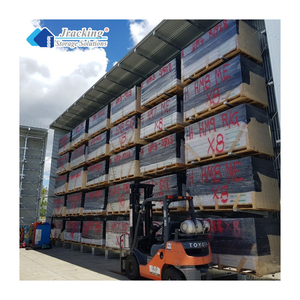
Rising cubic yard industrial land leases mandate multi-tier vertical cantilever builds. Forward-looking facilities are utilizing articulated four-directional reach trucks and multi-directional side loaders. By minimizing aisle clearances from 5.5 meters to under 2.4 meters, overall site warehouse density expands by 60%.
Manual material handling is progressively replaced by mechanical extendable cantilever arms. Overhead gantry cranes can lower heavy 8-ton bar bundles straight onto fully telescoped levels, eliminating sideways forklift approach collisions and elevating warehouse occupational safety parameters.
A panoramic breakdown of engineering advances improving asset life-cycles, load balancing, and atmospheric corrosion defense.
Traditional zinc phosphating plus electrostatic powder coatings fail rapidly under marine salt atmospheres (ISO 12944 C4/C5 environments). The emerging global standard utilizes thermal hot-dip galvanizing bath processes (ASTM A123) providing 85+ micron zinc layers, guaranteed to stop oxidation across external lumber yards for over 25 continuous years.
Modern cantilever engineering has evolved past legacy fixed-welded brackets. Patented precision-formed wedge connectors and heavy-duty locking safety hitch pins allow warehouse teams to reconfigure arm elevation levels on 100mm increments on site without cutting torches, re-welding, or structural compromises.
Future automated warehousing demands real-time strain-gauge sensor integration directly within cantilever upright bases. Critical structural alerts detect localized overloading, foundation settlement, or forklift impact deformation before progressive stress-strain failures can occur.
Benefit from vertically integrated Chinese manufacturing excellence: fully certified, custom-engineered, and delivered on-budget to over 120 countries worldwide.
Operating continuously since 2001, we incorporate load calculation data from over 10,000 completed facilities directly into your facility's customized layout.
Our licensed structural engineers deliver detailed CAD layouts, warehouse simulations, and load-limit reports within 24 hours to secure immediate stakeholder approval.
Full 10-stage processing: acid pickling, automated column punching, continuous roll forming, multi-phase welding, and high-temp cured powder coating.
Every profile, arm length, column spacing, and surface finish is adapted to your material handling equipment (side loader, reach truck, or overhead crane).
Key technical, structural, and logistics clarity for warehouse managers, civil engineers, and international procurement specialists.
Arm load capacities are calculated based on Uniformly Distributed Loads (UDL) across both arm length and column centerline. Under FEM 10.2.02 and EN 15512 guidelines, point loads placed at the extreme tip of an arm roughly double bending moments, requiring either structural down-rating or reinforcement with load distribution steel decking.
Due to intense overturning moment loads, heavy cantilever installations require a minimum reinforced concrete slab depth of 200mm to 300mm with a compressive rating of C20/25 or C25/30. Chemical resin anchors or heavy M16/M20 expansion bolts are drilled to specific depths dictated by seismic zone and column height specifications.
Single-sided cantilever uprights endure asymmetric horizontal pulling forces, requiring wider, reinforced base footprints firmly anchored into the foundation. Double-sided uprights naturally counterbalance opposing load forces through a common vertical web, providing increased structural stability and superior floor-space utilization efficiency.
HEDA Shelves holds official CE Certification (No. 2435-CPR-8605159) confirming adherence to European Construction Products Regulation (CPR 305/2011/EU) and EN 1090 execution of steel structures, coupled with our certified ISO 9001:2015 Quality Management System (No. 18624Q00169R0M).
Submit your facility's architectural dimensions, profile storage requirements, and load parameters today. Our senior structural layout team will prepare your full CAD drawings, 3D renderings, and FOB/CIF quotations within 24 hours.
Contact Us