25+
Years Manufacturing
Continuous industrial racking fabrication excellence since 2001.
10,000+
Delivered Projects
Turnkey installations across manufacturing, cold chain, and global 3PL hubs.
30,000m²
Modern Facility
Equipped with automatic punching, CNC roll forming, and electrostatic powder lines.
100%
Seismic & QA Checked
Strictly compliant with CE No. 2435-CPR-8605159 & ISO 9001:2015 frameworks.
Engineering Authority: Structural Integrity and Compliance in Heavy Storage Systems
Modern industrial supply chains cannot afford downtime, beam deflection failures, or unverified load tables. When selecting an industrial storage racking supplier or exporter, the technical evaluation must go beyond raw steel weight. International engineering standards—such as the European EN 15512, the American RMI (Rack Manufacturers Institute) MH16.1, and the Australian AS 4084—dictate strict limits on torsional buckling, connection moment capacity, and seismic drift ratios.
Technical Principle: Structural integrity in cold-formed upright sections relies on optimizing the perforations along the axis without causing local flange buckling. Our upright profiles undergo finite element computer analysis (FEA) to ensure that the yield point of structural carbon steel (exceeding 235 to 355 MPa) is never compromised during eccentric dynamic loading.
Material Selection: Hot-Rolled vs. High-Yield Cold-Formed Steel
Industrial racking systems utilize two distinct structural metallurgies depending on operational severity:
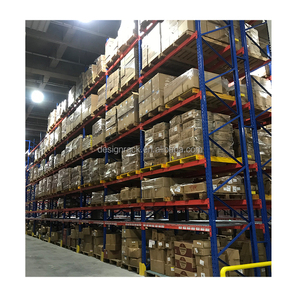
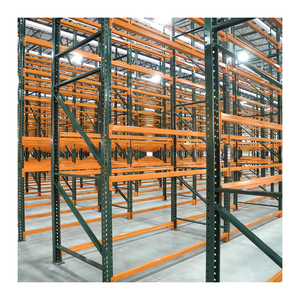
1. Cold-Formed High-Tensile Steel (Q235B / Q355B): Primarily used for selective pallet uprights, box beams, and push-back channels. Formed through multi-stage continuous roll-forming machines to create multiple stiffening ribs along the profile. This geometry maximizes the moment of inertia while decreasing overall deadweight, cutting international freight expenditure per pallet position by up to 18%.
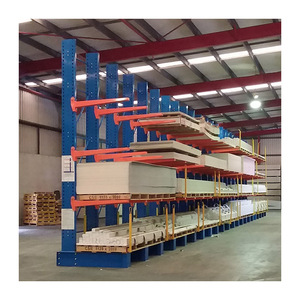
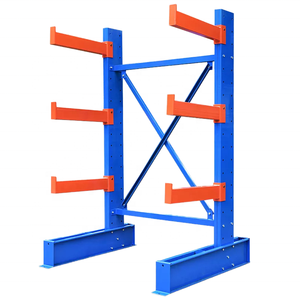
2. Structural Hot-Rolled Structural Sections (ASTM A36 / I-Beams): Recommended for heavy-duty cantilever columns, drive-in uprights subject to heavy forklift contact, and heavy machinery platforms. Heavy structural steel sections deliver superior impact resistance against lateral mast collisions in high-speed distribution terminals.
Surface Metallurgy for Extreme Operating Environments
A frequent failure point in long-distance racking procurement is corrosion from maritime shipping condensation or high-humidity tropical microclimates. Our components undergo a comprehensive 9-stage pre-treatment regimen: automated alkaline degreasing, industrial acid pickling to eliminate mill scale, immersion phosphating to form a crystalline corrosion barrier, and an electrostatic deposition of thermosetting polyester powder cured at 200°C. For deep-freeze chambers (-30°C) or coastal installations exposed to sodium chloride vapors, hot-dip galvanizing according to ISO 1461 standards ensures zinc-iron alloy protection that exceeds 25 years of service life without paint flaking.
Why Global Wholesalers & EPC Contractors Partner with HEDA Shelves
Founded in 2001 in Guangzhou, China, Guangzhou Heda Shelves Co., Ltd. operates as an integrated manufacturer and exporter. With an expansive 30,000 square meter modern factory, 300+ technical craftsmen, and over 10,000 completed international projects, we remove intermediate trade markups and deliver certified, heavy-duty storage infrastructure directly to your port.
Controlled 10-Stage Production
From prime steel coil uncoiling, automatic numerical column punch-pressing, precision roll-forming, robotic welding, to continuous pickling and electrostatic powder lines—we control quality internally without outsourcing critical steps.
Third-Party Audited Certifications
Every structural profile is backed by accredited testing: CE Certification (No. 2435-CPR-8605159), ISO 9001:2015 Quality Management (No. 18624Q00169R0M), and independent tensile verification of raw carbon steel.
Free Engineering Design Services
We provide complimentary CAD floor layouts, dynamic 3D warehouse simulations, structural stress calculations, and pallet weight distribution plans before purchase orders are issued.
Custom OEM / ODM Capabilities
Whether you require customized teardrop upright pitch patterns, custom beam section sizes, corporate color schemes, or private-label distributor markings, our engineering team handles tailored steel specifications.
Export & Container Stacking Logic
Components are sorted, banded with steel strapping, wrapped in moisture-resistant vapor barrier film, and tagged by part numbers to facilitate smooth customs clearance and quick on-site assembly.
Turnkey Installation Guidance
Every delivered project includes detailed component assembly prints, bolt torque specifications, step-by-step video installation manuals, and available on-site engineering supervision for large installations.
Transform Your Warehouse Space into High-Efficiency Storage
Speak directly with our senior structural layout engineers. Receive a customized 2D/3D CAD layout, comprehensive structural load calculations, and a transparent FOB/CIF container shipping proposal within 24 hours.
Get Catalog