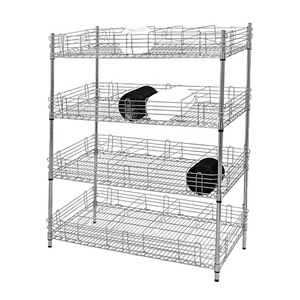
 Cleanroom Grade
Customized Anti-Static 4 Tiers Chrome Wire Shelves Storage Rack
ESD-protective carbon steel wire shelving with open ventilation, engineered for electronics and cleanroom facilities.
Explore our heavy-duty industrial storage racks, structural mezzanines, and specialty profile systems manufactured in ISO 9001:2015 and CE-certified production facilities.
Cleanroom Grade
ESD-protective carbon steel wire shelving with open ventilation, engineered for electronics and cleanroom facilities.
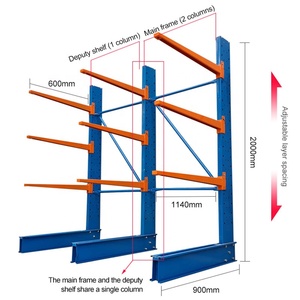 Long Material
Rugged column and arm structure rated up to 3,000 kg/arm, ideal for timber, steel tubes, PVC pipes, and profiles.
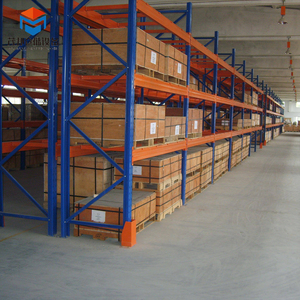 Universal Access
100% immediate pallet selectivity with interlocking adjustable beam levels for FMCG distribution and multi-SKU hubs.
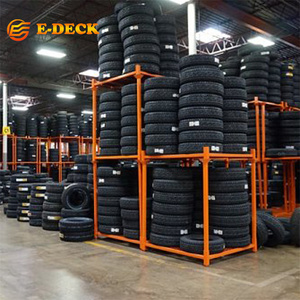 Modular Transport
Collapsible post pallets and portable tire/fabric steel stacking frames that maximize dynamic temporary storage floor footprint.
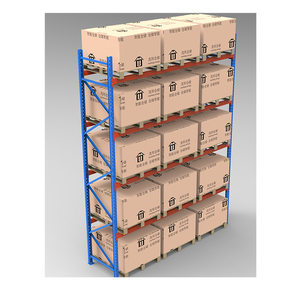 Push Back / Drive In
2-6 pallet deep push-back cart configurations on inclined rail guides, increasing volumetric utilization by over 75%.
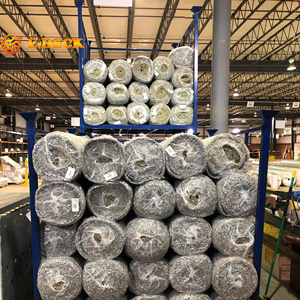 Textile & Roll
Heavy structural cradle engineering designed for non-standard cylindrical rolled goods, fabrics, carpets, and coil goods.
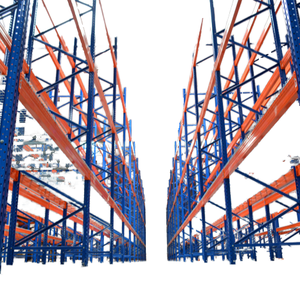 Corrosion Resistant
Multistage pickling, phosphating, and baked epoxy-polyester electrostatic powder coating built for humid or coastal logistics.
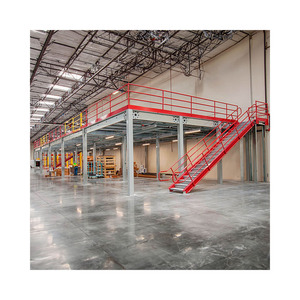 Floor Expansion
High floor-load capacity (300-1000kg/sqm) self-supporting column and purlin assembly to double footprint efficiency.
Operating since 2001, Guangzhou Heda Shelves Co., Ltd. serves over 120 countries, engineering heavy-duty storage racks and structural platforms backed by verified global certifications.
Certified under CE No. 2435-CPR-8605159 and ISO 9001:2015 No. 18624Q00169R0M (valid through June 2027), ensuring structural steel conformity under EN 15512 and RMI standards.
Our in-house design engineering department executes rigorous finite element structural analysis (FEA), optimizing aisle clearance, seismic load margins, and pallet turnover speeds.
Direct ocean export through major maritime gateways. Component tagging, steel strapping, and custom crating protect against transit vibrations and ocean transit moisture.
From custom profile gauge stamping to multi-color electrostatic powder coating, we provide turnkey bespoke solutions adapted to specialized inventory dimensions and handling machinery.
Push back pallet racking balances the space conservation of Drive-In systems with the operational throughput of Selective racking by using nested gravity-flow carts riding on inclined structural rails.
In a push back system, pallets are loaded from a single working aisle onto wheeled carts nested within tiered structural steel channel tracks. As a forklift loads the first pallet, it rests on the top nested cart. Loading the subsequent pallet gently pushes the front cart backward along a 2% to 3% engineered slope, exposing the underlying cart for the next pallet position.
Unloading operates conversely: when the front pallet is retrieved, gravity gently pulls the trailing carts forward toward the aisle face at a controlled speed, readying the next pallet for retrieval without the forklift ever entering the rack bay.
| Engineering Attribute | Standard Specification Range |
|---|---|
| Storage Depth Density | 2 to 6 Pallets Deep per Bay Channel |
| Structural Raw Steel | Hot-Rolled Q235B / Cold-Formed High Strength Q355B |
| Cart Unit Capacity | 500 kg to 1,500 kg (1,100 lbs - 3,300 lbs) per pallet cart |
| Track Incline Gradient | 2.0% - 3.2% calibrated gravity slope angle |
| Inventory Flow Logic | LIFO (Last-In, First-Out) by Lane / FIFO by Batch Bay |
| Surface Finishing | 60-80μm Electrostatic Powder Coating or Hot-Dip Galvanized |
Global supply chain restructuring and fluctuating warehouse real estate lease costs are reshaping how corporate procurement executives specify industrial racking systems through 2026-2030.
Skyrocketing industrial real estate values force operations directors to evaluate racking not by capital expenditure per upright, but by Storage Density per Square Meter of Footprint. Push back systems deliver up to a 90% increase in storage capacity over traditional selective systems, yielding complete capital payback in under 18 months through saved building footprint.
International buyers are moving away from traditional single-coat solvent enamels. Current procurement mandates demand low-VOC, multi-stage eco-friendly pretreatment coupled with thermoset polymer epoxy coatings. For tropical, coastal, and blast freezer projects, hot-dip galvanization meeting ISO 1461 requirements is increasingly stipulated to prevent structural corrosion from condensation.
Supply chain security concerns have led tier-1 logistics operators to bypass intermediaries, working directly with established primary manufacturers in China. Importers now demand full mill test certificates (MTC), verifiable steel heat numbers, robotized seam welding inspections, and documented third-party compliance with international EN and ANSI safety protocols.
Continuous engineering refinements in cart bearing alloys, rail geometry, and hybrid automation integration are setting new benchmarks for push back storage longevity.
Next-generation push back systems employ sealed, high-precision industrial bearings with specialized low-temperature synthetic lubricants. This prevents lubricant crystallization in -30°C blast freezers and reduces the forklift force needed to push back deep 5-deep cart stacks, keeping operation light and predictable.
Modern nested carts incorporate precision laser-cut steel guide pins and captive retention tabs. Even during imperfect pallet placement by lift truck operators or seismic floor oscillations, the nested carts cannot jump their tracks, avoiding lane jams and operational downtime.
Emerging push back variants feature built-in optical retro-reflective sensors and mechanical stops compatible with automated guided vehicles (AGVs) and autonomous mobile robots (AMRs), linking static mechanical high density with modern automated factory logistics.
Addressing structural calculations, container shipping logistics, forklift compatibility, and export engineering verification for international distribution projects.
While both systems maximize floor density, push back does not require forklifts to enter the rack matrix, saving up to 40% on operating cycle times. Furthermore, push back supports different SKUs on each lane level, providing much higher selectivity than drive-in lanes which usually store a single product type from floor to ceiling.
Standard counterbalanced or reach forklifts are fully compatible. Because the nested carts run on an inclined slope, the truck must provide enough forward pushing thrust to nudge trailing pallets uphill. No specialized attachments or narrow-aisle steering guides are required.
Every HEDA racking system is designed around site-specific geotechnical parameters, building codes, and concrete slab specifications. Our engineering team calculates upright profiles, back and vertical cross-bracing patterns, footplate surface areas, and anchor bolt diameters using finite element analysis (FEA) to ensure structural stability under dynamic lateral loads.
Yes. Push back systems are especially effective in cold storage where refrigeration costs demand maximum cubic density. For sub-zero operations, we fit custom cold-rated sealed bearings with low-temperature synthetic grease and finish components in hot-dip galvanized steel or cold-flexible epoxy powder to prevent brittleness and rust.
Standard custom fabrication lead time runs 20 to 30 days depending on total project tonnage. We manage export documentation, container loading lists, and freight through major regional shipping ports, providing competitive CIF or FOB terms complete with detailed assembly drawings for fast on-site erection.
Push back carts can be custom-engineered to handle variable footprints including US standard GMA (48"x40"), European EUR-1 (1200x800mm), and Australian standards. The rigid structural frame of the cart fully supports weak, warped, or non-standard bottom boards, reducing the risk of product drop-through compared to open beam systems.