High-Performance Industrial Storage Systems
Explore our export-grade racking structures, designed for seamless compatibility, seismic stability, and maximum spatial density in modern global logistics facilities.
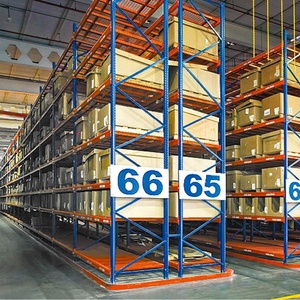
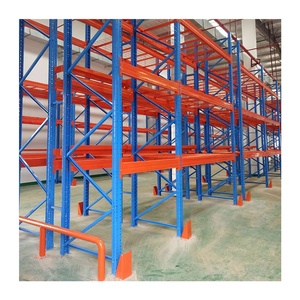
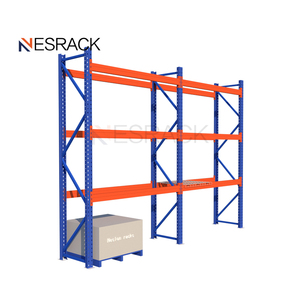
Engineering Teardrop Racking: Structural Mechanics & Global Sourcing
A rigorous metallurgical and mechanical evaluation of teardrop punching topologies, North American dimensional compatibility, and seismic-resistant upright frame configurations.
Interchangeability & The 2-Inch Standard
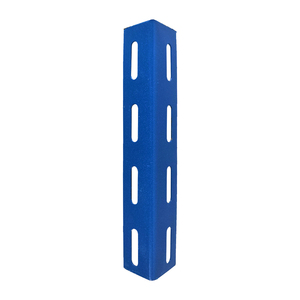
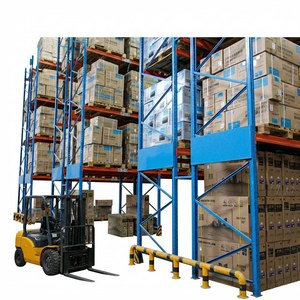
Teardrop pallet racking remains the uncontested standard throughout North America and international 3PL logistics networks. The inverted teardrop hole pattern utilizes an engineering-standard 2-inch (50.8 mm) vertical adjustment pitch, allowing instant beam re-profiling without unbolting or complex hardware.
As premier Chinese exporters, our CNC punching dies achieve a continuous pitch tolerance of ±0.1 mm, ensuring 100% interoperability with established global brands including Interlake, SpaceRak, Mecalux, and Ridg-U-Rak.
- Tapered gravity-engagement hole pattern
- Tool-less beam assembly with high friction lock
- Dual-rivet connector brackets with safety pins
- Direct retrofit compatibility with existing facilities
Metallurgy & Cold-Roll Forming Rigidity
Structural reliability starts with raw coil integrity. We source premium-grade Q235B and high-yield Q355B structural steel directly from premier domestic mills. Steel coils undergo rigorous tensile testing ($f_y \ge 235\text{–}355\,\text{MPa}$) and yield ratio verifications before progressive cold roll-forming.
Our multi-station roll-forming lines continuously shape open upright columns with internal reinforcing ribs, maintaining an exceptional strength-to-weight ratio while resisting local torsional buckling under extreme axial compressive loads.
- Continuous roll-forming with integrated online embossing
- Optimized upright post geometries (80×60 to 120×95 mm)
- Heavy-duty step beams with continuous seam robot welding
- Deflection index maintained strictly within $L/200$
Anti-Corrosion Surface Finishing Standards
Racking longevity in tropical environments, coastal maritime depots, and sub-zero cold stores depends entirely on pre-treatment chemistry. Our automated surface-finishing complex employs an intensive 10-stage preparation protocol before electro-deposition.
Components pass through pressurized acid pickling, immersion rust neutralization, and dense zinc phosphating. Finished components receive high-grade electrostatic epoxy-polyester powder baking ($180^\circ\text{C}\text{–}200^\circ\text{C}$), producing an ultra-tough, chip-resistant coating of 60 to 90 microns.
- Pickling & phosphating exceeds ASTM B117 standards
- Salt-spray resistance verified over 500+ hours
- RoHS compliant, non-toxic, TGIC-free powder chemistries
- Hot-dip galvanized (HDG) available for walk-in blast freezers
Comparative Evaluation of Export Racking Architectures
Contrast structural characteristics, operational dynamics, and capital expenditure indices across major industrial warehouse racking formats.
| System Architecture | Pitch & Locking Mechanism | Pallet Selectivity | Typical Beam Capacity | Footprint Utilization | Seismic Adaptability |
|---|---|---|---|---|---|
| Teardrop Selective Racking | 50.8 mm (2") Gravity Rivet + Safety Clip | 100% Direct Access | 1,000 – 4,500 kg / level | 40% – 45% (Standard Aisles) | High (Tested RMI) |
| European Diamond/Box Racking | 50 mm / 75 mm Hook & Wedge Bolt | 100% Direct Access | 1,000 – 5,000 kg / level | 40% – 45% (Standard Aisles) | High (EN 15512) |
| Very Narrow Aisle (VNA) | 50.8 mm / 75 mm Precision Slotting | 100% Direct Access | 1,200 – 4,000 kg / level | 55% – 65% (Aisle < 1.8 m) | Ultra-High Base Anchored |
| Drive-In / Drive-Through | Continuous Rail Bracket Mount | LIFO or FIFO by Bay | 800 – 1,500 kg / pallet slot | 75% – 85% (High Density) | Requires Top-Tie Bracing |
| Heavy-Duty Cantilever | Bolted Pivot / Pin Joint Column | Continuous Linear Span | 500 – 3,000 kg / arm | Specialized Long Loads | Heavy Base Anchor Plates |
Future Procurement Trends in Warehouse Storage (2025–2030)
Global supply chain executives are migrating beyond basic steel storage toward intelligent, robotics-ready, and seismically validated racking infrastructures.
AMR & 3D Shuttle Co-Engineering
Modern distribution centers are rapidly superseding conventional reach trucks with automated mobile robots (AMRs) and automated four-way pallet shuttles. Upright profiles must maintain millimetric vertical tolerances, deflection limits below $L/350$, and sensor-integrated end-stops to support autonomous operations.
High-Strength Micro-Alloyed Steels
With volatile maritime shipping container freight, buyers are shifting toward ultra-high-yield, micro-alloyed steels (such as Q355B and automotive-grade hot-rolled plates). These materials permit thinner wall gauges without reducing total frame load capacities, drastically lowering tare freight weight per 40HQ container.
Digital Structural Modeling (FEA)
Procurement teams increasingly require pre-order verification via Finite Element Analysis (FEA). Utilizing ANSYS and RISA-3D simulations, structural engineers can calculate dynamic ground acceleration factors ($S_s, S_1$), soil-slab anchor interactions, and beam deflection under asymmetrical cyclic loads.
Closed-Loop ESG & Traceable Coating
Environmental standards in the US, Europe, and Latin America demand verifiable supply chain sustainability. Modern teardrop racking procurement prioritizes manufacturers utilizing zero-discharge wastewater recycling plants, heavy-metal-free pre-treatments, and bio-based powder coatings with documented carbon footprints.
Why Global Importers Partner with Our Manufacturing Base
Founded in 2001 in Guangzhou, our integrated manufacturing campus has engineered and exported superior storage equipment for over two decades. Controlling every link in the supply chain—from prime steel coil decoiling to CNC stamping, roll-forming, robotic welding, and automated powder coating—guarantees uncompromised dimensional consistency and structural safety.
Whether fitting out a high-throughput 50,000-square-meter fulfillment center in North America, a tropical food processing hub in Central America, or a cold-chain pharmaceutical facility in Europe, we provide verified structural calculations, comprehensive installation blueprints, and container-optimized loading schematics.
Verified Regulatory Compliance
Our production operations are audited and certified by leading international third-party testing registries:
Engineering & Procurement FAQ for Racking Importers
Direct answers from our senior warehouse planning team addressing load calculations, compatibility, ocean container dispatch, and safety verification.
Is Chinese-manufactured teardrop racking completely compatible with American brands?
Yes. Our precision teardrop punching machines replicate standard 2-inch center-to-center hole spacing, hole diameter taper angles, and rivet offset profiles. Our step beams, upright frames, cross ties, and safety locking clips latch smoothly into Interlake, Mecalux, SpaceRak, and standard US teardrop systems without structural binding or mechanical mismatch.
What structural steel grades are utilized for cold-rolled uprights and step beams?
We primarily utilize certified Q235B (yield strength $\ge 235\text{ MPa}$) and Q355B (yield strength $\ge 355\text{ MPa}$) high-strength low-alloy structural steel, comparable to North American ASTM A36 and ASTM A572 Grade 50. All steel raw coils are accompanied by authenticated EN 10204 3.1 chemical composition and tensile elongation certificates.
How do you design teardrop racking for seismically active regions?
For projects located in active seismic corridors (such as California, Central America, or the Pacific Rim), our structural engineers run 3D modal response spectrum calculations. We increase upright gauge thickness, enlarge bottom baseplate dimensions, add diagonal vertical portal bracing, and specify heavy-duty Hilti or chemical anchors based on site geotechnical reports and local building codes.
How is cargo packaged to prevent corrosion and damage during maritime shipment?
Ocean freight exposes steel cargo to extreme humidity and saline atmospheres. We bundle upright posts and step beams onto structural steel dunnage with heavy protective cardboard corner buffers, edge guards, and multi-layer stretch shrink wrapping. All upright baseplates and hardware components are packed in moisture-sealed wooden crates containing industrial silica desiccant bags.
What information is required to receive a comprehensive CAD layout and quotation?
To produce an engineered proposal within 24 hours, our layout team requires: warehouse architectural drawings (internal clear height, column grids, overhead dock door locations), pallet dimensions (Width × Depth × Height including pallet overhang), maximum pallet gross weight, forklift make and model (turning radius and maximum mast lift reach), and daily throughput velocity.
What are the allowable beam deflection tolerances under full operational load?
In full compliance with ANSI MH16.1 and European EN 15512 specifications, our beam design limits maximum elastic deflection to $L/200$ (where $L$ is the clear span distance between upright columns). For sensitive automated picking or shuttle-integrated warehouses, we can custom-engineer ultra-rigid beams rated for deflections of $L/300$ or $L/400$.
Request an Engineered Layout & Direct Factory Quotation
Collaborate directly with our senior racking engineering department. We deliver complimentary AutoCAD spatial designs, 3D photorealistic renderings, finite element structural calculations, and itemized CIF/FOB export pricing for your upcoming warehousing project.
Contact Us