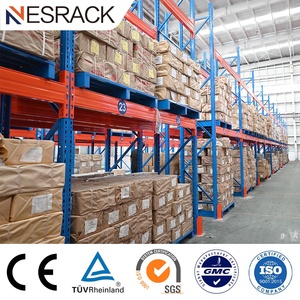
Engineered Solutions
Industrial Warehouse Storage & Flow Racking Systems
Explore our precision-fabricated heavy-duty warehouse racking assemblies, engineered to maximize cubic storage volume and cycle times.
25+
Years Manufacturing & Structural Engineering Heritage
30,000 m²
Automated Manufacturing Workshop Footprint
30,000 t
Monthly Structural Steel Production Capacity
10,000+
Intralogistics Installations Delivered Across 120+ Countries
Technical Whitepaper
Engineering Gravity Flow & Dynamic Pallet Systems
Strategic deployment of gravity pallet flow and carton live storage: Optimizing SKU throughput, reducing forklift travel, and maintaining perfect FIFO compliance.
Warehouse logistics engineering is undergoing a critical paradigm shift. Modern distribution hubs, fulfillment centers, and manufacturing warehouses face soaring square-meter facility leasing costs, severe labour shortages, and stringent service-level turnaround times. In response, high-density gravity flow racks (pallet flow and carton flow) have emerged as an indispensable intralogistics standard. By capitalizing on an engineered gravitational incline (typically between 2.5% and 4.0%), flow racking converts vertical airspace into active, dynamic material flow channels.
Key Engineering Metric: Flow racks decouple replenishment loading aisles from picking extraction corridors. This architectural isolation increases throughput velocity by up to 45% while reducing forklift collisions, pallet handling maneuvers, and aisle spatial footprints compared to conventional selective racking layouts.
Dynamic Racking Systems Architectural Comparison
Procurement directors must objectively evaluate how dynamic racking configurations align with specific warehouse throughput cycles, stock unit variation, and turnover policies. The structural matrix below specifies how gravity flow racks contrast against alternative compact topologies:
| Storage Topology | Inventory Principle | Density Efficiency | SKU Accessibility | Primary Application Spectrum |
|---|---|---|---|---|
| Pallet Flow (Gravity) | Strict FIFO (First-In, First-Out) | Ultra-High (Up to 85%) | Per-Lane Selectivity | Perishables, Cold Stores, Fast-Moving Pharmaceuticals |
| Push-Back Racking | LIFO (Last-In, First-Out) | High (Up to 75%) | Per-Lane Nested Carts | Batch Manufacturing, Buffer Zones, Moderate SKU Depths |
| Drive-In / Drive-Thru | LIFO (Drive-In) / FIFO (Drive-Thru) | High (Up to 80%) | Low / Homogeneous SKUs | Raw Bulk Materials, Seasonal Stock, Beverage Bottling |
| Radio Shuttle System | Dynamic FIFO or LIFO | Maximum (Up to 90%) | Automated Channel Access | Large-Scale Cold Chain Distribution, Mega-Fulfillment Hubs |
Critical Engineering & Mechanical Brake Calibration
The operational longevity and physical safety of pallet flow racking rest upon rigorous mechanical component engineering. Unlike static pallet racking where loads remain seated on stationary box beams, gravity systems subject steel profiles, track assemblies, and brake drums to continuous kinematic forces. Pallets weighing anywhere from 500 kg to 2,000 kg traverse dedicated roller tracks. Without calibrated centrifugal speed controllers, acceleration curves would cause crushing collisions at picking unload faces.
At our Guangzhou manufacturing base, roller tracks are configured with precision-spaced centrifugal brake rollers designed to limit terminal pallet descent speeds to an ultra-safe 0.25–0.30 meters per second. Coupled with structural pallet separators, rear-pallet pressure is removed from the lead pallet, allowing operators or AGVs to extract pallets smoothly without risk of kinetic rebound or tip-overs.
Strategic Foresight
Future Procurement Trends in Warehouse Flow Systems
How global enterprise supply chain directors and facility managers are adjusting technical procurement criteria for the upcoming decade.
AGV & AMR Autonomous Interoperability
Procurement specifications are shifting rapidly from pure human-operated forklift clearances to automated guided vehicle (AGV) interfacing. Flow rack pickup discharge faces are increasingly outfitted with precision optical sensor targets, mechanical pallet centering aligners, and automated safety stops to guarantee millimeter-level positioning accuracy for robotic end effectors.
Seismic-Resilient Structural Metallurgy
Global logistics hubs situated along active seismic belts require verified non-linear dynamic structural FEA (Finite Element Analysis). Buyers prioritize high-yield cold-rolled microalloy steel profiles (such as certified Q235B and Q355B grades) with augmented diagonal frame bracing and custom-anchored base plates capable of dissipating horizontal ground accelerations.
Lifecycle Corrosion Protection & Cold Chain
As cold-chain pharmaceutical and food logistics demand accelerates, standard surface treatments are being superseded. Procurement requirements now dictate multi-stage surface treatments: ultrasonic pickling, zinc phosphating, and heavy-duty thermosetting electrostatic powder coating (60–80 microns) or full hot-dip galvanizing to resist cyclic condensation corrosion.
OEM/ODM Manufacturing Authority
Direct Factory Capabilities & International Standards
Established in 2001, Guangzhou Heda Shelves Co., Ltd. operates a vertically integrated production ecosystem backed by comprehensive global certifications.
Independently Audited Certifications
Our structures comply strictly with European EN 15512 and FEM intralogistics racking guidelines. We maintain active CE Certification (No. 2435-CPR-8605159), ISO 9001:2015 Quality Management accreditation (No. 18624Q00169R0M), and full RoHS compliant production inputs.
Complimentary Engineering & 3D Modeling
Before issuing structural quotations, our dedicated in-house civil and logistics engineering team constructs custom CAD warehouse floor plans, detailed 3D structural visual simulations, and rigorous pallet weight load calculations tailored to your exact forklift fleet tolerances.
Export-Optimized Logistics & On-Site Support
We provide full container load (FCL) packing, grouping, strapping, and comprehensive multi-language component labeling designed for swift customs clearance across all major international maritime hubs. Comprehensive installation blueprints and remote engineer video guidance accompany every project.
10-Stage Precision Production Methodology
Controlled in-house manufacturing ensures absolute metallurgical integrity and load safety.
PHASE 01
Raw Certified Steel
PHASE 02
Precision Cutting
PHASE 03
CNC Column Punching
PHASE 04
Cold Roll Forming
PHASE 05
Profile Calibration
PHASE 06
Surface Polishing
PHASE 07
Robotic Welding
PHASE 08
Pickling & Phosphating
PHASE 09
Electrostatic Powdering
PHASE 10
QA Load Test & Pack
Procurement Knowledge Base
Frequently Asked Questions on Flow Racks
Direct answers to the most common technical, logistical, and structural questions submitted by enterprise procurement engineers.
How does flow rack engineering prevent pallet runaway and collisions?
We integrate calibrated centrifugal brake rollers into the roller bed at calculated intervals (typically every 1–2 pallet depths). These mechanically govern descent velocity to a smooth 0.25–0.30 m/s regardless of pallet load variations (300kg up to 2000kg). Additionally, mechanical end-stops and pallet separators isolate the lead pallet from upstream line pressure.
What pallet bottom styles and specifications are compatible?
Gravity flow systems operate optimally with smooth, rigid bottom runner pallets (such as GMA, Euro, or perimeter-base timber and plastic pallets). Slatted or warped bases can create irregular friction. During layout planning, our engineers test your specific pallet sample dimensions, runner arrangements, and deflections to configure roller diameter and spacing.
What is the standard incline angle required for gravity flow lanes?
Standard flow beds are engineered with an incline gradient between 2.5% and 4.0% (roughly a 35–45 mm drop per meter of track). The exact inclination angle is customized during our engineering design phase based on pallet gross weight, skid material friction coefficients, and lane depth (from 2 deep to over 20 pallets deep).
Can your racking structures withstand earthquakes in seismic regions?
Yes. Every system engineered for seismically active zones undergoes comprehensive structural analysis in accordance with local building codes. We calculate upright column profiles, heavy-duty footplates, floor chemical anchor depth, and vertical/horizontal bracing geometry to counteract dynamic seismic shear forces.
What surface finishes are recommended for cold storage or humid ports?
For standard humidity-controlled ambient warehouses, our multi-stage electrostatic powder coating provides superior scratch and rust resistance. For deep cold storage (-30°C), coastal facilities, or chemical warehousing, we offer premium hot-dip galvanization that forms an impenetrable zinc metallurgical barrier against oxidation.
What details must we provide to receive a free 3D CAD design proposal?
To generate an engineered layout, our engineering team requires: facility clear height and column grid drawings, pallet dimensions (W x D x H) including overhang and gross weight, forklift model and maximum mast lift reach, target daily throughput, and your preference between FIFO or LIFO operating logic.