Enterprise Heavy-Duty Inventory
Engineered High-Density Storage Systems
From self-regulating pallet gravity flow beds to semi-automated shuttle racking, discover China's precision-manufactured intralogistics solutions tested for global distribution corridors.
25+
Years Engineering
Continuous innovation and factory-direct precision since 2001.
30,000m²
Manufacturing Facility
Automated roll-forming lines, laser profiling, and powder coating bays.
30,000Tons
Monthly Throughput
Scalable capacity supplying major turnkey logistics hubs globally.
120+
Export Destinations
Certified execution across Americas, Europe, Middle East, and APAC.
Enterprise Competitive Edge
Why Top Global Intralogistics Integrators Partner With Us
As China’s preeminent gravity pallet racking manufacturer and exporter, we integrate heavy industrial metallurgy with computer-simulated dynamic roller performance to guarantee unyielding structural safety.
Seismic Structural Engineering
Our systems are computed via finite element analysis (FEA) compliant with RMI, FEM 10.2.02, and AS4084 standards. Upright profiles, custom baseplates, and high-tensile anchor sets are optimized specifically for high-risk seismic zones.
Tropical Anti-Corrosion Finishes
Components undergo rigorous 10-stage preparation including chemical pickling, phosphating, and electrostatic epoxy-polyester powder coating. For cold storage and humid coastal zones, hot-dip galvanizing prevents corrosive breakdown.
Precision Brake & Speed Control
Gravity flow beds utilize proprietary centrifugal speed controller rollers matched to pallet weights ranging from 300kg to 1500kg, maintaining steady descent velocities of 0.2 to 0.3 m/s without pallet collisions.
Export Container Cubing Logic
Every export consignment is bundled via specialized structural steel stacking cradles. Beam and upright packages are sequenced with itemized manifests to maximize shipping container cube utilization and slash demurrage costs.
Industry Whitepaper & Technical Analysis
Gravity Pallet Flow Mechanics: Dynamics, Safety & Throughput Efficiency
A comprehensive engineering evaluation of high-density dynamic storage, detailing velocity control, pallet separation separators, and lifecycle cost economics.
1. The Kinematics of Controlled Gravity Flow
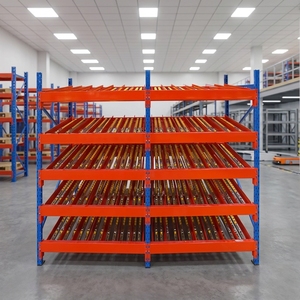
Gravity pallet racking (commonly referred to as dynamic pallet flow racking) is the premier passive high-density storage system operating on First-In, First-Out (FIFO) rotation logic. Supported by an inclined steel roller track typically set at a gradient between 3.0% and 3.5% (approx. 1.7° to 2.0°), pallets advance under natural gravitational forces from the loading (charge) face to the retrieval (discharge) face.
The core challenge in deep-lane gravity flow (lanes accommodating from 4 to upwards of 30 pallets deep) lies in velocity accumulation. Unregulated kinetic energy introduces impact forces capable of damaging pallet wooden runners, compromising structural uprights, and destabilizing high-center-of-gravity cargo. To mitigate this, our system incorporates non-powered centrifugal brake rollers spaced systematically along the lane. As a pallet passes over a brake roller, an internal planetary gear accelerates brake shoes against an outer casing, generating resistance proportional to speed and restraining descent to an OSHA-safe velocity between 0.25 m/s and 0.30 m/s.
| Performance Parameter | Selective Racking | Drive-In Racking | Gravity Flow Racking | Radio Shuttle Racking |
|---|---|---|---|---|
| Storage Density Ratio | Baseline (1.0x) | High (2.4x) | Maximum (2.8x) | Maximum (3.0x) |
| Inventory Rotation | Random Access | Strictly LIFO | Pure Automated FIFO | Flexible FIFO & LIFO |
| Forklift Travel Aisles | 1 Aisle Per 2 Racks | Shared Drive-In Lane | Separate Inbound/Outbound | Single Access Aisle |
| Operating Energy Cost | Zero | Zero | Zero (100% Gravity) | Battery Charging Costs |
| Pallet Pick Cycle Time | Standard | Slow (Deep Maneuvering) | Fastest (Direct Picking Face) | Fast (Mechanical Retrieval) |
2. Critical Structural Subsystems: Separators & Impact Interfaces
Operational integrity in gravity racking depends heavily on the discharge extraction interface. When the front pallet rests against the terminal end stop, the accumulated static backpressure exerted by trailing pallets can exceed tens of kilonewtons in a 15-pallet lane. This makes extraction by standard counterbalanced or reach forklifts hazardous, leading to mast strain and pallet fracture.
Our solutions integrate mechanical load separators. When the leading pallet makes contact with the retrieval stop, a mechanical trip arm locks the subsequent pallet in position 450mm upstream. This isolates the front pallet from static line pressure, permitting smooth, unhindered extraction. Once removed, the trip arm resets, enabling the upstream sequence to index forward precisely one position. The entrance charging zone features heavy-gauge, flared entry guide funnels that self-center misaligned forklifts, guarding roll-formed uprights against collision damage.
Strategic Sourcing Intelligence
Future Procurement & Technological Trends in Dynamic Racking
How modern corporate logistics engineers are navigating ESG compliance, warehouse automation hybridization, and next-generation metallurgy.
Hybridization with Autonomous Mobile Robots (AMRs)
Procurement strategies are pivoting from standard forklift interaction to robotic integration. Modern gravity lanes are engineered with automated optical alignment targets and specialized cantilever discharge stops. These interfaces allow vision-guided autonomous counterbalanced forklifts to deposit and harvest pallets without human intervention, operating 24/7 in zero-light facilities.
Carbon Footprint Abatement & Passive Automation
With energy costs rising and net-zero targets tightening across multinational corporate hubs, gravity flow provides massive sustainability advantages. By exploiting natural gravitational potential energy instead of electrified continuous conveyor lines or battery-dependent AGVs for internal lane indexing, distribution centers achieve up to a 65% reduction in ongoing power consumption within dynamic buffer stages.
Ultra-High Strength Low-Alloy (HSLA) Steels
Next-generation engineering specifies cold-rolled micro-alloyed steels with yield strengths exceeding 420–550 MPa. This metallurgy permits reduced component mass without sacrificing load capacity, drastically dropping ocean freight costs per pallet location while increasing seismic resilience through higher ductility and shock absorption ratios.
Procurement Knowledge Hub
Frequently Asked Questions by Global Racking Buyers
Direct technical clarification on structural engineering, international compliance, site installation, and export logistical parameters.
How do you evaluate pallet quality and bottom runner orientation for gravity flow lanes?
Pallet flow systems rely completely on surface contact geometry. Wood pallets must have unbroken bottom runners running parallel to the direction of flow for full wheel contact. In cases where Euro-pallets (800x1200mm) or perimeter-base GMA pallets (1000x1200mm) must flow cross-directionally, our engineers supply full-width cylindrical steel rollers or multi-track staggered skate wheels to prevent deflection and wheel pinching.
Can China-manufactured gravity flow racking be certified to Western seismic and building standards?
Yes. Our engineering department executes structural calculations utilizing customized STAAD.Pro and ANSYS FEA software configured to RMI (ANSI MH16.1), European FEM 10.2.02, and Australian AS4084 guidelines. We calculate exact baseplate sizes, anchoring depths, upright gauges, and seismic bracing geometries tailored to regional acceleration coefficients ($S_s, S_1$) provided by your structural engineer.
What coating treatment is specified for deep-freeze cold storage environments down to -30°C?
Cold storage induces thermal contraction, condensation, and rapid structural oxidation. For deep-freeze environments, we provide hot-dip galvanized finishes according to ISO 1461, achieving a protective zinc layer exceeding 65–85 microns. Roller tracks feature low-temperature synthetic lubricants inside sealed ball bearings to prevent freezing and ensure uniform pallet deceleration down to -35°C.
How does your factory ensure overseas installation accuracy without physical trial assemblies?
Before container stuffing, every production batch undergoes precision automated jig verification with allowable hole punching pitch tolerances constrained within $\pm 0.5\text{mm}$. We supply comprehensive 3D CAD isometric installation manuals, component marking schemes matching shipping packing manifests, and high-resolution instructional video walk-throughs. For enterprise projects, our site installation supervisors deploy globally on demand.
What minimum project information is required to receive a formal layout and structural engineering quote?
To receive a certified 3D CAD design and itemized FOB/CIF quotation within 24 hours, provide: (1) Warehouse clear height and pillar-grid drawings, (2) Pallet footprint dimensions including load overhang ($W \times D \times H$), (3) Gross weight min/max per pallet, (4) Forklift maximum lift mast height and aisle turning radius, and (5) Ambient operating temperature profile.
Ready to Engineer Your High-Density Storage Project?
Connect directly with our senior structural racking engineers. Receive factory-direct pricing, finite-element seismic load calculations, and complimentary 3D warehouse layout models within 24 hours.