Enterprise Portfolio
High-Density Bulk Industrial Storage Racks
Engineered with hot-rolled and cold-formed certified Q235B/Q355B structural steel, tailored for international supply chains, automated fulfillment, and extreme load capacities.
Direct Manufacturing & Global Export
Guangzhou Heda Shelves Co., Ltd.: Global Manufacturing Infrastructure
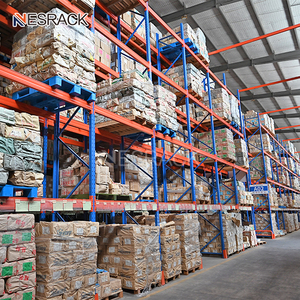
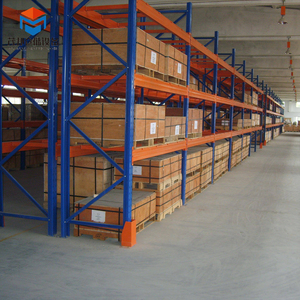
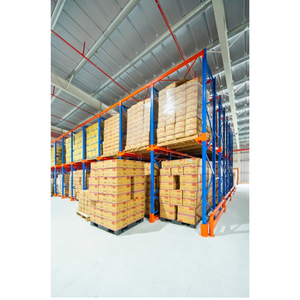
Operating continuously since 2001, Guangzhou Heda Shelves Co., Ltd. has grown into one of China's most trusted manufacturers and exporters of heavy-duty warehouse storage systems. Operating from our modern 30,000-square-meter facility with more than 300 experienced professionals, we maintain a monthly manufacturing capacity reaching 30,000 tons of precision-engineered cold-rolled steel profiles. We do not operate as intermediaries; our integrated workflow delivers end-to-end design, FEA structural calculation, roll-forming, automated robotic welding, surface passivation, and powder-coating under strict ISO 9001:2015 certification.
Certified Structural Compliance: Our bulk storage systems hold official CE Certification (Certificate No. 2435-CPR-8605159), ISO 9001:2015 compliance (Registration No. 18624Q00169R0M, valid through June 2027), and verified RoHS environmental compliance. Every calculation model incorporates wind, live, dead, dynamic, and seismic ground accelerations aligned with Eurocode EN 15512 and RMI MH16.1 specifications.
Having successfully executed over 10,000 complex logistics and high-density racking projects across more than 120 countries, Heda Shelves bridges the gap between cost-effective Chinese steel processing and strict international engineering safety standards. We offer comprehensive OEM/ODM structural production, providing custom beam connector configurations, custom upright profile punches, and customized protective packaging configured precisely for 20GP, 40GP, 40HQ, and 45HQ sea containers.
25+
Years Engineering Expertise
30,000 m²
State-of-the-Art Factory
10,000+
Warehouses Optimized
120+
Export Destination Markets
Certified Material Integrity
We strictly utilize certified high-yield Q235B and Q355B structural steel directly from tier-one domestic steel mills. Mill test certificates (MTC) detailing yield, tensile strength, and elongation accompany every production lot.
Automated CNC Roll Forming
Our facility houses 18 automated roll-forming lines with multi-station inline punching, ensuring pitch tolerances within ±0.2mm along standard 12-meter upright columns for seamless onsite assembly.
Multi-Stage Pre-Treatment
Prior to electrostatic powder coating, all components undergo 7-stage industrial chemical dipping including degreasing, rust removal, acid pickling, and phosphating to eliminate micro-corrosion risks in humid regions.
Complimentary 3D Layout & FEA
Our certified structural engineers prepare comprehensive 2D CAD floor plans, 3D BIM visualizations, and load displacement stress reports tailored to your specific forklift turning radii and building dimensions.
Strategic Procurement Whitepaper
Future Procurement Trends in Bulk Storage Infrastructure (2025–2030)
Analyzing shifting macro-economics, automation transitions, and structural safety mandates transforming global industrial warehousing.
Shift from Pure CapEx Minimization to Life-Cycle Total Cost of Ownership (TCO)
In contemporary warehouse development, global corporate buyers and supply chain executives are no longer evaluating bulk storage racks solely through FOB purchase pricing per pallet position. Racking systems represent critical structural assets with projected service lifespans spanning 15 to 25 years. Leading 3PLs, cross-border e-commerce networks, and international food manufacturers increasingly calculate TCO based on structural uptime, impact resistance, and reconfigurability.
Thin-walled, non-certified uprights sourced from unverified workshops frequently lead to early frame distortion, structural sagging, and severe systemic collapse risks during light forklift impacts. Consequently, procurement strategies are shifting decisively toward standardized heavier-gauge upright sections, column leg protectors, reinforced heavy baseplates, and certified high-tensile safety pins. Investing in superior steel grades and automated robotic welds eliminates post-commissioning reinforcement costs and mitigates catastrophic liability risks.
Automation-Ready Hybrid Racks
Modern supply chain procurement prioritizes hybrid designs capable of transitioning from conventional reach-truck operations to autonomous mobile robots (AMR) and pallet shuttles without replacing base upright structures.
Seismic Micro-Zoning Demands
Global warehouse projects now enforce dynamic response-spectrum seismic design. Racking suppliers must supply finite-element modeling (FEM) verifying base-plate anchoring and beam connector ductility during ground acceleration.
Modular Boltless Adjustability
Due to high volatility in packaging sizes, e-commerce distribution centers require quick-disconnect connector pins and 50mm/75mm pitch increments, enabling maintenance teams to reconfigure shelf levels without hot work.
Engineering Innovation
Evolution of Bulk Storage Racking: Engineering Advancements
How metallurgy, robotic roll-forming, and automated digital warehouse management systems are redefining high-density industrial racking performance.
The global storage manufacturing industry has evolved far beyond basic structural post-and-beam configurations. Today’s industrial operations require sophisticated engineering that integrates heavy metallurgy with automated logistics software interfaces. The table below illustrates the critical technological shift between legacy racking designs and modern engineered storage systems.
| Engineering Parameter | Traditional Legacy Racks | Next-Gen Engineered Bulk Racks (Heda Shelves) |
|---|---|---|
| Steel Substrate Specification | Generic commercial scrap steel, inconsistent yield <215 MPa | Certified primary cold-rolled Q235B / Q355B with MTC (>355 MPa) |
| Profile Punching Precision | Mechanical single-stroke punch; variable pitch deviation >1.5mm | High-speed multi-stage CNC punch presses with pitch tolerance <±0.2mm |
| Surface Corrosion Protection | Manual paint spray without acid immersion (prone to peeling) | Automated 7-stage phosphating + robotic electrostatic powder (60-80μm) |
| Structural Deflection Limits | Unregulated, frequent beam sag exceeding L/180 | Rigid EN 15512 calculation limiting deflection strictly to L/200 or L/300 |
| Automation & Shuttle Integration | Incompatible; structural frame sways under automated shuttle braking | Dynamic runout control, laser-aligned guide channels, rigid top portal bracing |
| Seismic Footing Engineering | Thin flat stamp plates with low pullout safety factor | Engineered thick plate footings with chemical anchor pullout verification |
A key focus in modern rack engineering is the optimization of cold-formed thin-walled steel profiles under combined compression, bending, and torsional loads. Utilizing nonlinear finite element methods, our engineers simulate buckling modes—including local, distortional, and global flexural-torsional buckling—ensuring that every profile section delivers maximum strength per kilogram of steel consumed.
Advanced Anti-Corrosive Chemistries
For coastal distribution centers, cold chain freezers (-30°C), and fertilizer depots, components receive hot-dip galvanizing conforming to ISO 1461, yielding 85μm+ zinc coatings that withstand constant condensation and aggressive chemical vapors.
Intelligent Sensor Integration
Next-generation bulk rack installations increasingly feature load cells, laser positioning sensors, and vibration monitors embedded within beam connections to report structural fatigue or accidental forklift collisions in real time.
Sustainable Low-Carbon Manufacturing
By transitioning to energy-efficient continuous powder curing ovens and recapturing process heat, Heda Shelves minimizes the embodied carbon of its steel storage solutions, aligning with global corporate ESG targets.
Procurement Knowledge Hub
Frequently Asked Questions for Bulk Storage Racks Procurement
Essential structural, logistics, and verification guidance for warehouse managers, industrial builders, and international importers.
How do I determine whether Selective, Drive-In, or Radio Shuttle Racks suit my operations?
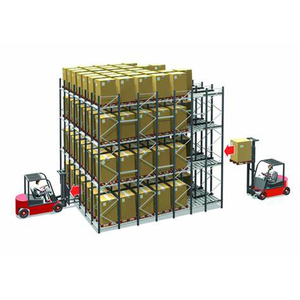
Selection depends directly on SKU diversity and turnover requirements. If you manage hundreds of distinct SKUs requiring 100% immediate accessibility, Selective Pallet Racking is the industry standard. If you store homogeneous bulk goods with limited SKUs (e.g., beverage production, cold rooms) and operate under LIFO principles, Drive-In Racking maximizes floor utilization. For high-throughput environments demanding deep-lane storage with either FIFO or LIFO flexibility and zero forklift aisle entry, Radio Shuttle Racks offer the highest operational throughput and lowest labor overhead.
What essential engineering inputs are required to produce an accurate warehouse CAD layout?
Our structural design department requires: (1) Architectural floor drawings detailing internal building dimensions, clear height below ceiling obstructions, and locations of structural building columns; (2) Detailed pallet load profiles including pallet dimensions (width, depth, overall height including cargo overhang) and gross weight per unit; (3) Material handling equipment (forklift) specifications including model, turning radius, maximum mast elevation, and minimum aisle width requirements; and (4) Floor slab thickness, compressive strength rating (e.g., C25/C30), and local seismic design values.
How does HEDA ensure dimensional accuracy and coating adhesion across massive export orders?
Our quality assurance protocol follows a continuous 10-step production monitoring framework. Dimensionally, upright and beam profiles undergo continuous laser micrometric checks during CNC roll-forming. Prior to coating, components pass through multi-stage acid degreasing and zinc phosphating. Finished coatings are tested via cross-hatch adhesion testing (ASTM D3359), impact resistance checks, and digital dry-film thickness (DFT) gauges to confirm an even 60–80 micron electrostatically applied finish.
How are heavy-duty industrial racks packaged and secured to prevent transit damage during ocean freight?
Export packaging is engineered to withstand extreme marine transit conditions. Heavy upright frames and horizontal beams are nested, wrapped with heavy-duty air-cushion film, strapped with high-tensile steel bands, and fitted with reinforced composite edge protectors. Small accessories (bolts, nuts, safety locking pins, shims, anchors) are packed in heavy-duty wooden crates or banded steel boxes clearly labeled per container manifest to streamline customs inspections and onsite distribution.
What structural standards and safety factors govern your load capacity calculations?
All HEDA storage systems are designed according to international standards, primarily the European Racking Federation FEM 10.2.02 / EN 15512 specifications and North American RMI (Rack Manufacturers Institute) MH16.1 guidelines. A minimum safety factor of 1.5 to 1.65 is applied to ultimate load capacities. Beams are designed with a strict deflection limit under full safe working load (SWL) not exceeding 1/200th of the clear span, guaranteeing structural stability and operational safety.
Can HEDA Shelves support on-site installation for international projects?
Yes. Every overseas shipment is accompanied by comprehensive 2D erection plans, detailed isometric component layouts, and high-definition step-by-step installation videos. For large logistics installations, distribution centers, and high-bay mezzanine projects, we dispatch experienced installation supervisors and project engineers to manage local installation crews, conduct final torque calibrations, and certify the installed system prior to warehouse commissioning.
Engineering Inquiry & Planning
Ready to Maximize Your Warehouse Storage Capacity?
Submit your warehouse dimensions and storage requirements today. Our experienced structural engineers will deliver a complimentary 2D CAD floor plan, 3D structural rendering, and an itemized direct-from-factory proposal within 24 hours.