High Bay Racking Systems & High-Density Pallet Storage
Engineered with precision cold-rolled structural steel, optimized for heavy-load payloads, narrow-aisle access, high-verticality logistics, and automated crane-integrated warehousing.
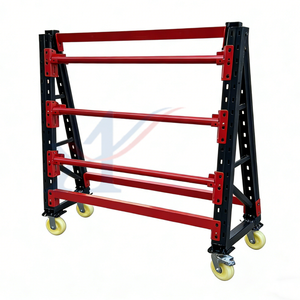
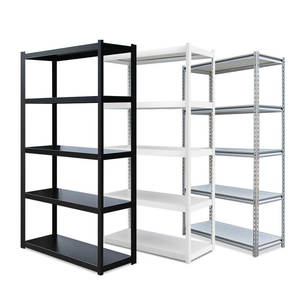
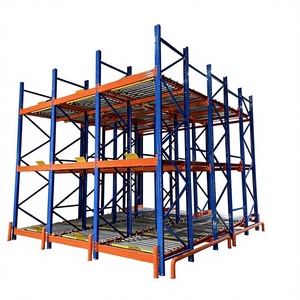
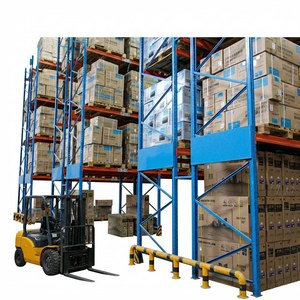
Structural Integrity, Metallurgy & Compliance in High Bay Racking
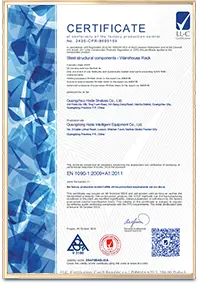
High bay racking systems (exceeding heights of 12 meters and scaling up to 40 meters in automated clad-rack configurations) represent critical civil-structural assets rather than mere static warehouse shelving. As an international manufacturing exporter certified under CE Certificate No. 2435-CPR-8605159, our facilities fabricate high-bay structural uprights and load-bearing beams complying stringently with European standards EN 15512 (Structural Design of Racking), EN 15620 (Tolerances, Deformations, and Clearances), and EN 15629 (Specification of Storage Equipment).
The metallurgical backbone of our high bay production relies on certified high-yield Q235B and Q355B cold-rolled structural steel coils sourced directly from top-tier state-owned mills. Through continuous multi-station progressive roll-forming lines, the profiles are cold-worked into specialized Omega (Ω) and modified closed-box sections. This process induces work-hardening along bend radii, substantially raising the profile's ultimate yield point while maintaining optimal sectional modulus and torsional rigidity under combined axial compression and biaxial bending moments.
High-verticality installations demand strict mitigation against second-order geometric sway effects (Δ P-Δ and P-δ phenomena). By employing sophisticated finite element analysis (FEA) and full-scale beam-column connection test rigs, our engineering department validates beam connector claw moment-rotation stiffness curves. Every batch of base plates, anchor bolts, and bracing lattices is dimensioned to absorb cyclic fatigue and withstand local seismic design accelerations specified by Eurocode 8 or regional codes like UBC-97 and ASCE 7-22.
EN 15512 & RMI Structural Rigor
Every profile design undergoes limit state analysis, assessing load combinations including dead pallet weights, placement impact coefficients, asymmetric floor loading, and seismic acceleration spectrums.
Seismic Dissipation & Heavy Base Sizing
High-bay uprights transfer enormous vertical and overturning forces to floor slabs. We engineer multi-hole heavy-gauge footplates with high-tensile chemical or wedge anchor studs designed for dynamic ground shear forces.
Stringent Deflection & Plumb Tolerances
Per EN 15620 Class 100 to 400 requirements, our manufacturing controls upright straightness within 1/1000 deflection thresholds, ensuring seamless operation for Automated Storage and Retrieval System (ASRS) stacker cranes.
Tropicalized Multi-Stage Pretreatment
Steel surfaces pass through 10 stages including immersion ultrasonic degreasing, zinc-phosphate micro-etching, and automated electrostatic thermosetting epoxy-polyester powder coating for maximum humidity resistance.
10-Stage Industrial Production & Quality Control Workflow
From raw steel coils to ISO 9001:2015 audited container packing, our 30,000 m² factory operates end-to-end CNC roll forming and robotic fabrication lines.
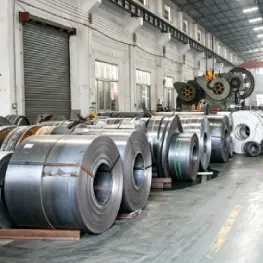
Mill Steel Inflow
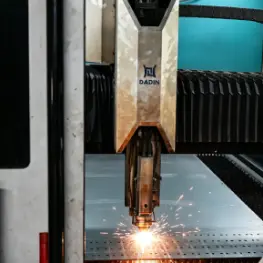
Precision Slitting
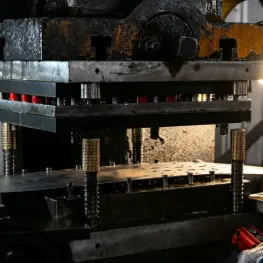
CNC Column Punching
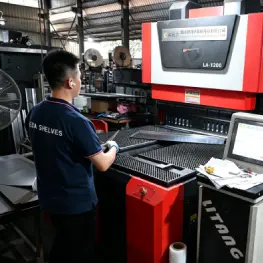
Continuous Roll Forming
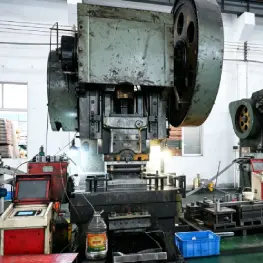
Profile Calibration
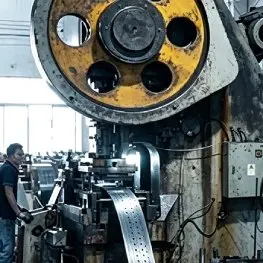
Shot Blasting & Polish
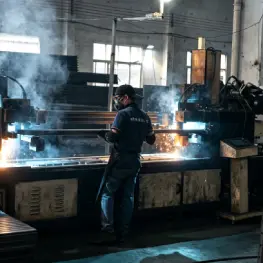
Robotic Laser Welding
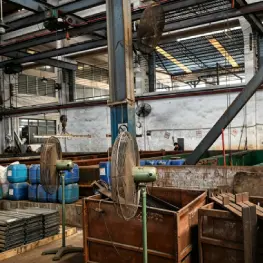
Phosphating Pretreatment
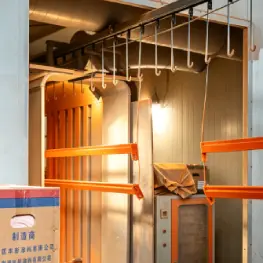
Electrostatic Coating
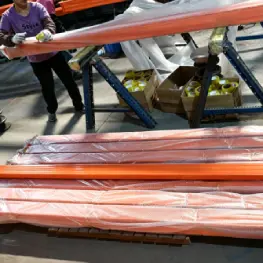
QC & Export Stowing
Future Procurement Trends in High Bay Logistics Infrastructure
Global warehouse operations are navigating intense macroeconomic shifts, urban industrial land price surges, and carbon-accounting directives. Our market analytics highlight six fundamental procurement trends shaping high bay investments through 2030.
1. Vertical Cube Saturation Over Horizontal Sprawl
With industrial real estate lease costs climbing worldwide, procurement executives are decommissioning 6-meter single-tier facilities in favor of 18m to 35m high-bay configurations. Vertical racking doubles or triples pallet capacity per square meter of footprint without triggering municipal ground-tax penalties.
2. Clad-Rack / Rack-Supported Civil Integration
The boundary between civil building works and racking is dissolving. Rack-supported buildings (where racking uprights carry roof and external cladding wall wind loads directly) are becoming the procurement choice for mega-distribution hubs, cutting overall structural steel expenditure by 20% to 30%.
3. Automation-Ready Engineering Tolerances
High bay procurement no longer targets manual forklift handling exclusively. Even traditional selective pallet installations are now ordered with stringent EN 15620 millimeter-level deflection and plumb tolerances to enable future drop-in retrofits of AGVs, AMRs, and high-speed automated crane shuttles.
4. Total Cost of Ownership (TCO) vs Upfront CapEx
Global supply chain managers evaluate racking suppliers on 20-year structural life-cycle costs. Factors like powder coat salt-spray durability (ASTM B117), laser-cut connector weld integrity, beam safety pin pull-out resistance, and standardized replacement modularity supersede raw price-per-ton metrics.
5. Seismic Risk Mitigation & Insurance Conformity
Global commercial insurers increasingly demand certified structural engineering calculations verified by licensed third-party engineers. Facilities sited in circum-Pacific seismic zones require dynamically modeled upright bases with verifiable ductile energy dissipation to prevent catastrophic structural cascade failure.
6. Decarbonization & Circular Steel Traceability
Corporate ESG policies are cascading into material procurement. Importers favor manufacturers that utilize scrap-recycled EAF (Electric Arc Furnace) steel, non-toxic heavy-metal-free powder coatings, and containerization layouts that eliminate volumetric dead freight and maritime carbon waste.
Next-Generation Engineering Applied in HEDA Racking Fabrication
Continuous investment in robotic automation, metallurgic engineering, and parametric finite element modeling ensures every high-bay framework delivers long-term stability.
Closed-Loop CNC Roll Forming Automation
Our multi-station roll-forming lines continuously monitor strip feed thickness and flange spring-back via optical sensors, cold-forming complex high-moment Omega upright profiles with zero micro-fracturing along bend lines.
Adaptive Beam Connector Claw Geometry
High bay beams utilize multi-tooth stamped alloy connector brackets that engage columns with reverse taper locks. Under load, gravitational shear wedges the connector tighter into column perforations, increasing rigidity.
Finite Element Stress & Buckling Simulations
Each custom installation is mapped in 3D finite element software (FEA) to simulate eigenmode global buckling, local flange crippling, beam lateral torsional buckling, and post-yield seismic plastic hinge formations.
Parametric 3D Layout & Digital Twin Coordination
We supply fully articulated CAD layouts, IFC / Revit BIM files, and structural calculation reports in advance, allowing facility engineering teams to de-clash sprinkler pipes, HVAC ducts, and lighting runs prior to procurement release.
Advanced Protective Finishes for Extreme Operational Environments
Standard warehouse racking routinely suffers from paint delamination, corrosion in tropical coastal air, and catastrophic micro-cracking inside sub-zero cold chains. At HEDA Shelves, our chemical finishing lines implement proprietary epoxy-polyester copolymer formulations applied electrostatically at 70–90 kilovolts.
Prior to thermal curing at 200°C, components pass through rigorous cleaning baths: alkaline degreasing, hot water rinsing, micro-crystalline zinc phosphating, and deionized passivating rinses. This establishes an inert chemical bonding layer that successfully withstands more than 500 hours of continuous neutral salt spray testing (ASTM B117), exceeding international standards.
For sub-zero food logistics (-30°C blast freezers) or corrosive chemical environments, we provide hot-dip galvanized uprights and beams compliant with ISO 1461, ensuring zinc-iron alloy protection that self-heals against scratches and prevents steel embrittlement throughout decades of heavy operational service.
Audited Manufacturing Authority & Global Export Logistics
HEDA Shelves operates as a trusted industrial backbone for Fortune 500 logistics operators, multi-national retailers, and regional distributors across Latin America, Southeast Asia, the Middle East, Europe, and North America.
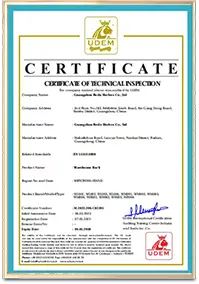
Factory Direct Compliance: CE, ISO 9001 & RoHS
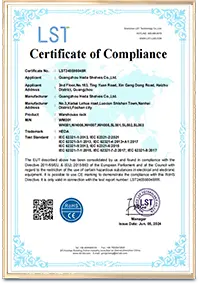
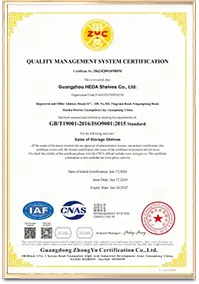
Navigating overseas structural procurement demands transparent, verifiable certification to ensure smooth customs clearance, municipal fire-life safety permits, and insurer approvals. Our compliance portfolio includes:
- CE Certification No. 2435-CPR-8605159 — Verified conformity to EN 1090-1 and European structural steel component regulations.
- ISO 9001:2015 Certification No. 18624Q00169R0M — Audited quality management system covering design, manufacturing, and export.
- RoHS Heavy Metal Free Coatings — Thermoset finishes certified free of lead, cadmium, and hazardous hexavalent chromium.
- Worldwide Maritime Port Logistics — Efficient container packing quoted FOB or CIF to major international hubs (Puerto Quetzal, Puerto Cortés, Balboa, Colón, Corinto, Puerto Caldera, and beyond).
High Bay Racking Procurement FAQ
Critical structural, operational, and shipping questions answered by our chief layout engineers to guide procurement committees and project managers.
Initiate Your High Bay Logistics Engineering Project
Consult directly with senior warehouse structural engineers at Guangzhou Heda Shelves Co., Ltd. Receive a comprehensive CAD floor plan, 3D parametric rendering, load-capacity calculation, and itemized CIF/FOB export quotation tailored to your exact facility dimensions.