Featured Industrial Storage & High-Density Racking Equipment
Engineered to Japanese industrial standards (JIS B 8920) with automated robotic compatibility, precision roll-formed Q235B/Q355B structural steel, and rigorous seismic-resistant anchoring.
Strategic Imperatives in the Greater Tokyo Warehousing Market
The Tokyo logistics zone—spanning the critical coastal waterfronts of Koto Ward, Shinagawa, Ota, and the reclaimed port districts of Yokohama and Kawasaki, through to inland consumption arteries along the Ken-O Expressway in Saitama and Chiba—faces the most acute warehousing cost pressures in the Asia-Pacific region. Real estate land valuations frequently exceed 7,000 to 10,500 JPY per tsubo in monthly warehouse lease rents. Simultaneously, the implementation of the statutory "2024 Logistics Problem" (2024年問題) under Japan's revised Labor Standards Act has capped annual driver and logistics overtime at 960 hours, severely tightening material handling schedules.
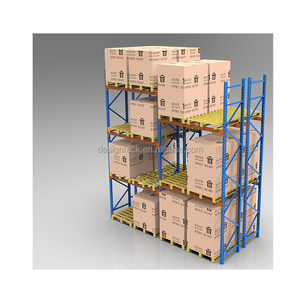
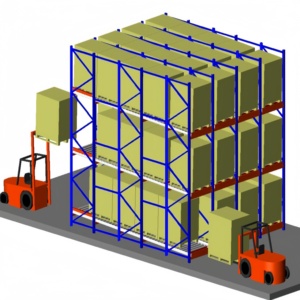
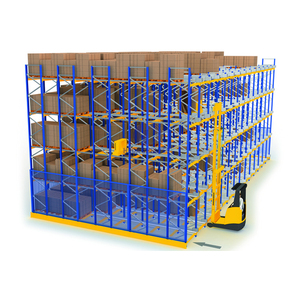
Under these macroeconomic dynamics, conventional selective pallet racking, which commits up to 60% of floor area to operational forklift aisles, has become commercially unviable for volume distribution hubs. Radio Shuttle Racking Systems (シャトルラックシステム) deliver an engineering solution by converting open aisles into deep, multi-level continuous storage tunnels. By utilizing semi-automated or fully automated battery-powered radio shuttle carts navigating within guided rail systems, Tokyo-based logistics directors can achieve pallet density gains of 70% to 180% within their existing building footprints.
Crucially for the Japanese operating environment, every installation within Tokyo must satisfy structural seismic safety verifications under the Building Standards Act of Japan (Kenchiku Kijun-hō) and adhere to fire prevention compartmentalization under the Tokyo Fire Department Fire Prevention Ordinance (Kasai Yobō Jōrei). The following market overview provides structural comparisons and supply chain capabilities for the leading manufacturers and export engineering providers serving Tokyo.
Top 10 Radio Shuttle Racking System Factories & Exporters Serving Tokyo
Comprehensive evaluation based on seismic structural compliance, JIS standard conformity, export manufacturing scale, IoT/WMS integration, and cold-storage capability.
| Rank / Manufacturer | Headquarters / Production | Primary Strengths in Tokyo Market | Seismic / JIS Compliance | Pallet Standard Compatibility | Market Tier |
|---|---|---|---|---|---|
| 01. HEDA Shelves | Guangzhou, CN (Global Export) | Full direct-factory OEM/ODM, 30,000m² plant, cold chain (-25°C), custom 3D CAD design | CE, ISO9001, Japanese Seismic Calcs | JIS T11 (1100×1100), Euro, US GMA | Global Value Leader |
| 02. Daifuku Co., Ltd. | Osaka / Shiga, JP | Pioneer in automated material handling, high-bay ASRS stacker crane integration | JIS B 8920, BCJ Certified | JIS T11, Custom Container | Domestic Tier-1 |
| 03. Murata Machinery (Muratec) | Kyoto / Inuyama, JP | Precision electronics manufacturing, automated shuttle robotics & cleanroom storage | JIS, High Seismic Rating | JIS T11, European Standard | Domestic Tier-1 |
| 04. Okamura Corporation | Yokohama / Tokyo, JP | Extensive local sales network, cold storage high-density drive-in and shuttle racks | Kenchiku Kijun-hō Compliant | JIS T11 (1100×1100) | Domestic Tier-1 |
| 05. Toyota L&F (Toyota Material Handling) | Aichi, JP | Turnkey integration with automated guided forklifts (AGF) and fleet telemetry | JIS Standards Certified | JIS T11, Custom Pallet | Domestic Tier-1 |
| 06. SSI Schaefer Japan | Neunkirchen, DE / Tokyo Branch | Heavy structural roll-forming, Orbiter shuttle systems for multi-deep lanes | EN 15512, FEM, JIS Rated | Euro (1200×800), JIS T11 | Multinational |
| 07. Mecalux Japan | Barcelona, ES / Tokyo Sales | Pallet Shuttle 4.0 systems, WMS Easy Mecalux software integration | EN 15620, FEM Standards | JIS T11, US GMA, Euro | Multinational |
| 08. Sumitomo Heavy Industries Material Handling | Tokyo, JP | Industrial dockyard heavy storage, ruggedized structural shuttle frames | JIS B 8920, Extreme Load | JIS T11, Heavy Coil/Die | Domestic Tier-1 |
| 09. Sanwa Shoko Co., Ltd. | Tokyo, JP | Mid-sized distribution racking, localized warehouse retrofit specialist | Domestic Seismic Codes | JIS T11 | Domestic Specialist |
| 10. Nippon Yusoki (Nichiyu / Mitsubishi Logisnext) | Kyoto, JP | Automated warehouse rack synergy, specialized shuttle-to-truck loading | JIS Compliant | JIS T11, Beverage Pallet | Domestic Tier-1 |
Engineering Matrix: 2-Way vs 4-Way Radio Shuttle Racking
Selecting the optimal kinematic automation topology for high-throughput fulfillment in the Kanto distribution network.
2-Way Radio Shuttle Systems
The standard workhorse for high-volume, low-SKU operations such as beverage bottling, grain storage, and cold-chain blast freezers. Shuttles navigate longitudinally inside deep channels (up to 40 pallets deep). Forklifts relocate the shuttle between levels. Provides unbeatable ROI for FIFO (First-In, First-Out) and LIFO batch operations.
4-Way Automated Shuttles
Engineered for high-density 3D matrix storage. Autonomous 4-way shuttles travel both cross-aisle and longitudinally, transitioning between vertical levels via automated reciprocating lifts. Eliminates standard forklift entry entirely, interfacing with Warehouse Control Systems (WCS) for lights-out automation in Tokyo Bay urban e-commerce fulfillment hubs.
Extreme Cold-Chain Sub-Zero (-25°C)
Tokyo Bay facilities (such as Jonanjima and Oi Wharf) handle vast quantities of imported seafood, meat, and pharmaceutical goods. Our cold-rated shuttles utilize specialized Lithium Iron Phosphate (LiFePO4) or Lithium Titanate (LTO) battery cells with internal heating elements, low-temperature gear lubricants, and IP65-rated electronic encapsulation.
Localized Applications Across the Tokyo Metropolitan Distribution Fabric
The deployment of radio shuttle racking systems in Tokyo requires careful adaptation to distinct geographical zoning characteristics:
- Tokyo Bay Coastal Freezers & Cold Ports (Shinagawa, Ota, Yokohama Daikoku): High land reclamation costs necessitate cubic utilization upwards of 85%. Shuttle racking eliminates forklift heat generation inside the thermal envelope, cutting refrigeration kilowatt consumption by up to 35% compared to wide-aisle storage.
- Ken-O Expressway Inland E-Commerce Corridors (Atsugi, Sagamihara, Kawajima, Tsukuba): Rapid fulfillment centers serving the 38 million consumers of Greater Tokyo require flexible SKU sorting. Radio shuttle racking configured for FIFO rotation ensures strict inventory aging control for fast-moving retail consumer goods (FMCG).
- Automotive Just-In-Time (JIT) Depots (Kanagawa & Saitama Perimeters): Shuttle racking accommodates heavy raw material tooling, stamping dies, and knocked-down auto assemblies on standardized JIS T11 pallets with payload ratings up to 1,500 kg per pallet position.
Furthermore, all structural engineering calculations conducted by HEDA Shelves for Japanese projects account for the Standard Seismic Base Shear Coefficient (Co ≥ 0.2 to 0.3), ensuring that during high-intensity shaking (such as seismic events matching the Great Kanto or 2011 Tohoku earthquakes), upright column buckling and progressive catastrophic collapse are completely prevented through oversized baseplates, high-tensile chemical anchoring, and horizontal cross-bracing ties.
Why Tokyo Logistics Operators Partner with HEDA Shelves
A quarter-century of precision manufacturing engineering delivering direct-from-factory cost advantages, certified structural steel, and complete project accountability.
Direct Factory Manufacturing
Operating a 30,000 m² state-of-the-art manufacturing plant with over 300 experienced engineers and skilled technicians. We maintain full in-house control from continuous cold roll-forming to automated multi-stage electrostatic powder coating, eliminating intermediary margins for Japanese importers.
Rigorous International Certification
Certified under CE (Certificate No. 2435-CPR-8605159), ISO 9001:2015 (Certificate No. 18624Q00169R0M), and compliant with RoHS environmental directives. Our structural components undergo ultrasonic weld testing, tensile yield verification, and salt-spray corrosion analysis.
Free 3D CAD & Seismic Layout Engineering
Our dedicated engineering department prepares detailed AutoCAD floor layouts, 3D BIM structural models, and finite element analysis (FEA) load calculations tailored to specific building column spans, clear roof heights, slab load capacities, and fire sprinkler clearances before manufacturing begins.
Frequently Asked Questions for Tokyo Procurement Managers
Technical, regulatory, and logistics clarifications for engineering firms, general contractors, and supply chain operators sourcing racking for Japanese facilities.
Are your radio shuttle racks compatible with the standard Japanese JIS T11 pallet?
Yes. The JIS T11 standard pallet (1,100 mm × 1,100 mm) is the dominant format across Japan. HEDA Shelves engineers custom-profiled shuttle guide rails with specific wheel-flange tolerances and optical sensor reflector points calibrated precisely for 1,100 mm wooden and plastic pallets, preventing skewing or jamming during high-speed shuttle transits.
How do you address seismic engineering requirements under the Japanese Building Standards Act?
Tokyo is situated in a high seismic risk zone. Our structural calculation packages incorporate base shear coefficients (Co), dynamic response spectra, and horizontal seismic load factors. We utilize high-yield Q235B/Q355B structural steel, enlarged baseplates with dual M16/M20 chemical anchors, and reinforced top-tie beam networks designed to withstand Level 2 earthquake ground motions without structural collapse.
What are the shipping routes, lead times, and port handling terms for shipments to Tokyo?
Cargo is manufactured and loaded into containerized ocean shipments departing from the Port of Nansha or Shenzhen with direct liner service to the Port of Tokyo (Aomi/Oi Terminals) or the Port of Yokohama. Ocean transit typically takes 5 to 8 days. Every container is packed with numbered, piece-marked bundles and accompanied by full packing lists for swift customs clearance.
How does the radio shuttle system operate inside cold-storage freezers (-25°C)?
For sub-zero applications, our shuttles are equipped with military-grade LiFePO4 batteries with integrated thermal heating mats, low-viscosity synthetic lubricants rated down to -40°C, and condensation-resistant circuit board coatings. This ensures uninterrupted 8-to-10-hour duty cycles before automated recharge.
How do your systems comply with Tokyo Fire Department regulations regarding in-rack sprinklers?
Under Japanese fire codes, high-density storage exceeding specified cubic thresholds or building heights must provide vertical flue spaces for fire detection and automated sprinkler water penetration. Our CAD engineers design integrated vertical longitudinal and transverse flue gaps with pre-engineered brackets for in-rack sprinkler pipework.
Can our on-site Japanese engineering team receive installation supervision?
Yes. Every project includes comprehensive 3D assembly shop drawings, torque specification tables for high-strength bolts, and step-by-step video manuals. In addition, HEDA Shelves can deploy seasoned on-site installation supervisors to coordinate and certify mechanical assembly alongside local Japanese subcontracting crews.