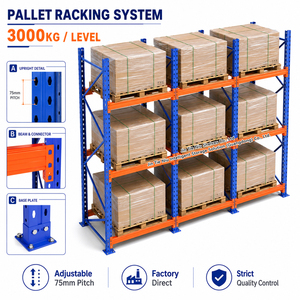
Engineered Storage Equipment Showcase
Explore heavy-duty warehouse infrastructure manufactured with high-tensile structural steel, multi-pass anti-corrosion surface treatments, and variable capacity profiles.
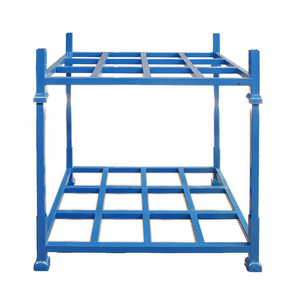
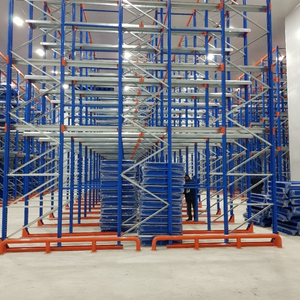
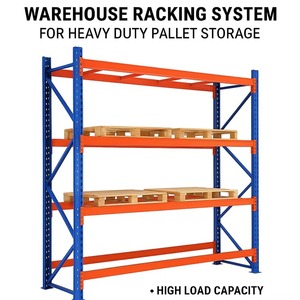
25+
Years Engineering Expertise
30Km²
Integrated Production Plant
30Kt
Monthly Fabrication Capacity
120+
Export Sovereign Destinations
Enterprise Strengths & Fabrication Rigor
A certified, vertically-integrated tier-one manufacturing pipeline engineered to meet FEM 10.2.02, EN 15512, and RMI industrial structural compliance standards.
Verified Global Compliance
Certified strictly under CE Certification (No. 2435-CPR-8605159) and ISO 9001:2015 Quality Management System (No. 18624Q00169R0M). Our structural uprights, crossbeams, and connectors are subjected to dynamic weld crack evaluations and yield testing.
Full In-House Industrial Process
From prime cold-rolled steel uncoiling, automated multi-point punching, precision roll-forming, continuous seam robotic welding, to an industrial 10-stage chemical pickling and electrostatic thermosetting powder coat line.
Free Turnkey Engineering Design
Every facility demands calculated logistics metrics. We provide complimentary CAD floor plans, finite element analysis (FEA) deflection simulations, 3D architectural renders, and verified base-plate anchoring calculations.
Engineering Insights: Racking Procurement & Technology Roadmap
A comprehensive analysis for warehouse project directors, operations planners, and supply chain managers assessing modernization versus floor capital allocation.
Future Procurement Trends: 2026–2030
1. Decoupling from Single-Depth Storage: Supply chain volatility has elevated high-density shuttle racking systems and dynamic gravity flow layouts, shifting volume utilization from 45% (selective systems) up to 85% of total cubic volume.
2. High-Strength Alloy Down-Gauging: Procurement mandates are shifting from conventional Q235B structural steel toward micro-alloyed, cold-formed structural steels like Q355B and high-yield alloys, lowering dead-weight loads on concrete slabs while preserving yield margins.
3. Severe-Environment Coating Specs: Multi-climate supply chains (e.g., Central American coastal humidity, cold-storage condensation, and chemical salt air) prioritize hot-dip galvanized profiles (ASTM A123) over standard dry powder coatings.
Technological Evolution & Systems Convergence
1. Automation-Ready Tolerances: Manual forklift racking accommodates beam deflection ratios of 1/200. Conversely, AGV, AMR, and ASRS high-bay integration enforces beam and column deflection tolerances strictly tightened to 1/300 or 1/400.
2. Smart Structural Monitoring: Racking columns are integrating retrofitted piezoelectric strain sensors and telemetry nodes along critical impact points, reporting structural shifts or forklift collisions in real time before systemic collapses occur.
3. Structural Optimization Software: Advanced FEA modelling enables automated, precise seismic zoning design (UBC Zone 4, Eurocode 8, and local seismic parameters) to protect critical capital investments.
| Racking System Type | Space Density Ratio | Selectivity Profile | Inventory Logic | Forklift Compatibility | Ideal Industry Application |
|---|---|---|---|---|---|
| Selective Pallet Racking | Low-Medium (~40-50%) | 100% Direct Access | FIFO / LIFO | Counterbalance, Reach Trucks | 3PLs, Multi-SKU Retail Distribution |
| Drive-In / Drive-Through | Extremely High (~75-85%) | Low (Lane-dependent) | LIFO (Drive-In) / FIFO | Narrow Counterbalance | Beverage, Cold Chain, Bulk Seasonal |
| Radio Shuttle Automation | Ultra-High (~80-90%) | High by Lane Access | Configurable FIFO/LIFO | Standard Reach / Automated Shuttles | Food Manufacturing, Cold Storage (-25°C) |
| Push-Back Cart Systems | High (~65-75%) | Moderate (Per lane level) | LIFO | Standard Forklifts | Intermediate Buffer, High SKU Turnaround |
| Rack-Supported Mezzanine | Doubled Vertical Footprint | 100% Manual Access | Mixed Batch Picking | Pallet Jacks, Vertical Cargo Lifts | E-commerce, Auto Spare Parts, Hardware |
Industrial Buyer's Frequently Asked Questions
Critical structural, operational, and commercial parameters clarified by our chief logistics engineering team.
How are seismic loading and soil conditions integrated into custom rack calculations?
We configure upright sections, bracing patterns, floor base plates, and anchoring bolts via finite element calculation methods following localized seismic standards (such as Eurocode 8 or equivalent UBC/IBC zone spectra). Our engineers calculate the spectral acceleration parameters based on your geotechnical reports to ensure safety under both dead and dynamic live-load seismic events.
What concrete slab thickness and compressive strength are required for heavy-duty pallet installations?
For standard selective racks handling 1,000kg to 3,000kg per level, we require a minimum non-shrink reinforced concrete floor depth of 150mm to 200mm, with compressive strength ratings between C25/30 and C30/37. High-density shuttle systems and VNA towers exceeding 10 meters typically require 250mm reinforced concrete with super-flat FF/FL levelling tolerances to prevent mast tipping.
How do you ensure corrosion protection for cross-ocean transit and tropical operating environments?
Standard components undergo an automated 10-stage pre-treatment, combining acid pickling, zinc phosphate conversion coating, and thermosetting epoxy-polyester powder baking (minimum 60-80 microns thickness). For coastal sites, cold-storage freezers, or agrochemical fertilizer plants, hot-dip galvanizing per ISO 1461/ASTM A123 is applied to guarantee zero oxidation across decades of damp exposure.
What export packaging protocols are implemented to eliminate transit distortion and damage?
Uprights and beam bundles are banded using heavy-gauge PET straps with timber dunnage spacers and edge corner protectors. Finished components are shrink-wrapped in micro-perforated VCI (Vapour Corrosion Inhibitor) plastic film to arrest condensation damage during ocean carriage. Detailed pack manifests correlate every crate directly with container loading diagrams to streamline customs release and field staging.
What baseline project data is required to generate a complete layout and quotation?
We require: (1) Architectural CAD floor plans with column grids, clear ceiling heights, and door locations; (2) Pallet specifications (Length x Width x Height including cargo overhang and maximum gross unit weight); (3) Forklift model details (turning radius, maximum mast elevation, collapsed mast height); and (4) Throughput requirements and target operating temperature.