Engineered Storage Systems & Fabrication Solutions
Explore our industrial-grade shelving architectures, designed with certified cold-rolled steel, high structural integrity, and tailored load capacities ranging from 500 kg to 5,000 kg per tier.
Executive Whitepaper: Strategic Selection of Industrial Storage Shelving Systems
In modern industrial manufacturing, third-party logistics (3PL) fulfillment hubs, cold chain distributions, and automated e-commerce sorting facilities, industrial storage shelving systems no longer function as inert steel furniture. Instead, modern racking and shelving infrastructures represent capital assets that dictate operational cadence, cubic volume utilization, throughput velocity, inventory fidelity, and facility life safety. Selecting top trusted industrial storage shelving systems manufacturers and suppliers requires comprehensive evaluation that bridges structural mechanics, metallurgic purity, seismic mitigation, dynamic load dissipation, and intralogistics system interoperability.
Industrial storage configurations range from selective single-deep pallet racks and multi-tier picking mezzanines to deep-lane gravity flow beds and fully autonomous radio shuttle systems. Miscalculating floor slab deflection tolerances, beam connection locking resistance, yield stress indices under cyclic loading, or corrosion vulnerability in tropical, maritime, or sub-zero environments can lead to structural creep, premature metal fatigue, catastrophic rack failure, or unrecoverable inventory write-downs. This engineering whitepaper outlines structural typologies, future procurement trends, technological shifts, and compliance benchmarks to guide enterprise procurement executives, logistics engineers, and warehouse operations heads worldwide.
Deep-Dive Product Recommendations & System Typologies
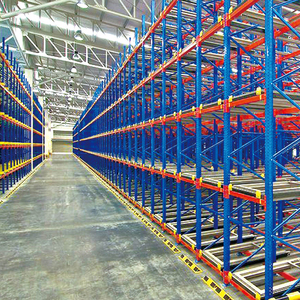
To maximize volumetric efficiency and streamline picking paths, facility planners must match operational SKU velocity and physical load parameters to appropriate storage configurations. Below are our engineering recommendations for leading industrial configurations:
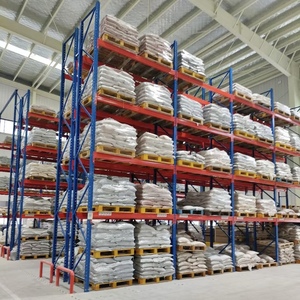
Selective Heavy-Duty Pallet Racks
Scenario: High-SKU environments requiring continuous, unobstructed 100% direct access to every pallet position.
Engineering Parameters: Uprights roll-formed with omega-ribbed profiles, 75mm or 50mm pitch adjustability, dual safety locking clips per connector, capacity rated up to 5,000 kg per beam tier. Compatible with reach trucks, counterbalanced forklifts, and VNA turret systems.
Semi-Automated Radio Shuttle Racking
Scenario: High-density cold storage (-25°C), beverage bottling, and FMCG warehouses moving high volumes of identical SKUs with minimal forklift aisle entry.
Engineering Parameters: Galvanized or electrostatic coated runway rails, autonomous battery-powered shuttle vehicles running on independent programmable logic controls (PLC), supporting both FIFO and LIFO rotation schemes with deep-lane depths over 40 pallets.
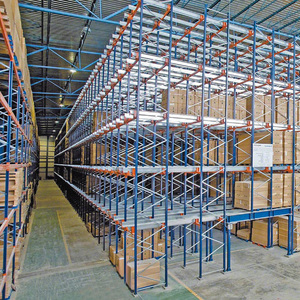
Push-Back & Gravity Flow Racking
Scenario: Dynamic storage balancing space consolidation with moderate stock rotation speed for pharmaceutical, chemical, and perishables logistics.
Engineering Parameters: Inclined roller tracks (2.5% to 3.5% incline) featuring centrifugal speed controllers and end-stop impact dampers, or nested telescoping carts with low-friction sealed bearings engineered to handle 2 to 6 pallets deep per lane on a strict LIFO or FIFO basis.
Multi-Tier Mezzanines & Longspan Racks
Scenario: E-commerce fulfillment, apparel sorting, and spare parts distribution requiring dense manual SKU order picking without expanding warehouse footprint.
Engineering Parameters: Rack-supported or structural I-beam platforms designed for uniform floor loadings of 300 to 1,200 kg/m², integrated with cold-formed perforated steel floor planks, industrial safety balustrades, kickplates, and staircase ascents compliant with OSHA/IBC standards.
Cantilever & Tubular Subframe Systems
Scenario: Timber yards, building supplies, PVC piping, steel bars, sheet metals, and automotive chassis transport.
Engineering Parameters: Free-standing vertical columns with bolted or welded pivot arms designed to eliminate front-column access obstructions. Arm capacities reach 1,500 kg per arm with calculated structural safety factors against eccentric arm loading and impact torque.
Data Enclosures & Intelligent Archives
Scenario: Secure IT server infrastructure, telecommunications data hubs, financial archives, and corporate records vaults.
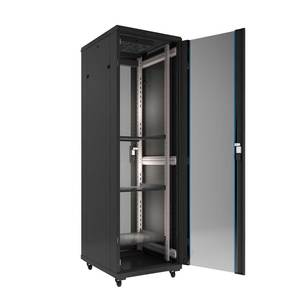
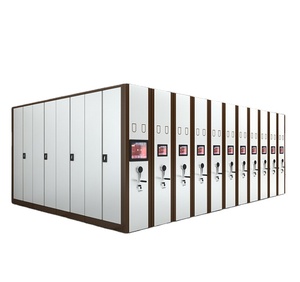
Engineering Parameters: FINEN 19-inch rack enclosures conforming to ANSI/EIA RS-310-D with integrated cable raceways and forced thermal dissipation; JINGYE mobile archives equipped with electronic anti-squeeze sensors, infrared obstruction halts, and high-density gear-track drives.
Comprehensive System Engineering Comparison Matrix
A rigorous engineering comparison helps industrial planners evaluate rack configurations across spatial, financial, and operational vectors:
| Racking Topology | Floor Footprint Efficiency | Pallet Accessibility | Stock Rotation Discipline | Standard Load Limits | Relative CapEx Index |
|---|---|---|---|---|---|
| Selective Pallet Racking | Baseline (40%-45%) | 100% Immediate Direct Access | FIFO or LIFO | 1,000 - 4,500 kg / beam tier | Low (1.0x Baseline) |
| Drive-In / Drive-Thru Racking | High Density (65%-75%) | Low (Last In, First Out) | LIFO (Drive-In) / FIFO (Drive-Thru) | 1,000 - 1,500 kg / pallet slot | Moderate (1.4x) |
| Push-Back Cart Racking | Dense (60%-70%) | Moderate (Per Lane Picking) | LIFO | 1,000 - 1,500 kg / cart tier | Moderate-High (1.9x) |
| Pallet Gravity Flow | Maximum (70%-80%) | High at Discharge Face | Strict FIFO Automatic Rotation | 500 - 1,500 kg / roller track | High (2.4x) |
| Automated Radio Shuttle | Ultra-Dense (80%-85%+) | Lane-Level Rapid Automation | Agile FIFO & LIFO Software Switching | 500 - 2,000 kg / shuttle unit | Advanced (2.8x - 3.5x) |
| Cantilever Long Racks | Targeted Long Goods | 100% Linear Access | Direct SKU Retrieval | 500 - 3,000 kg / arm arm level | Moderate (1.6x) |
| Rack-Supported Mezzanine | Multiplied (200%-300%) | 100% Manual Hand-Picking | Batch & Zone Picking | 300 - 1,000 kg / m² deck area | Moderate-Engineered (2.0x) |
Future Procurement Trends in Industrial Storage Shelving (2025-2035)
The procurement of industrial storage shelving systems has moved beyond simple spot-market buying into strategic lifecycle partnerships. Facilities are evolving rapidly under pressure from nearshoring, omnichannel retail, real estate cost increases, and strict sustainability mandates. Forward-looking procurement directors must anticipate several shifts:
1. Transition Toward "Automation-Ready" Structural Infrastructure
While fully automated ASRS (Automated Storage and Retrieval Systems) demand significant upfront capital, enterprise buyers increasingly procure static racking built to tighter tolerances that can host future autonomous guided vehicles (AGVs), autonomous mobile robots (AMRs), or radio shuttle conversions. Traditional standard racking tolerances of ±5mm across vertical upright spans are narrowing to ±1.5mm to allow laser-guided robotic navigation. Investing in automation-ready base structures prevents disruptive warehouse shutdowns when upgrading from manual picking to robotic automation later on.
2. Cubic Optimization Over Footprint Expansion
Industrial real estate lease costs across major global freight corridors have risen significantly over the past five years. Consequently, organizations are building taller rather than wider. Clear heights of modern distribution centers now commonly reach 14 to 22 meters. Racking designs must withstand dynamic wind loading inside open bay environments, heightened seismic overturning moments, and strict floor slab levelness constraints (defined by ASTM E1155 F-min numbers or DIN 18202 standards). Deep-lane radio shuttle networks and narrow aisle (VNA) systems are replacing standard layouts to maximize cubic volume usage.
3. Green Steel, Powder Recycling, and Life-Cycle Carbon Accounting
Scope 3 carbon reduction mandates are entering industrial procurement agreements across multinational corporations. Storage suppliers must provide transparent life-cycle environmental assessments (EPDs). Specifying steel processed via electric arc furnaces (EAF) utilizing high recycled scrap metal content, paired with non-toxic, closed-loop electrostatic powder coating systems that recycle overspray and eliminate VOC outgassing, allows buyers to achieve LEED Gold or BREEAM environmental certifications for their distribution facilities.
4. Digitally Integrated Traceability and RFID-Embedded Structural Monitoring
Enterprise procurement teams are exploring the convergence of structural steel with IoT sensor telemetry. Smart upright assemblies equipped with tri-axial accelerometers and strain gauges can detect structural impact from forklifts in real-time, instantly logging incident severity into warehouse management software (WMS). Concurrently, laser-etched 2D DataMatrix codes and embedded RFID tags on uprights, load beams, and safety pins streamline annual rack safety audits required by OSHA and EN 15635 standards.
Technological & Engineering Innovations in Modern Racking Fabrication
Engineering excellence separates reputable industrial shelving manufacturers from low-cost fabricators. The production lifecycle at tier-one manufacturing plants incorporates finite element analysis (FEA) modeling, automated cold roll-forming lines, robotic welding stations, and specialized multi-stage surface passivation lines.
Finite Element Analysis (FEA) and Seismic Calibration: Global facilities located along active seismic zones require specialized joint engineering. Using advanced FEA simulations, structural engineers assess torsional moments, base plate uplift resistance, and portal beam shear deformations under simulated earthquake conditions. Upright column geometry has advanced from simple channel shapes to multi-faceted omega profiles with up to 12 distinct mechanical bends, increasing torsional stiffness without adding unnecessary dead steel weight.
Advanced Surface Protection Protocols: In humid coastal hubs, cold-room blast freezers, and chemical warehouses, surface corrosion poses a major threat to steel integrity. Reliable manufacturers execute rigorous ten-stage chemical surface conversion before powder application: ultrasonic degreasing, twin cold-water rinses, acid pickling to eliminate mill scale, phosphate crystalline conversion to form an anti-corrosive barrier, demineralized water washing, and thermal drying. Electrostatically applied TGIC-free polyester powder finishes are cured at 180°C to 200°C to produce an impact-resistant, peel-free coating tested to endure over 500 hours of continuous ASTM B117 salt spray exposure without micro-blistering.
Why HEDA Shelves: Enterprise Strengths & Factory Capabilities
With an engineering legacy spanning more than 25 years since its establishment in 2001, Guangzhou Heda Shelves Co., Ltd. has established itself as an authoritative global manufacturer of engineered warehouse storage systems, heavy-duty pallet racks, industrial shelving, and multi-tier mezzanine platforms. Our operations provide global procurement teams with verifiable capabilities, direct factory pricing, and full-spectrum intralogistics design.
Internationally Audited Certifications
Every structural profile manufactured in our facility is backed by verified certifications: CE Certification (No. 2435-CPR-8605159), ISO 9001:2015 Quality Management System Certification (No. 18624Q00169R0M, valid through June 2027), and complete RoHS material compliance.
Massive Scale & Fast Lead Times
Operating a modernized 30,000 m² manufacturing plant staffed by more than 300 skilled technicians, roll-forming specialists, and robotic welders, our facility achieves a monthly output exceeding 30,000 metric tons. This capacity ensures on-time completion of multi-hundred-container rollout projects.
10,000+ Projects in 120+ Countries
From large regional distribution facilities across North, Central, and South America to heavy-duty installations in Europe, Africa, Southeast Asia, and the Middle East, our team has designed and delivered over 10,000 custom warehouse installations tailored to local climates, codes, and operational demands.
Free 3D Architectural CAD & Load Simulation Service: We assign certified intralogistics structural engineers to evaluate your warehouse floor plan, clear heights, column positions, concrete slab compressive strengths, and forklift turning radii before manufacturing begins. Within 24 hours of receiving site dimensions, our team delivers full 2D layout drawings, 3D spatial models, and structural loading calculations free of charge.
Ten-Stage Quality Controlled In-House Manufacturing: Our ISO-audited production line controls quality from coil to container: (1) Certified Raw Steel Coil Selection, (2) Precision High-Speed Slitting & Cutting, (3) Automated CNC Upright Punching, (4) Precision Cold Roll Forming, (5) Profile Mechanical Calibration, (6) Automatic Mechanical De-burring & Polishing, (7) Robotic High-Penetration Welds, (8) Chemical Pickling & Phosphating Passivation, (9) Dual-Booth Electrostatic Powder Spraying, and (10) Comprehensive Pre-Shipment Inspection and Export-Grade Bundling.
Frequently Asked Questions (FAQ) for Industrial Storage Procurement
Procuring heavy-duty warehouse storage systems involves complex structural, regulatory, and logistics decisions. Below are direct answers to common technical questions submitted by logistics directors, civil engineers, and supply chain managers: