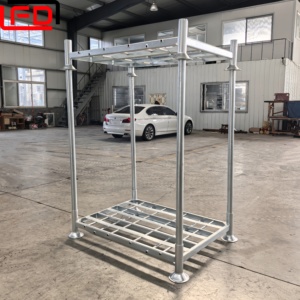
Dip Galvanized Industrial Storage Stackable Post Pallet
Modular stackable post pallet engineered for harsh yard environments, bulk agricultural grain, and cold rooms. Resists corrosive humidity while offering 4-high free vertical stacking.
Every warehousing operation possesses distinct SKU velocities, clearance thresholds, and structural constraints. Discover our factory-certified high-density solutions, standard cold-rolled framing, and custom-fabricated systems built to European EN 15512 and global RMI safety benchmarks.
Modular stackable post pallet engineered for harsh yard environments, bulk agricultural grain, and cold rooms. Resists corrosive humidity while offering 4-high free vertical stacking.
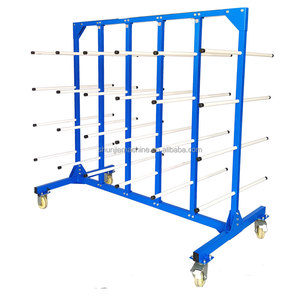
Designed for aluminum profiles, structural bars, and conduit tubing. Double-sided extended cantilever arms mounted on industrial caster arrays for agile workshop logistics.
Increases storage density by 50% relative to standard selective racking by storing two pallets deep per aisle face. Optimized for specialized deep-reach pantograph mast trucks.
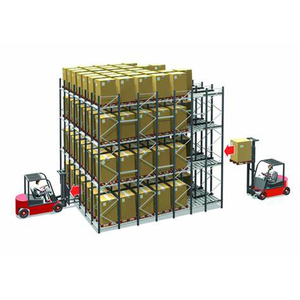
Continuous gravity-fed flow tracks utilizing precision speed controllers and separator brakes. Implements effortless First-In, First-Out (FIFO) stock turnover for perishables.
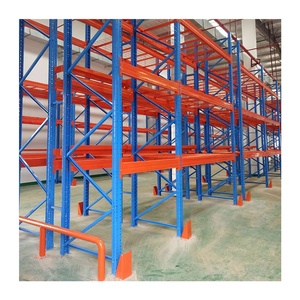
Unrestricted dual-access bays enabling simultaneous loading and unloading. Features rolled one-piece structural cantilever arms and reinforced heavy floor guide rails for safe forklift entry.
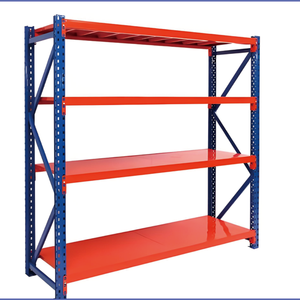
Solid galvanized or painted steel shelf plates for manual carton staging, heavy plastic containers, and irregular boxed inventory. Completely eliminates timber degradation risks.
Engineered with cold-formed 120mm upright sections and heavy box beams with 4-claw connector brackets. Perfect for machinery dies, chemical drum storage, and mining raw stores.
Nested steel carriage carts gliding smoothly across tilted structural channel rails. Offers 2 to 6 pallet deep positions with dedicated single-aisle operational loading access.
Unlike selective racking where horizontal beams brace adjacent upright frames, Drive-In and Drive-Through racking configurations omit cross beams within the pallet travel aisles. Structural stability depends strictly on portal overhead bridging, top horizontal bracing, and cantilever rail geometry.
Because lift trucks maneuver directly inside the storage lanes, upright frames experience combined axial compression and lateral torsional buckling stresses. Our engineering department calculates upright cross-sections using advanced Finite Element Analysis (FEA) based on EN 15512 and RMI standards to ensure deflection remains well under L/200 under maximal load.
We fabricate exclusively with certified Q235B and Q355B prime high-tensile structural carbon steel. Uprights feature continuous un-spliced roll-forming with multi-bend Omega (Ω) profiles, delivering an optimized radius of gyration. This provides exceptional energy absorption and fatigue resistance against accidental lift truck collisions.
Forklift drivers must thread pallets through deep lanes with tight clearances. Our systems utilize heavy 2.5mm–3.5mm one-piece formed cantilever rails featuring a flared lead-in entry guide and raised safety outer lips. This self-centers the pallet, prevents edge tear, and safeguards bottom boards from dislocation.
| Storage System Type | Floor Footprint Utilization | Vertical Cube Utilization | SKU Selectivity Index | Standard Stock Rotation Rule | Typical Investment / Pallet |
|---|---|---|---|---|---|
| HEDA Heavy Drive-In Racking | Up to 80% (Extreme) | 85% – 92% | Low (Uniform SKU per lane) | LIFO (Last-In, First-Out) | $ – Economical High Density |
| Drive-Through Pallet Racking | 75% – 80% (High) | 85% – 90% | Moderate (Dedicated bays) | FIFO or LIFO | $$ – Low to Moderate |
| Standard Selective Racking | 35% – 42% (Aisle-Heavy) | 50% – 65% | 100% (Direct Access) | Any (Unrestricted) | $ – Baseline Commodity |
| Double Deep Racking | 55% – 60% (Moderate) | 65% – 75% | 50% (Two-deep reach) | LIFO (Per bay pair) | $$ – Moderate |
| Automated Radio Shuttle Racking | 80% – 85% (Maximal) | 90% – 95% | Moderate to High | Flexible FIFO / LIFO | $$$$ – High-End Automation |
Founded in 2001 in Guangzhou, China, Guangzhou Heda Shelves Co., Ltd. has grown into an international powerhouse in warehouse storage systems engineering. We eliminate trading intermediaries, providing EPC contractors, industrial distribution centers, and commercial cold chain operators direct factory pricing, certified metallurgical integrity, and custom architectural CAD designs.
Our manufacturing operations operate under strict audited management systems. We hold EU Construction Products Regulation CE Mark No. 2435-CPR-8605159, ISO 9001:2015 Certification No. 18624Q00169R0M (valid through June 2027), and complete material compliance testing under RoHS standards.
Whether installing in Central America’s Pacific Rim seismic corridor, volcanic regions of Guatemala and Costa Rica, or earthquake-prone Chilean and Southeast Asian zones, our engineering specialists configure dynamic load anchor systems, enlarged floor footplates, and heavy tie-back portals validated for Zone 4 seismic acceleration values.
We manage factory-to-port export operations across the globe. Direct containerized sea cargo departures through South China ports provide reliable CIF/FOB delivery to key hubs such as Puerto Quetzal, Santo Tomás de Castilla, Puerto Cortés, Acajutla, Puerto Caldera, Balboa, and Colón, complete with itemized bundle marks for error-free customs clearance.
From high-grade coil slitting to our multi-tank chemical pre-treatment and electrostatic powder coating, every stage is fully controlled in-house.
Certified mill tests for tensile yield strength and carbon grading.
Precise strip tolerances prevent cold-forming edge variations.
Continuous hydraulic stamping of tear-drop and 75mm diamond pitch.
18-station cold roll-forming ensures upright Omega straightness.
Automated MIG welding for load claws and endplates with zero porosity.
Surface descaling to Sa 2.5 purity for maximum paint adhesion.
4-stage chemical pre-wash creates an anti-rust micro-crystalline skin.
Swiss Gema powder guns deliver 80-120μm uniform polymer thickness.
Full cross-link polymerization ensures scratch and impact immunity.
Dimensional cross-checking, barcode labelling, and sea packing.
Warehouse real estate prices, cold-chain energy expenditures, and seismic structural regulations are reshaping procurement strategies. Review how next-generation warehouse storage planning is shifting from low-grade static storage toward engineered, semi-automated systems.
While traditional Drive-In systems remain the most economical high-density solution, procurement teams are increasingly specifying "Shuttle-Ready" configurations. By installing dual-purpose side rails capable of holding static pallets today or supporting autonomous 24V pallet shuttles tomorrow, facilities future-proof their CAPEX while drastically reducing forklift transit accidents.
Refrigerated cubic volume costs up to four times more per square meter than ambient storage. The global surge in frozen food, pharmaceutical vaccine logistics, and fresh produce export drives demand for deep 8-12 pallet Drive-In lanes with anti-brittle steel alloys that retain tensile ductile strength at temperatures down to -30°C.
Procurement frameworks increasingly demand certified Environmental Product Declarations (EPD). Advances in cold-forming allow Q355B alloy steel profiles to achieve superior load-bearing capacity with 12% lower material deadweight, saving freight expenditure and lowering embedded carbon across international transit lanes.
Upright columns in Drive-In lanes remain highly vulnerable to forklift wheel contact. Future procurement specifications incorporate embedded piezoelectric impact sensors and laser-scanned deflector plates that log collision severity to cloud warehouse management software (WMS), alerting safety managers to load-bearing frame shifts before catastrophic collapse occurs.
With international manufacturers diversifying supply chains through regional free zones (such as Panama's Colón Free Trade Zone and Mexico's industrial hubs), procurement contracts favor modular, fully bolted rack structures that can be dismantled, reconfigured, or expanded with zero on-site structural welding.
Send your warehouse dimensions, clear ceiling height, pallet dimensions, forklift turn radiuses, and seismic zone location. Our senior racking engineers deliver complete shop drawings, load charts, and an itemized CIF export quote within 24 hours.
Essential technical and commercial insights for project engineers, supply chain vice presidents, and procurement teams evaluating Drive-In Pallet Racking infrastructure.
Drive-In racking eliminates individual forklift access aisles, allowing trucks to drive directly into deep multi-level storage lanes. While standard selective racking uses only 35-40% of warehouse floor footprint for storage (the rest being aisles), Drive-In racking utilizes up to 75-80% of floor space and achieves an 85-90% vertical cube storage density. It is specifically designed for operations handling large volumes of uniform SKUs under Last-In, First-Out (LIFO) or First-In, First-Out (FIFO via Drive-Through) logic.
Because Drive-In systems concentrate heavy multi-tier pallet loads onto localized baseplate footings without cross-beam load dispersal, concrete floor specifications are critical. For standard upright frame loads up to 12,000 kg, we typically specify a minimum slab thickness of 180mm to 220mm utilizing reinforced C25/30 or C30/37 grade concrete. We equip each upright post with heavy 8mm-12mm thick floor anchor plates secured by high-grade chemical or mechanical wedge anchor bolts.
Yes. A significant portion of our global exports serve active seismic zones across Central and South America (e.g., Guatemala, Costa Rica, Panama, Chile, and Peru). Our structural engineering team incorporates local building codes and seismic coefficients into structural calculation software. We customize baseplates, configure double-anchor assemblies, integrate heavy overhead portal tie-beams, and incorporate top/back vertical bracing systems to withstand lateral acceleration forces.
Forklift impact is the primary operational hazard in Drive-In configurations. To counter this, HEDA integrates a multi-layered protection approach: 1) Full-length floor-mounted heavy steel guide rails (either C-channel or heavy angle steel) that mechanically guide forklift tires through the center of the lane; 2) Wrap-around heavy column guards fabricated from 6mm structural steel at all outer entry uprights; 3) Heavy flared pallet rail guide heads that self-center swinging pallets.
For climate-controlled dry distribution centers, our 9-stage electrostatic powder coating provides exceptional scratch resistance and aesthetic durability. For harsh coastal warehouses exposed to salt spray or deep-freeze cold storage facilities (-20°C to -30°C) with high condensation, we strongly recommend Hot-Dip Galvanizing (HDG) per ISO 1461. HDG immerses the fabricated steel into molten zinc at 450°C, forming a bonded metallurgical zinc-iron alloy coating that provides decades of maintenance-free rust resistance.
To produce a structural calculation and layout, our engineering department needs: 1) Warehouse architectural drawings (PDF/CAD) showing dimensions, ceiling clear height, column positions, door clearances, and dock doors; 2) Pallet specifications (width, depth, overall height including cargo overhang, and gross weight); 3) Forklift model, mast collapsed height, maximum lift height, and chassis turning width; 4) Target destination port for sea container freight calculation.
Contact Guangzhou HEDA Shelves today to schedule a technical consultation with an experienced warehouse logistics systems specialist. Ensure structural safety, maximize floor storage yield, and procure factory-direct racking engineered for long-term performance.