Featured Industrial Racking & Shelving Systems
Engineered from premium Q235B cold-rolled steel, custom-tailored for maximum load dynamics, space efficiency, and international structural codes.
Industry White Paper: Engineering Authority & Precision Manufacturing Standards
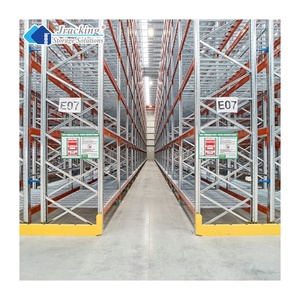
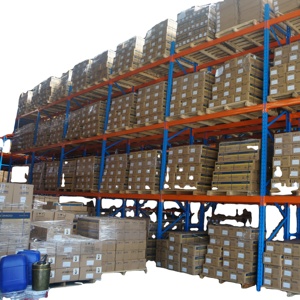
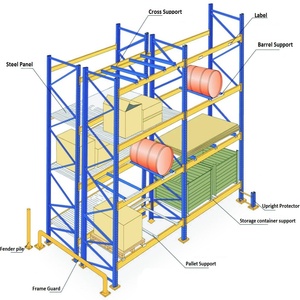
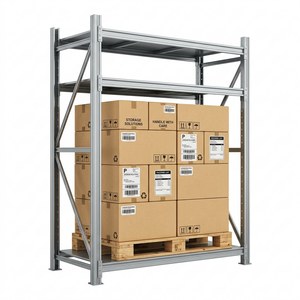
In modern industrial logistics, static storage capacity directly correlates with structural safety, supply chain throughput, and operational capital allocation. As one of China's premier manufacturers and global suppliers of wall mounted racking shelves and structural heavy-duty storage racks, we integrate end-to-end metallurgical control, computerized robotic manufacturing, and rigorous international quality certification frameworks.
Proprietary Cold-Roll Forming & Load Capacity Analysis
Our upright columns feature custom-designed multi-bend profiles engineered to resist lateral torsional buckling under seismic accelerations and uneven point loadings. By utilizing advanced Finite Element Analysis (FEA), our structural engineers simulate yield stress distributions under extreme loading configurations, verifying that safety factors exceed 1.5 to 1.8 across all standard operating load ratings.
Whether deploying cantilevered profiles for lengthy dimensional stock or high-density pallet shelving anchored to perimeter walls and concrete slab bases, our engineering matrix guarantees complete alignment with AS4084 (Australian Standard), FEM 10.2.02 (European Code), and RMI (Rack Manufacturers Institute) standards.
| System Type | Material Specification | Standard Load Dynamic | Surface Treatment | Compliance Certifications |
|---|---|---|---|---|
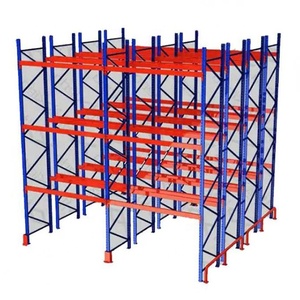
| Selective Pallet Racking | Cold Rolled Q235B / Q355B Steel | 1,000 kg – 4,500 kg / Beam Level | Epoxy Powder Coating (60-80μm) | CE (2435-CPR-8605159), ISO 9001 |
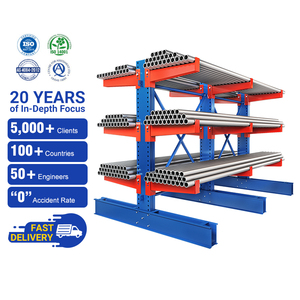
| Heavy Duty Cantilever Racks | Structural H-Beam / Hot-Rolled Steel | 500 kg – 3,000 kg / Cantilever Arm | Hot-Dip Galvanized / Electrostatic Powder | ISO 9001:2015, RoHS Compliant |
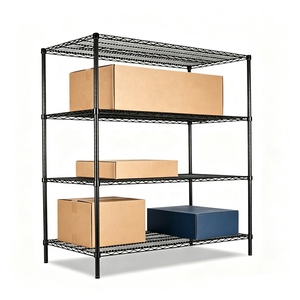
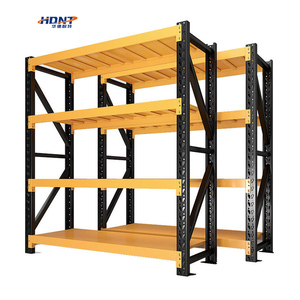
| Medium-Duty Longspan Shelves | High-Yield Cold-Formed Sheet | 200 kg – 800 kg / Uniform Shelf Level | Pickled, Phosphated & Powder Coated | CE Standard, NSF Compatible |
| Mezzanine-Supported Racking | Structural Steel I-Beam & C-Purlins | 300 kg – 1,000 kg / m² Floor Area | Anti-Corrosion Primer + Top Coat | AS4084, FEM 10.2.02 Design Codes |
Future Procurement & Development Trends in Industrial Storage Racking
Global supply chain disruptions and omnichannel retail transformation have driven profound technological evolution in warehouse infrastructure procurement.
1. Convergence with Automated Material Handling
Procurement teams are shifting away from standalone manual shelving toward hybrid systems that integrate with autonomous mobile robots (AMRs), automated guided vehicles (AGVs), and automated storage and retrieval systems (AS/RS). Wall mounted and perimeter racking units are increasingly engineered with precise robotic clearance tolerances, integrated optical sensor channels, and barcode scanning tracks.
2. High-Strength, Low-Gauge Micro-Alloy Steels
To reduce shipping costs and carbon footprints, leading manufacturers are adopting high-yield micro-alloyed steels (such as Q355B and specialized cold-work hardenable alloys). This allows thinner gauge profiles to achieve equivalent or superior load-bearing capacity, reducing freight weight per container while improving seismic elasticity in earthquake-prone zones.
3. Modular Reconfigurability & Fast-Lock Mechanics
Rapid changes in SKU velocity demand warehouse racking systems that adapt dynamically. Future procurement mandates modular teardrop or keyhole beam connectors with tool-free boltless adjustments. This allows operations to transition from bulk pallet storage to multi-tier carton flow or pick-and-pack workstations within hours without hot-work permits.
4. IoT-Enabled Structural Health Monitoring
Smart logistics hubs are beginning to mandate built-in load-strain gauges and vibration sensors embedded within upright baseplates. These IoT sensors alert warehouse managers in real time to forklift impacts, beam deflection limits, or micro-subsidence in concrete floor slabs, mitigating progressive collapse risks before structural failures occur.
5. Advanced Corrosion Resistance for Harsh Environments
The explosive expansion of cold chain logistics, pharmaceutical cold rooms, and coastal distribution centers has accelerated the demand for continuous hot-dip galvanizing (HDG) and thermosetting fluoropolymer hybrid coatings. These surface finishes provide salt spray test resistance exceeding 1,000 hours, outperforming traditional liquid spray paint finishes.
6. Digital Twin CAD & Algorithmic Layout Optimization
Procurement is no longer based on static catalogs. B2B purchasers now require direct CAD/BIM digital twins and 3D algorithmic space optimization before issuing purchase orders. Integrating volumetric simulations ensures total utilization of clear ceiling heights while maintaining optimal forklift turning radii.
Enterprise Strengths: Why Partner With Our Manufacturing Facility
Founded with a focus on structural storage systems, our manufacturing facility in Guangzhou has grown into a high-capacity production center covering 30,000 square meters. By managing every stage in-house—from continuous roll forming to automated surface treatment—we deliver engineering consistency and factory-direct cost efficiencies across all major markets.
Verified Quality Certifications
Our structural production processes hold formal CE certification (No. 2435-CPR-8605159) and ISO 9001:2015 registration (Certificate No. 18624Q00169R0M, valid through June 2027), along with comprehensive RoHS chemical compliance for eco-friendly electrostatic powder coatings.
In-House 3D Layout & Structural Engineering
Every industrial proposal is supported by an in-house team of structural engineers. We provide complimentary CAD 2D layouts, photorealistic 3D warehouse renderings, and seismic load calculation sheets tailored to your warehouse floor slabs.
Global Logistics & Export Packaging
Exporting to more than 120 countries across the Americas, Europe, Australia, and Southeast Asia, our logistics team organizes containerized shipments with protective strapping, labeled bundles, and detailed packing manifests to streamline local customs clearance.
Frequently Asked Questions for B2B Importers & Buyers
Clear, engineer-verified answers to common questions about structural loads, lead times, customs shipping, and on-site assembly.
True industrial wall-mounted and perimeter racking systems transfer over 85% to 90% of gravity loads vertically into the reinforced concrete floor slab via heavy-duty baseplates and mechanical wedge anchors. Wall fixings mainly provide lateral restraint against overturning moments. Our engineering team calculates anchor embedment depth and shear loads based on your slab thickness (typically 150mm–250mm) and concrete compressive strength.
We supply comprehensive documentation packages for municipal engineering inspections, including mill test certificates (MTC), structural calculation sheets, static deflection reports, CE compliance documentation, and certified assembly drawings with recommended fastener torque ratings.
Standard configurations (such as selective pallet racking and cantilever components) carry a standard manufacturing cycle of 15 to 20 days per 40ft high-cube container. While our standard MOQ is one 20ft container to optimize ocean freight efficiency, sample runs and custom structural prototypes can be scheduled upon engineering review.
All structural uprights and horizontal beams are pre-treated through automated pickling and phosphating stages to eliminate surface mill scale, followed by high-voltage electrostatic epoxy coating cured at 180°C. For export shipping, items are wrapped with heavy-gauge corrugated board, strapped with high-tensile polyester bands, and packed with desiccant packs to prevent moisture condensation during long sea transits.
Yes. We offer comprehensive OEM/ODM custom tooling capabilities. If your facility uses legacy profiles (such as 50mm pitch, 75mm pitch, or teardrop punched uprights), our engineering department can replicate beam-end connectors and column punching layouts to match your existing equipment.
Every delivery includes an indexed installation manual, 3D exploded assembly diagrams, and component identification tags. We provide remote video-conferencing guidance with structural engineers, and can deploy on-site installation supervisors for large-scale multi-tier mezzanine and warehouse builds.
Plan Your Optimized Storage Layout Today
Send us your warehouse CAD floor plan, ceiling clear heights, and target pallet weights. Our engineering team will return a comprehensive 2D/3D layout, static calculation report, and competitive factory-direct proposal within 24 hours.
Contact Us