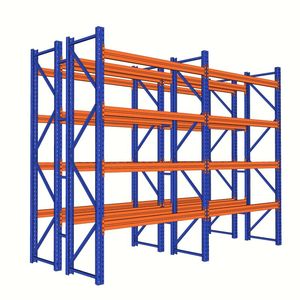
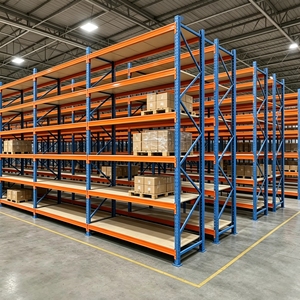
Heavy Duty Steel Drive-In Pallet Racking System 5 Tier Warehouse Racks
- High Density LIFO/FIFO
- Cold Room Optimized
- Electrostatic Powder Finish
All load-bearing structures are fabricated with structural cold-rolled steel (Q235B / Q355B / SS400 equivalents), conforming to FEM 10.2.02, EN 15512, and RMI standards with surface anti-corrosion finishes.
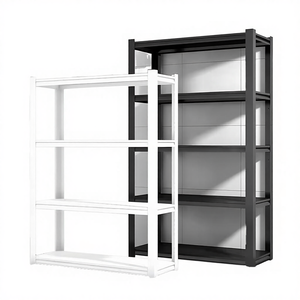
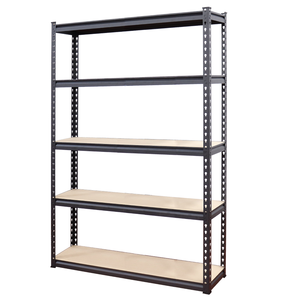
When engineering directors, logistics executives, and general contractors source warehouse racking systems directly from China, their primary challenge is shifting from mere FOB price comparisons to evaluating holistic structural integrity, seismic safety margins, and long-term supply resilience. Chinese racking manufacturing clusters centered around Guangdong and the Yangtze River Delta have evolved far beyond rudimentary manual metal fabrication. Modern Chinese original equipment manufacturers (OEMs) operate computerized continuous roll-forming lines, automated punching stations, laser fiber cutting heads, and robotic welding cells that surpass classical European fabrication benchmarks in volume consistency and dimensional tolerances.
However, significant variance remains in the metallurgical pedigree of raw materials and surface pre-treatment techniques. A reliable tier-one supplier such as Guangzhou HEDA Shelves Co., Ltd. relies strictly on certified mill-test structural coil (typically Q235B or high-tensile Q355B carbon steel), which guarantees yield strengths of 235 MPa and 355 MPa respectively, with controlled elongation indices exceeding 21%. Inferior non-certified fabricators often utilize re-rolled or uncertified hot-rolled coils with wide gauge variations and chemical inclusions, resulting in unpredictable structural deflection under full-rated live loads.
Furthermore, evaluating factory credentials requires scrutinizing structural calculation reports. True engineering compliance requires structural finite element analysis (FEA) based on EN 15512:2020 (European Standard for Steel Static Storage Systems) or ANSI/RMI MH16.1 (Specification for the Design, Testing and Utilization of Industrial Steel Storage Racks). A reputable China supplier provides itemized upright cross-section properties, section modulus data, beam end connector moment-rotation curves, and seismic base anchor shear-tension calculations verified by third-party testing laboratories before the initial container is dispatched.
Select the optimal storage density, throughput velocity, and inventory handling methodology based on SKU volume and material handling equipment.
| Racking Methodology | Space Utilization | Selectivity | Stock Management | Forklift Capital Cost | Best Suited Applications |
|---|---|---|---|---|---|
| Selective Pallet Racking | 40% – 50% footprint | 100% direct access | FIFO / LIFO versatile | Standard Counterbalance / Reach | FMCG, 3PL logistics hubs, high-SKU distribution |
| Drive-In / Drive-Through | 65% – 75% footprint | Low (Lane-dependent) | LIFO (Drive-In) / FIFO (Drive-Thru) | Narrow reach truck with mast guard | Cold storage, beverage bottling, bulk homogeneous lots |
| Radio Shuttle Automation | 80% – 85% footprint | Medium-High by lane | Automatic FIFO or LIFO | Standard lift truck (no rack entry) | Sub-zero freezers, agro-industrial commodities, meat & seafood |
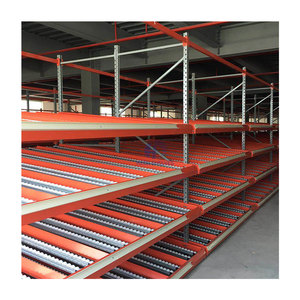
| Gravity Flow (Pallet / Carton) | 70% – 80% footprint | 100% per dedicated lane | Strict FIFO by gravity rollers | Standard fork & picking carts | Pharmaceuticals, perishable foods, e-commerce order picking |
| Heavy Cantilever Racks | Custom linear volume | Immediate column access | Batch selective access | Side-loader or heavy counterbalance | Timber, steel pipes, profiles, PVC extrusions, building supplies |
| Rack-Supported Mezzanines | 100% vertical cube gain | Tier-level manual access | Manual picking / Cart transport | Forklift load gate + personnel stairs | Auto parts warehousing, e-commerce fulfillment, garment sorting |
Emerging geopolitical shifts, carbon compliance standards, and robotics integration are fundamentally reshaping how international supply chain directors procure industrial storage systems.
Global procurement teams are moving away from purely manual racking toward automation-compatible structural designs. Uprights and guide tracks are now engineered with micro-millimeter tolerance tolerances (±0.5mm over 12-meter vertical spans) to facilitate seamless retroactive retrofitting of 4-way automated radio shuttles and Autonomous Mobile Robots (AMRs).
Volatile trans-oceanic freight tariffs have prompted engineering teams to prioritize optimized nesting geometry. Chinese leading manufacturers now utilize finite element modeling to design high-moment box-beams and tear-drop teardown designs that increase shipping container volumetric utilization rates up to 92%, substantially slashing per-pallet landed freight expenses.
Procurement teams no longer accept static 2D PDF blueprints. Leading suppliers provide comprehensive Building Information Modeling (BIM) files, Revit families, and 3D IFC models with stress distribution heatmaps within 24 to 48 hours of project consultation, ensuring warehouse civil infrastructure and sprinkler drops align perfectly with the racking matrix.
How cutting-edge Chinese manufacturing centers ensure safety in extreme environments, tropical humidity, and active earthquake seismic zones.
Utilizing high-tensile cold-rolled micro-alloyed steel grades, seismic racking profiles feature heavy-duty baseplates and omega-style upright geometry engineered to absorb horizontal ground acceleration forces along the Pacific Rim seismic belts.
Replacing traditional heavy-metal phosphating, modern automated pre-treatment lines incorporate zirconium silane conversion coatings. This produces an eco-friendly molecular barrier that doubles powder-coating salt spray endurance past 500 hours.
For blast freezers and aggressive agricultural chemical environments, heavy hot-dip galvanizing conforming to ISO 1461 (65–85μm thickness) prevents micro-fissuring and rust creep under extreme thermal cycles from -30°C to +40°C.
State-of-the-art continuous multi-stand roll-forming lines maintain punch hole distance deviations under 0.1mm per 10 meters, eliminating beam binding and ensuring interlocking safety locking pins engage with absolute mechanical rigidity.
From primary hot-rolled steel coils to ocean-worthy containerized shipping, every stage is audited under ISO 9001:2015 and CE certification standards.
Coil inspection for thickness tolerance, yield strength verification, and precision longitudinal strip slitting.
Continuous hydraulic stamping of teardown/diamond pitch holes with laser position sensing.
Multi-roller pass progressive profile shaping for omega uprights and interlocking box beams.
High-speed carbide-tipped circular cutting to exact structural cut lengths without burrs.
Dual-station robotic pulse welding of beam connector brackets and heavy post base plates.
Mechanical de-burring, slag removal, and edge beveling for optimal electrostatic paint adherence.
Multi-tank chemical degreasing, rust stripping, and water rinsing to expose bare pristine steel.
Molecular passivation forming a crystalline anti-corrosion bonding layer across all inner/outer profiles.
Automated electrostatic powder spray guns with curing in 200°C convective heating tunnels.
Cross-hatch adhesion testing, thickness gauging, steel strapping, and moisture-proof export packaging.
Founded in 2001 in Guangzhou, China, Guangzhou HEDA Shelves Co., Ltd. has grown into an authoritative powerhouse in the heavy warehouse storage and material handling equipment industry. Spanning a specialized 30,000-square-meter modern production facility staffed by over 300 veteran technical experts and certified engineers, HEDA commands an immense fabrication throughput exceeding 30,000 metric tons per month.
Unlike trading entities or intermediate brokers, HEDA Shelves delivers a fully closed-loop engineering service: from free computerized structural CAD floor designs, 3D parametric renderings, and finite element stress analysis to custom roll-tooling fabrication and seamless door-to-port ocean freight forwarding. Our engineering credentials include valid CE Certification (No. 2435-CPR-8605159), ISO 9001:2015 Quality Management Accreditation (No. 18624Q00169R0M), and verified RoHS environmental safety conformance. Having completed more than 10,000 complex storage installations across North America, Latin America, Southeast Asia, Europe, and the Middle East, HEDA Shelves maintains an unyielding commitment to structural reliability, seismic resilience, and transparent, direct-from-factory pricing.
Direct answers to engineering specifications, shipping logistics, customs verification, and site assembly.
All HEDA storage systems are engineered with a minimum safety factor of 1.5 to 1.65 based on ANSI/RMI MH16.1 and FEM 10.2.02 codes. Our structural calculations assess maximum permissible beam deflection (typically limited to L/200 under uniformly distributed load) and upright column axial-flexural interaction under combined gravity, seismic, and accidental impact loads.
Yes. By collecting your project's regional seismic spectral acceleration parameters (Ss, S1), building soil site class, and floor slab compressive strength (e.g., C25/30 or 3000 PSI min.), our engineers design reinforced upright profiles, expanded baseplates with M12–M16 high-grade mechanical anchors, and transverse/longitudinal spine bracing systems.
To produce an optimized CAD proposal within 24 hours, provide: (1) Warehouse clear ceiling height and interior column grid coordinates; (2) Pallet dimensions (W × D × H) including product overhang and gross weight; (3) Forklift turning radius, mast lift height, and model type; (4) Expected SKU count, batch velocity, and temperature conditions.
Components undergo comprehensive chemical cleaning, acid pickling, silane passivation, and high-adhesion electrostatic powder curing (60–90μm thickness). For export, upright bundles and beams are separated by protective corrugated cardboard, wrapped in waterproof stretch wrap, reinforced with steel strapping, and fitted with corner guards to eliminate abrasion during transit.
Every shipment is delivered with comprehensive 3D isometric assembly blueprints, component piece-lists keyed to container loading marks, and step-by-step video tutorials. For major turnkey logistics installations, HEDA can deploy veteran installation field supervisors or dispatch an English/Spanish-speaking engineering team directly to oversee erection and commissioning.
Standard manufacturing cycle times range from 15 to 25 calendar days depending on tonnage (typically 3–5 containers per week). We support complete Incoterms including EXW, FOB (Guangzhou/Shenzhen/Ningbo), CIF, and DDU/DDP terms, coordinating directly with top global container carriers to secure competitive freight rates and guaranteed ocean space.
Connect directly with our senior structural layout engineers. Submit your warehouse dimensions, pallet profiles, or RFP specifications today to obtain an itemized quotation, comprehensive finite element load calculation, and customized 3D CAD model within 24 hours.
Get a Quote