Engineering High Bay Vertical Density: The Modern Storage Architecture
A rigorous standard for logistics planners, supply chain consultants, and industrial engineers seeking high cubic volume utilization.
The Paradigm Shift in Cubic Metre Optimization
Modern global logistics hubs are experiencing rapid land price escalation and strict municipal land quotas, driving warehouse design upwards rather than outward. Warehouses exceeding 12 to 40 metres in clear height, historically categorized as specialized structures, have become the standard footprint for distribution centers, manufacturing facilities, and bonded logistics free zones. Transitioning to High Bay Racking Systems demands an uncompromising shift from conventional prescriptive shelving to finite-element computational structural engineering.
As premier Chinese exporters and ISO 9001:2015 and CE-certified manufacturers, our infrastructure accommodates tolerances as fine as fractions of a millimetre over upright runs that exceed thirty metres. The dynamic interaction between handling machinery—ranging from Very Narrow Aisle (VNA) man-up turrets to robotic Automated Storage and Retrieval Systems (AS/RS)—and cold-formed steel racking requires calculated rigidity, precise rail deflection indices, and exact seismic dissipation engineering.
Metallurgical Discipline and Load Engineering Protocols
The structural reliability of high bay installations depends on steel coil selection, micro-alloying chemistry, and automated cold-roll profiling. Utilizing certified Q235B and Q355B structural structural carbon steel, our rolling mills form multi-bend omega profiles that significantly improve slenderness ratios while reducing steel deadweight. Continuous computerized punching ensures precise pitch spacing without initiating micro-fissures in upright profiles.
To resist torsional rotation under irregular single-pallet impact, interlocking connectors feature multi-claw drop-forged brackets secured by hardened steel safety locks. For corrosive coastal logistics and sub-zero temperature environments down to -30°C, components undergo continuous degreasing, pickling, and phosphating baths before receiving electrostatic thermoset epoxy-polyester powder coating (60–80 microns) or automated hot-dip galvanization yielding an ASTM-standard anti-corrosive skin.
Flagship High Bay & Industrial Storage Assemblies
Direct manufacturer export pricing, tested to EN 15512, RMI, and FEM structural racking frameworks.
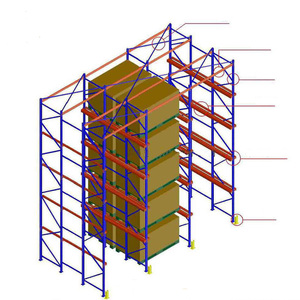
Engineered for homogeneous SKU density. Features cold-formed stiffened floor guide rails, wrap-around base column guards, and continuous support cantilever arms for intense forklift traffic.
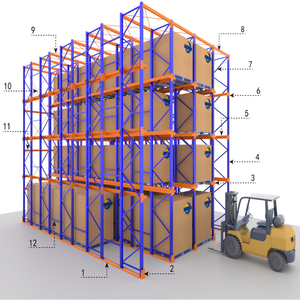
Dual-access entry profiles designed for FIFO pallet management. Offers 500-1500kg load rating per unit level with continuous structural top tie beams to preserve rigid bay verticality.
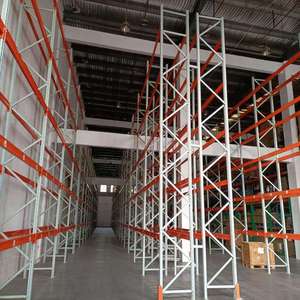
100% individual pallet selectivity. Precision slotted omega uprights coated in high-visibility safety orange box beams, protected against impact wear by epoxy powder coating.
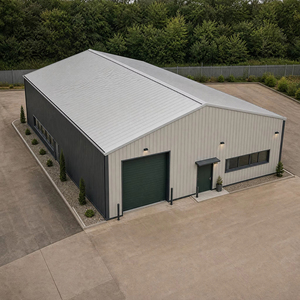
Integrated rack-supported building where the high bay steel uprights directly anchor exterior wall cladding and roof framing, optimizing civil building overheads.
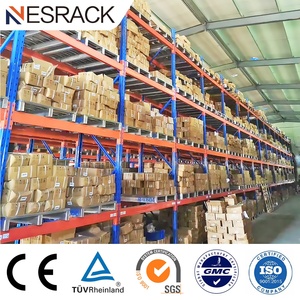
Modular industrial shelf design featuring rivet and keyhole interlocking joints. Enables swift shelf-height reconfigurations with zero loose fasteners, certified under CE directives.
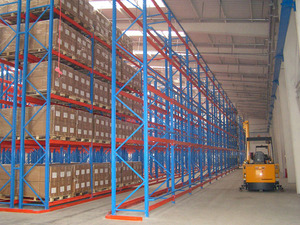
Multi-nested nested carriage tracks operating on inclined guide channels. Offers 2 to 5-deep dynamic storage using standard counterbalance lifts without driving directly into lanes.
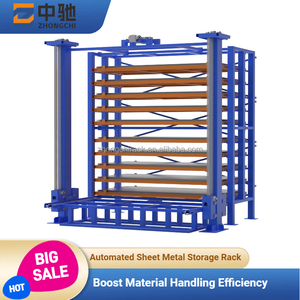
Ultra-dense horizontal cassette tower for raw sheet plate and heavy tooling dies. Features automated motorized crane lifters, load capacity ratings exceeding 3,000kg per tier.
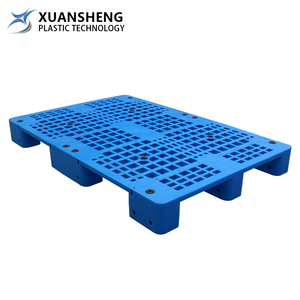
Engineered non-porous HDPE structural platform (1200x1000x140mm). Injection-moulded with anti-slip grommets for seamless interface with high bay automated stacker crane forks.
Why Global Logistics Planners Source HEDA High Bay Racking
Direct manufacturer execution eliminates multi-tier broker premiums while assuring traceable structural calculations.
Complimentary 3D & CAD Engineering Layouts
Before steel coil slitting begins, our structural engineering team delivers free comprehensive AutoCAD floorplans, 3D BIM-ready Navisworks/Revit structural models, and static load distribution analyses factoring in seismic coefficients and floor-slab soil mechanics.
Verified CE & ISO 9001:2015 Compliance
Every manufacturing lot conforms strictly to Factory Production Control standards under CE Certificate No. 2435-CPR-8605159, ISO 9001:2015 audited quality registers (Certificate No. 18624Q00169R0M), and independent RoHS testing on all powder-coat resins.
30,000 m² Integrated Manufacturing Hub
Housing 10 distinct in-line processing stages including automated roll-profilers, high-speed automated CNC punch presses, robotic dual-torch welding stations, and an environmentally monitored pickling and powder-coating tunnel.
Container-Optimized Bundling for Export
Export sea-freight packing protocols utilize customized steel strapping, heavy protective foam wraps, and position-coded component indexing. Pallets are nested precisely to maximize 40HQ maritime container cubic fill, saving thousands in ocean shipping charges.
Global Installation Supervision & Support
Our engineering division backs turn-key projects with isometric assembly blueprints, step-by-step video installation libraries, and bilingual on-site supervisory teams available for dispatch across international ports and free zones.
Seamless AS/RS High Bay Interfacing
We manufacture specialized guide rails, high-tolerance run-out beam sections, and optical sensor reflector brackets engineered to mate directly with top European, American, and Asian stacker crane brands and autonomous shuttle fleets.
Future Sourcing & Procurement Trends in Warehouse High Bay Racking
Actionable intelligence for supply chain directors preparing for 2026–2030 facility development.
AS/RS Stacker Crane & 4-Way Shuttle Symbiosis
Procurement teams are shifting away from standalone static wide-aisle racks toward modular automated storage. Buyers are increasingly sourcing cold-formed steel high bay structures engineered to support both traditional stacker cranes and four-way autonomous mini-load or pallet shuttles within the same structural skeleton.
Rack-Supported Building (RSB) Structures
Rather than erecting an independent concrete or portal-frame building and filling it with standalone racking, logistics developers are choosing Clad Racking Structures. The racking uprights serve double duty as the primary load-bearing columns for structural roofs and side sandwich-panel walls, dramatically cutting concrete foundations and project delivery lead times.
Hybrid Surface Finishes for Cold Chains & Tropics
Accelerating demand in pharmaceutical and frozen food cold storage (temperatures down to -30°C) is altering procurement specifications. Facility managers now specify hybrid coating configurations: hot-dip galvanized lower sections and base plates to prevent oxidation from aggressive floor washdowns, combined with zinc-rich powder-coated upper beams for optical contrast and beam deflection scanning.
The Technological Trajectory of High Bay Racking Manufacturing
Moving toward ultra-tall 35+ metre high bay envelopes has transformed manufacturing from manual workshop assembly into an automated data-controlled process. Modern structural profiles utilize ultra-high-strength steel grades capable of supporting localized dynamic loads while reducing overall deadweight on civil floor slabs.
Furthermore, digital twin modelling now guides the fabrication process. Component punchings are digitally mapped directly from CAD structural designs, ensuring that bolt hole alignment maintains millimeter-level fidelity along 30-metre uprights. Advanced robotics are utilized across all beam connector seams, creating smooth weld lines that avoid stress concentrations and resist sustained vibrational fatigue caused by continuous multi-shift automated stacker crane operations.
Frequently Asked Questions on High Bay Racking Export & Engineering
Direct technical answers addressing the critical factors of steel grade, seismic verification, and international logistics.
Transform Your Warehouse Cubic Potential
Contact our structural engineering team today to review your project blueprints, calculate dynamic steel loadings, and receive a complete CAD structural proposal.
Send an Inquiry