Q1 How are pallet travel speeds regulated in long live storage lanes?
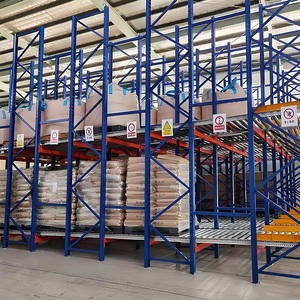
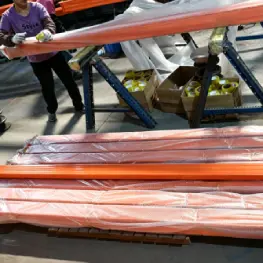
We integrate mechanical centrifugal speed controllers (brake rollers) placed intermittently along the gravity track bed—typically every 2 to 3 pallet positions. As a pallet accelerates down the 3.5% incline, the internal centrifugal flyweights engage the internal brake lining, holding rolling velocity to a safe crawl rate (0.2 - 0.3 m/s) regardless of pallet weight variance.
Q2 What pallet quality standards are required for reliable live flow gravity movement?
Live storage requires smooth bottom runners perpendicular to the roller axes. Defective bottom boards, missing stringers, or protruding nails can jam flow channels. For plastic pallets or mixed wooden formats with bottom defects, we specify heavy-duty full-width steel or twin-roller systems, or custom lower-channel slave boards.
Q3 Can live storage gravity flow racking withstand deep-freeze cold storage (-30°C)?
Yes. In low-temperature cold store facilities, we select Q355-grade steel to avoid low-temperature steel embrittlement, utilize low-temperature synthetic lubricants inside the roller sealed bearings, and apply high-micron hot-dip galvanization or specialized multi-coat epoxy systems to prevent moisture condensation rust.
Q4 How does our engineering team manage seismic forces in active seismic belts?
Our engineering department executes finite element structural modeling based on the client site's specific seismic spectral acceleration factors (Ss, S1). We incorporate thickened cold-formed base plates, dual mechanical/chemical wedge anchors, heavy back-to-back cross bracing, and reinforced upright profiles to handle high horizontal ground motion.
Q5 What primary operational information is required to receive a comprehensive 3D layout and proposal?
We require: 1) Warehouse architectural CAD drawing showing clear height, building columns, floor flatness (e.g., DIN 18202 or FM2), and fire sprinkler clearances; 2) Pallet dimensions (W x D x H), total gross weight, and bottom runner layout; 3) Forklift model, mast height, and turning radii; 4) Daily throughput rates (pallets/hour).
Q6 How do you prevent line pressure damage when unloading full pallet queues?
Every discharge lane is equipped with a mechanical separation stop mechanism (separator). When the first pallet reaches the exit stop, the separator raises a secondary stop behind it, holding the remaining queue 100mm back. Once the lead pallet is removed by the forklift, the separator automatically resets, smoothly releasing the next pallet forward.
 Manual Picking