Featured Shuttle & High-Density Storage Solutions
Discover our factory-direct radio shuttle carts, heavy-duty racking channels, and integrated AS/RS matrix systems tailored for dynamic supply chain demands.
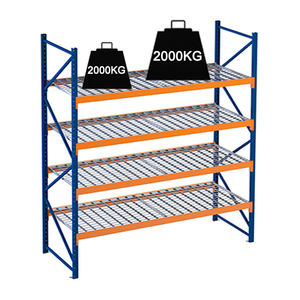
Stackable Warehouse Pallet Storage Systems
Heavy-duty load capacity (1000KG - 3000KG) offering structural versatility, maximum vertical clearance, and complete stability.
Explore Specs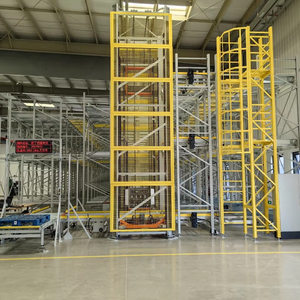
Intelligent Pallet Rack Conveying System
Precision-guided integration with dynamic conveying systems designed for automated order sorting and smart library buffering.
Explore Specs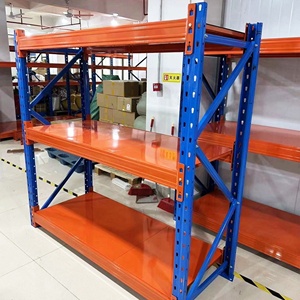
Heavy Duty 5-Layer Industrial Pallet Rack
Boltless, 2000kg-per-beam adjustable selective framework constructed from high-tensile steel for multi-SKU FMCG operations.
Explore Specs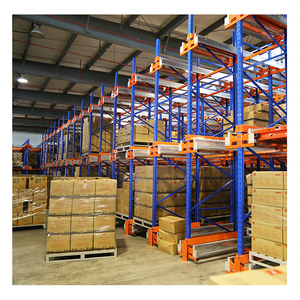
OEM/ODM Heavy-Duty Pallet Shuttle Racking
Custom-engineered rails and shuttle carrier systems tailored to handle specialized oversized pallets, drums, and heavy industrial bins.
Explore Specs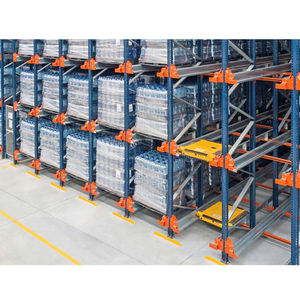
4-Way Pallet Shuttle AS/RS System
Next-generation multi-directional shuttle bots that transition laterally and longitudinally, maximizing density without manual aisle entry.
Explore Specs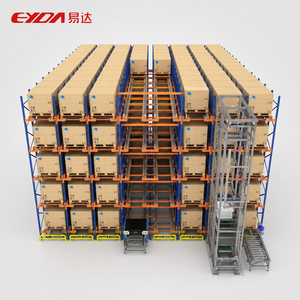
Anti-Rust Industrial Radio Shuttle System
Specialized phosphating and electrostatic powder coating built specifically for high humidity, marine climates, and cold storage freezers.
Explore Specs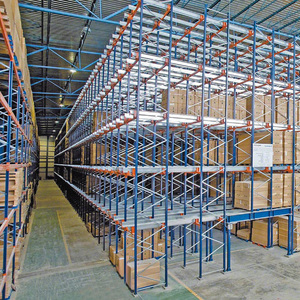
High-Density E-Commerce Shuttle Racking
Multi-tier stable rack structure with intelligent lane depth optimization, engineered for rapid FIFO dispatch during seasonal sales spikes.
Explore Specs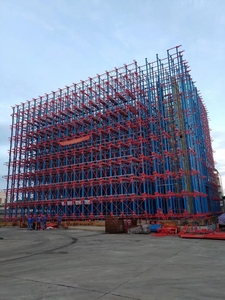
Deep-Lane Storage Optimization Shuttle Rack
Maximizes volumetric storage efficiency up to 85% by eliminating lift truck aisles, driving immediate reductions in operational overhead.
Explore SpecsComprehensive Engineering Guide: The Industrial Shift to Pallet Shuttle Racking
Modern supply chain engineering faces a dual constraint: escalating square-meter land valuation and surging labor overhead. Traditional storage frameworks—such as standard selective racking, drive-in systems, and static gravity flow—often force logistical directors to choose between volumetric density and pallet accessibility throughput. OEM/ODM Pallet Shuttle Racking addresses this systemic tradeoff by serving as a semi-automated, high-density matrix that eliminates internal forklift traffic within storage lanes.
Comparative Structural Analysis: Shuttle Racking vs. Legacy Systems
Understanding operational metrics is paramount when specifying warehouse architecture. Below is an engineering benchmark contrasting key technical variables across conventional and semi-automated high-density installations:
| Evaluation Parameter | Pallet Shuttle Racking | Drive-In Racking | Selective Pallet Racking |
|---|---|---|---|
| Volumetric Space Utilization | 80% – 88% (Deep-lane density) | 65% – 75% (Aisle-less) | 40% – 50% (Wide forklift aisles) |
| Stock Rotation Flexibility | Dual Hybrid (FIFO & LIFO configurable) | Strictly LIFO (High SKU selectivity risk) | 100% Direct Access (FIFO) |
| Structural Impact & Collision Risk | Zero Internal Mast Impact (Shuttle driven) | High Mast/Upright Collision Frequency | Moderate Bay Collision Risk |
| Operating Speeds (Meters/Min) | 40 – 60 m/min (Under full 1500kg payload) | 8 – 12 m/min (Careful driver navigation) | 15 – 25 m/min (Forklift transfer) |
| Cold Storage Thermal Efficiency | Optimal (Reduces cold air dissipation) | Moderate | Poor (High cubic volume cooling waste) |
Subsystem Mechanical Architecture & Cold-Chain Resilience
Our OEM/ODM manufacturing protocols prioritize alloy metallurgy and mechanical endurance. Uprights are precision roll-formed from premium certified steel coils (Q235B/Q355B equivalent to ASTM A36 / S355JR). The proprietary shuttle guide rail functions not merely as a vehicular track, but as an integral structural tie connecting load-bearing upright frames. In refrigerated logistics (-25°C to -30°C), conventional electronics encounter severe battery capacity degradation and condensed moisture short-circuiting. We engineer shuttle units equipped with Lithium Iron Phosphate (LiFePO4) thermal-core battery packs, integrated heating jackets, and optical sensors sealed against condensing dew points, ensuring continuous 8-to-10-hour duty cycles without thermal loss.
Future Trends in Shuttle Automation & Material Handling
Evaluate the macroeconomic, technological, and architectural shifts redefining high-density automated material handling across global enterprise warehouses.
Evolution to 4-Way AS/RS Swarms
Procurement is actively shifting from 2-way semi-automated shuttles to 4-way autonomous fleets. Utilizing vertical elevators and algorithmic WCS fleet balancing, 4-way shuttles operate across multi-level structural grids, dramatically reducing total material handling bottlenecks.
Ultra-Capacitor Fast Charging
Future automated warehousing mandates non-stop 24/7 uptime. Modern procurement criteria specify supercapacitor and rapid-charge lithium technologies, allowing shuttles to regenerate full operational power in 10-15 minute staging intervals directly within the rack.
Cold Chain & Energy Density Prioritization
With industrial energy tariffs climbing globally, cold store operators demand maximum pallet counts per cubic meter. Shuttle racking shrinks facility footprints by up to 45%, reducing the cubic space requiring continuous refrigeration and cutting compressor power drain.
Predictive IoT & Structural Vibration Telemetry
Smart shuttle carts increasingly integrate acceleration and vibration sensors. As shuttles travel the rails, real-time telemetry scans for rail deflection, loose anchor points, or uneven pallet seating, shifting rack maintenance from reactive repairs to predictive prevention.
Seismic & Geo-Specific Structural Engineering
International buyers require customized engineering compliant with localized seismic zones (e.g., Eurocode 3/8, RMI/ANSI MH16.1). Advanced modeling analyzes soil shear, ground acceleration, and dynamic water-tank effects in liquid container warehousing.
Manufacturing Rigor, Proven Global Capability
Direct from our 30,000 m² state-of-the-art manufacturing facility in Guangzhou, China, delivering audited structural safety and bespoke OEM/ODM design.
In-House Tooling & 10-Stage Production
From precision coil slitting and automated column hole punching to cold-bending profile roll forming, polishing, welding, pickling, and phosphating, our integrated line guarantees micron-level structural accuracy for shuttle travel.
Verified International Certifications
Our structures and production management maintain verifiable CE Certificate No. 2435-CPR-8605159, ISO 9001:2015 Certification No. 18624Q00169R0M (valid through 2027), and full RoHS compliance documentation.
Free Structural CAD & 3D Layout Modeling
Before entering manufacturing, our seasoned structural engineers provide comprehensive CAD layouts, 3D renderings, and finite element analysis (FEA) load calculations compatible with your local construction permits.
Container-Optimized Ocean Logistics
Exporting to over 120 countries, every bundle is packed, labeled, and balanced to optimize standard 40ft High Cube containers, minimizing freight costs and expediting customs processing at destination ports.
Complete OEM/ODM Project Planning
Whether you require private-label equipment for regional system integrators or custom profile dimensions to accommodate non-standard pallets, our engineering team manages complete customization from sketch to commissioning.
Frequently Asked Questions on Pallet Shuttle Procurement
Clear, technical, and commercial answers to common engineering questions faced by procurement managers and warehouse directors.
1. What parameters are essential for generating an accurate shuttle rack quote and CAD design?
To produce an engineered proposal, our team requires: exact clear warehouse height, building column spacing, floor slab thickness and compressive strength, pallet specifications (width, depth, overall height including cargo overhang, maximum weight), forklift mast reach specifications, SKU volume count, and daily throughput expectations.
2. How does the pallet shuttle switch between First-In, First-Out (FIFO) and First-In, Last-Out (LIFO)?
The switching mechanism is determined by the physical rack configuration and internal shuttle software settings. In LIFO setups, pallets are loaded and retrieved from the same frontal face. In FIFO layouts, an unloading aisle is engineered at the rear. The shuttle operator simply changes operating modes via the wireless industrial tablet.
3. Can our existing forklifts integrate with a new pallet shuttle racking system?
Yes. The pallet shuttle system does not require specialized VNA (Very Narrow Aisle) reach trucks. Standard counterbalance forklifts or reach trucks can lift the shuttle cart and deposit it into the guide rails of any desired lane, provided the forklift mast meets the top beam elevation requirements.
4. How is structural and electrical maintenance handled after overseas shipment?
We supply modular replacement components, detailed structural assembly diagrams, step-by-step video manuals, and real-time remote diagnostics. For key installations, our certified structural supervisors can be deployed on-site to oversee assembly, sensor alignment, and operator safety training.
5. What surface treatments prevent corrosion in high-humidity or cold-storage environments?
Standard components undergo an automated ten-stage process including pickling, phosphating, and electrostatic powder coating. For cold rooms with high condensation risk, coastal installations, or chemical facilities, we provide hot-dip galvanized uprights, rails, and baseplates for decades of rust-free operation.
6. What are the typical manufacturing and sea freight delivery schedules?
Standard manufacturing lead time ranges from 20 to 35 days depending on project tonnage (up to 30,000 tons monthly factory output). Ocean freight schedules are determined by the destination port (e.g., Central America, Europe, Southeast Asia, Middle East), and full CIF/FOB terms are supported.
Transform Your Warehouse Density Today
Consult with our senior logistics engineers to calculate your exact storage capacity gains, obtain a free 3D CAD facility layout, and review comprehensive technical specifications.
Get Catalog