Heavy-Duty & Custom Pallet Racking Portfolios
Explore our custom OEM high-capacity storage configurations manufactured using high-yield structural steel. Designed to optimize dynamic throughput, vertical cubic space, and high seismic stability across international 3PL, FMCG, and heavy manufacturing sites.
Direct Manufacturer Capabilities & Global Footprint
Guangzhou Heda Shelves Co., Ltd. delivers direct factory engineering, ISO-audited metallurgy, and heavy-gauge structural manufacturing for global exporters, project EPC contractors, and multinational supply hubs.
Metallurgical Specifications & Structural Safety Criteria
Procuring large industrial pallet racking requires deep technical scrutiny of steel grades, connection moments, deflections, and seismic absorption. Below are the verified metrics that distinguish heavy-duty engineered racking from standard commercial shelving.
Certified High-Tensile Steel
We source prime cold-rolled coils (Q235B and high-yield Q355B equivalent to ASTM A36 / SS400 and S355JR). This ensures optimal tensile elongation and prevents brittle failure under seismic harmonic loading.
- Tensile Strength: 370–500 MPa (Q235B) / 470–630 MPa (Q355B)
- Yield Point: Minimum 235 MPa to 355 MPa certified
- Full traceability with Mill Test Certificates (MTC)
Upright Roll-Forming Precision
Our continuous automated cold-roll lines yield precise Omega and multi-flange profiles with up to 12 bending folds. This maximizes torsional rigidity and slenderness ratios ($kL/r$) without deadweight steel penalties.
- Upright profiles from 80mm to 140mm width
- Material thickness gauges: 1.5mm, 1.8mm, 2.0mm, 2.5mm, 3.0mm
- Precision punch tooling with 50mm or 75mm beam adjustment
10-Stage Surface Protection
Corrosion-induced cross-section loss is the leading cause of racking collapse in humid and maritime environments. Components undergo automated immersion degreasing, ultrasonic rust removal, and zinc phosphating prior to electrostatic powder deposition.
- Thermoset epoxy-polyester powder: 60–90 µm thickness
- Adhesion standard: ISO 2409 Class 0 cross-hatch test
- Hot-dip galvanizing per EN ISO 1461 for cold storage
| System Type | Structural Load Rating | Space Utilization Ratio | Access Selectivity | Primary Industrial Use Case |
|---|---|---|---|---|
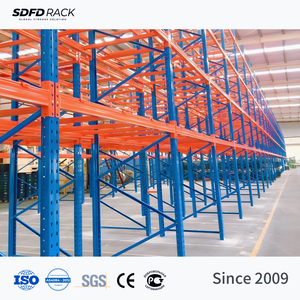
| Heavy Selective Pallet Racking | 1,000 – 4,500 kg per beam level | 40% - 50% Pure Footprint | 100% Direct Immediate Access | General Distribution, FMCG, 3PL Central Hubs |
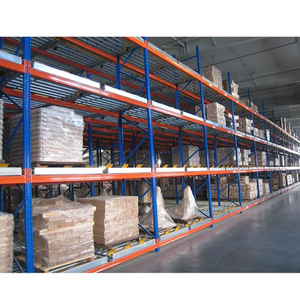
| Drive-In / Drive-Through System | 800 – 1,500 kg per pallet position | 75% - 85% High-Density | LIFO or FIFO by Block Channel | Beverage, Homogeneous Sacks, Cold Storage |
| Radio Shuttle Automation Racking | 500 – 2,000 kg per automated runner | 80% - 90% Ultra-Dense | Automated Batch FIFO/LIFO | Pharma, Blast Freezers, High-Throughput Hubs |
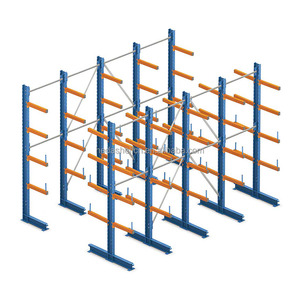
| Heavy Duty Cantilever Racks | Up to 1,800 kg per continuous arm | Flexible Linear | Unobstructed Frontal Loading | Lumber, Steel Pipes, Extrusions, Rebar Bundles |
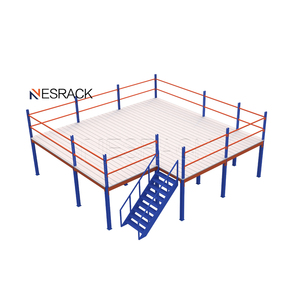
| Multi-Tier Mezzanine Storage | 300 – 1,200 kg/m² Uniform Load | 200% - 300% Vertical Gain | Floor-By-Floor Selective Access | E-commerce Piece Picking, Auto Spare Parts, Archives |
Structural Deflection Compliance Under Global Norms (RMI & EN 15512)
Under maximum rated static working load ($UDL$), beam vertical deflection must not exceed $L/200$ according to RMI MH16.1 (USA) and FEM 10.2.02 / EN 15512 (European Standards). For high-bay Automated Storage and Retrieval Systems (ASRS), HEDA Shelves engineers structural beam calculations to an ultra-strict $L/300$ or $L/400$ threshold to eliminate dynamic mast sway and automated shuttle engagement jams.
Future Procurement Trends for Industrial Pallet Racking (2026–2035)
Global supply chain directors and facility engineers are steering away from low-cost, off-the-shelf static shelving. Strategic capital expenditure now focuses on four key technological vectors.
1. Hybrid AMR & Pallet Rack Co-Engineering
Warehouses are progressively deploying Autonomous Mobile Robots (AMRs) alongside conventional reach trucks. Modern racking specifications now mandate laser-cut guide paths, enlarged column base-plate clearances, and ground-level tunnel passages designed specifically for autonomous underside traversal.
2. Total Cost of Ownership (TCO) vs. Raw Steel Weight
Procurement teams are evaluating total lifecycle resilience over initial purchase price. Factoring in anti-corrosive galvanized components, replaceable column base sacrificial boots, and dynamic impact deflector systems lowers long-term replacement Capex and insurance premiums by up to 34%.
3. Digital Twin & 3D BIM Structural Modeling
Global EPC contracts now require IFC and Revit-compatible BIM models before container dispatch. Integrated static Finite Element Analysis (FEA) ensures seismic anchoring, slab deflection interaction, and overhead fire suppression clearance are simulated prior to steel fabrication.
Technological Innovations in Heavy-Duty Rack Manufacturing
How modern structural fabrication, automated forming lines, and intelligent material distribution are redefining intralogistics efficiency.
High-Bay Clad-Rack Systems
The rack structure forms the primary building framework, supporting the external wall cladding and roof panels. This eliminates the requirement for standard industrial building columns, reducing structural steel capital expenditure by 18-25% while maximizing cubic height up to 40 meters.
Nonlinear Dynamic Seismic Engineering
Through customized ductile base-plate connections, semi-rigid beam-column joints, and dynamic vertical bracing, racking frames absorb and dissipate lateral ground acceleration forces without progressive structural collapse, exceeding seismic zone 4 design spectrum parameters.
Micro-Alloyed High-Yield Forming
Advanced hot-rolled micro-alloyed strip steels with niobium and vanadium additives allow thinner gauge uprights to achieve higher torsional rigidity. This reduces containerized shipping weights while preserving full structural load capacity.
Frequently Asked Questions by Industrial Importers & EPCs
Direct technical answers addressing structural calculation, container stuffing efficiency, local building codes, and OEM manufacturing customization.
We employ nonlinear response history analysis and modal response spectrum calculations in accordance with RMI MH16.1, EN 15512, and local seismic coefficient requirements ($S_s$, $S_1$). We configure widened baseplates, reinforced anchor embedment depths, heavy-gauge C-profile bracing, and ductile bolted moment connections to prevent progressive structural failure under high horizontal ground accelerations.
For standard selective systems up to 8 meters, a reinforced concrete slab with minimum 200mm thickness and compressive strength of C25/30 (3,000–4,000 PSI) is recommended. For Narrow Aisle (VNA) or high-bay installations exceeding 10 meters, floor flatness must strictly adhere to DIN 18202 Table 3 Line 4 or TR34 (DM2/FM2 classifications) to prevent mast oscillation and catastrophic racking collisions.
Heavy upright frames and beams are bundled using custom structural steel chocks, heavy polyester strapping, and corrugated edge protectors. Upright frames are nested head-to-toe to balance weight and volume, allowing standard 40-foot High Cube (40'HQ) containers to consistently pack between 22 and 26 tons of steel without damaging painted surfaces or wasting shipping volume.
Yes. In addition to our standard 50mm and 75mm European and American pitch profiles, our CNC tooling centers can fabricate proprietary hole patterns, teardrop configurations, and custom claw connectors for global distributors requiring backward compatibility with existing legacy rack systems.
Every production run includes steel mill raw material certificates, 10-stage salt spray corrosion test reports (ASTM B117), dry film thickness (DFT) verification, beam connection shear and bending test reports, and our CE Certification (No. 2435-CPR-8605159) along with ISO 9001:2015 quality compliance documentation.
Our 30,000 m² Guangzhou production facility operates continuous automated roll-forming and dual powder-coating lines. Standard lead time for complex multi-container orders (500–1,500 metric tons) is 20 to 30 calendar days from engineering drawing sign-off and approval.
Accelerate Your Warehouse Capacity With Direct Engineering
Connect with our structural engineers today. Receive comprehensive CAD layout design, detailed structural static calculations, and transparent itemized factory-direct quotations tailored to your site coordinates and operational throughput requirements.