Engineered Product Portfolio
Export-Grade High Bay Racking Systems
Structural solutions engineered for automated logistics hubs, regional distribution centers, and extreme-load warehousing.
2001
Established Year
30,000 m²
Manufacturing Facility
30,000 t
Monthly Output Capacity
120+
Countries Exported
Strategic Procurement Insight
Engineering Standards & Future Procurement Dynamics for High Bay Racks
A comprehensive technical evaluation for EPC contractors, logistics engineers, and international procurement managers sourcing from OEM factories.
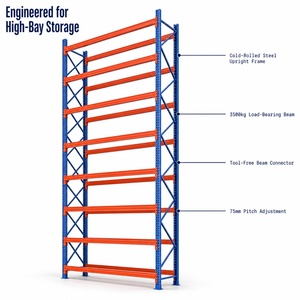
Modern automated high-bay warehouses have fundamentally evolved from static structural frames into high-precision, load-bearing mechanical infrastructures. With ceiling clearances regularly exceeding 12 meters to upwards of 40 meters, high-bay racking systems function as the literal skeletal backbone of modern intralogistics. Selecting an OEM partner and global exporter demands an exhaustive evaluation of cold-formed steel engineering tolerances, dynamic stress analysis, deflection thresholds under full payload, and cross-border container packing optimization.
Structural Steel Metallurgy & Cold-Roll Forming
High-bay integrity depends entirely on grade integrity. Utilizing certified Q235B and high-strength Q355B structural steel, upright profiles are shaped using computer-controlled 24-station continuous roll-forming lines. This ensures consistent yield strength, minimal residual inner stress, and absolute straightness over vertical runs surpassing 30 meters.
Precision Tolerances for AS/RS & VNA Turrets
Unlike standard static racking, high-bay racks interacting with Automated Storage and Retrieval Systems (AS/RS) or Very Narrow Aisle (VNA) automated cranes require microscopic tolerances. Beams, guide rails, and vertical plumb lines must conform to FEM 9.831 and EN 15620 Class 100/200 deflection standards to eliminate crane collision hazards.
Seismic-Zone Engineering & Finite Element Analysis
High-bay installations act as massive vertical pendulums during seismic events. Our structural engineering department incorporates FEA (Finite Element Analysis) simulation to calculate node stiffness, base-plate shear forces, and cross-bracing damping ratios tailored to local building codes throughout Europe, the Americas, and the Pacific Rim.
Future Procurement & Technological Trends in High Bay Racking (2025–2030)
Procurement teams navigating multi-million-dollar supply chain transformations are encountering radical structural shifts in racking procurement. Sourcing contracts are no longer simple spot-purchases of tonnage; they are multi-year capital commitments characterized by five dominant trends:
Clad-Rack Building Integration
Procurement is trending strongly toward "rack-supported buildings" (clad-racks). Instead of building a civil warehouse and filling it with racks, the rack framework itself carries the external wall paneling and roof trusses, eliminating steel building columns, slashing construction schedules by 30%, and reducing total capital footprint.
Smart Racking & Digital Twin Ready
Future high-bay systems integrate embedded strain-gauge sensors and RFID track nodes during OEM production. This allows operators to run digital twin diagnostics, real-time beam overload warnings, and automated structural deformation alerts directly connected to warehouse WMS/WCS platforms.
Decarbonized Steel & Durable Coatings
Tier-1 multinational importers now track Scope 3 manufacturing emissions. Procurement shifts toward OEM producers utilizing green electric-arc furnace (EAF) steel and TGIC-free thermosetting electrostatic powders. Coating lines must meet 500-hour salt spray resistance without toxic heavy metals for cold-chain food reliability.
Factory Traceability
Ten-Stage Advanced Production Lifecycle
Every structural column and boxed beam is manufactured inside our 30,000 m² Guangzhou production facility under strict ISO 9001:2015 protocol.
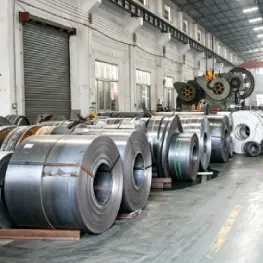
Raw Material Coils
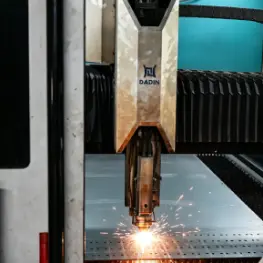
Precision Slitting
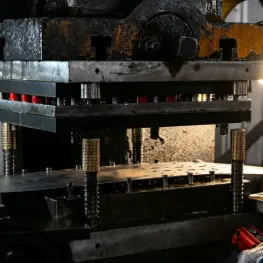
CNC Column Punching
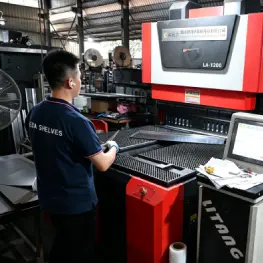
Cold Roll Forming
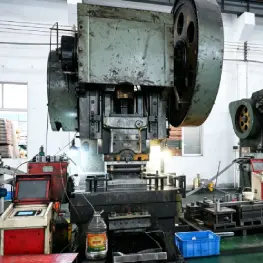
Profile Sizing
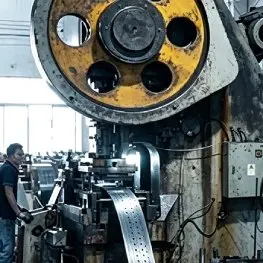
Surface Polishing
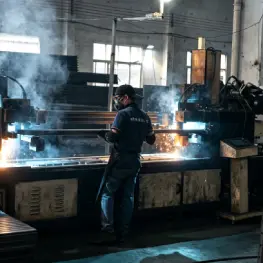
Robotic Welding
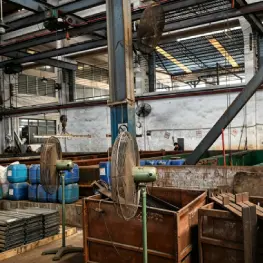
Pickle & Phosphating
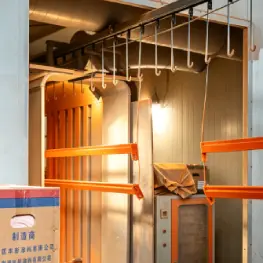
Powder Coating
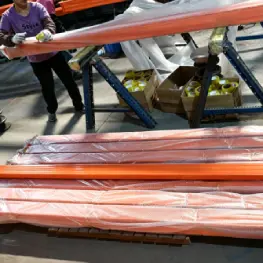
QC & Export Bundling
Guangzhou HEDA Shelves: Enterprise Strengths & Export Infrastructure
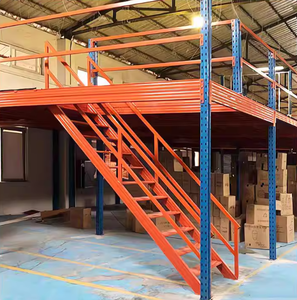
Founded in 2001, Guangzhou Heda Shelves Co., Ltd. has developed into a premier Chinese OEM & ODM manufacturer of heavy-duty warehouse storage systems. Operating from our modernized production center in Guangzhou with over 300 experienced technical personnel, we specialize in high-bay, mezzanine, and automated pallet systems engineered to global international standards.
Verified International Compliance
Our structural designs are verified by independently testable accreditations including CE Certification (Certificate No. 2435-CPR-8605159), ISO 9001:2015 Quality Management System (Certificate No. 18624Q00169R0M, valid through June 2027), and RoHS chemical safety standards.
Complimentary 3D & CAD Layout Design
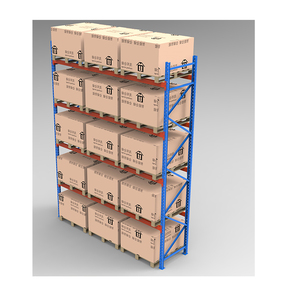
Our experienced application engineers generate full warehouse CAD layouts, 3D renderings, and precise load calculation models before production. This transparent blueprint package allows overseas client engineering teams to review floor slab loading, column spacing, and aisle clearances prior to capital allocation.
Containerized Export Logistics Execution
With monthly shipments exceeding thousands of metric tons via major maritime shipping channels, our bundling team executes barcoded, compartmentalized loading strategies. Structural components arrive with detailed component schedules, facilitating swift customs clearance and structured job-site sorting across 120+ export territories.
Procurement Q&A
Frequently Asked Questions: High Bay Racking OEM
Critical engineering and operational answers for procurement directors and structural engineers.
What vertical height limitations apply to OEM high bay racking, and how are splices engineered?
High bay racking can be engineered up to 30 meters for VNA forklift configurations and over 40 meters for automated AS/RS stacker crane installations. Because standard ocean freight shipping containers (40ft HQ) accommodate maximum component lengths of 11.8 meters, upright columns exceeding this length are fabricated with structural splice assemblies. Splices utilize precision-machined heavy gauge internal and external sleeves with high-tensile Grade 8.8 or 10.9 structural bolting, verified by FEA to retain equal or greater moment resistance than an unspliced section.
How does HEDA calculate floor slab point-load distribution under extreme high bay vertical loads?
Every high bay design calculates both dead loads (steel structure) and dynamic live loads (pallets, wind shear for clad buildings, crane braking forces, and seismic acceleration). We compute maximum vertical force ($N_{max}$) acting through the upright bases. To protect industrial concrete slabs against punch failure and excessive deflection, we size heavy-duty baseplates (often 12mm to 20mm thickness or larger) with expanded surface contact areas and specify high-strength mechanical or chemical anchor bolts tailored to concrete compressive strength ($f'c$).
What surface treatment is optimal for high bay installations in high-humidity or sub-zero environments?
For controlled indoor ambient conditions, our standard 10-stage preparation process includes industrial degreasing, acid pickling, zinc phosphating, and electrostatic epoxy-polyester powder baking (60–80 microns), providing robust abrasion resistance. For high-humidity coastal zones or deep-freeze cold storage warehouses operating down to -30°C, we supply either continuous pre-galvanized coils (Z275 coating) or full post-fabrication Hot-Dip Galvanizing (HDG) conforming to ISO 1461, ensuring complete protection against rust, condensation, and corrosion.
What design data must the buyer provide to initiate custom OEM layout engineering?
To generate verified CAD engineering schematics and structural proposals, our team requires: (1) Architectural building layout showing clear ceiling height, column matrix, and service obstruction locations; (2) Pallet specifications including width, depth, height, and maximum gross weight including pallet; (3) Material handling equipment (MHE) models or stacker crane specifications, including turning radius and minimum clear aisle widths; (4) Local seismic acceleration parameters (Ss, S1) or applicable local building code; and (5) Operational throughput expectations (FIFO or LIFO).