Featured Industrial Heavy-Duty Storage & Handling Systems
Direct factory production lines for cold-formed certified steel racking, push-back mechanisms, automated shuttles, and powered material stackers built for global compliance.
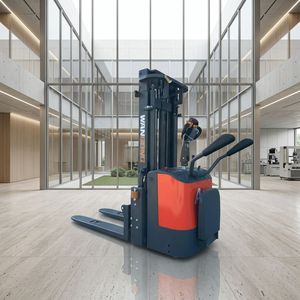
All-Terrain Full Electric Pallet Stacker 1.5T / 2T Lift (4m-5m)
Heavy-duty hydraulic stand-drive stacker with reinforced rough-terrain chassis, optimized for unpaved loading yards and outdoor cross-docking integration.
- 1500kg - 2000kg Rating
- 4000mm - 5000mm Mast
- Rough Terrain Pneumatic
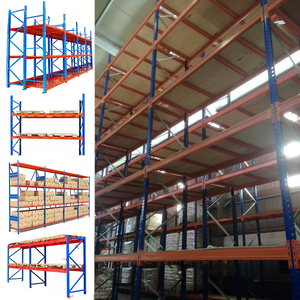
Adjustable Customized Gravity Flow Heavy Duty Racking System
Gravity-driven inclined roller tracks for automated FIFO dispatching. High structural cold-rolled channel uprights designed for rapid turnover FMCG and pharmaceutical warehouses.
- Strict FIFO Rotation
- Braked Roller Beds
- Custom Bay Spans
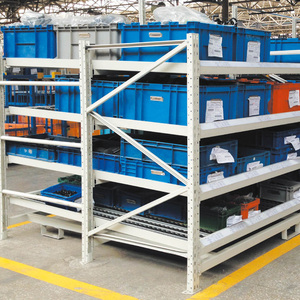
Powder-Coated High Density Carton & Pallet Gravity Flow Rack
Multi-tier heavy live storage racks with durable anti-scratch powder coating, drop-in separators, and entry guide-rails for continuous buffer storage.
- Up to 2500kg / Bay
- Pickling & Phosphated
- Zero Energy Rolling
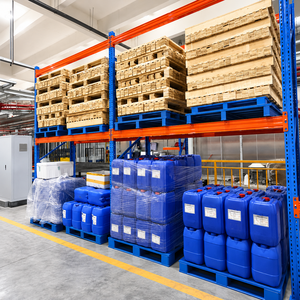
Industrial Heavy Duty Boltless Adjustable 5-Tier Pallet Racks
The benchmark for selective warehouse palletization. Features tear-drop or diamond punched upright profiles, 75mm/50mm pitch adjustability, and interlocking structural safety clips.
- 1000kg - 4500kg / Beam Tier
- Q235B / Q355B Steel
- 100% Direct Pallet Access
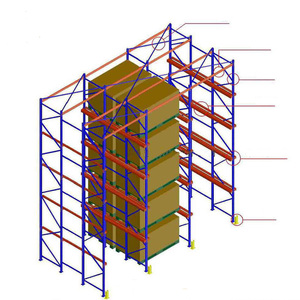
Impact-Resistant Drive-In Racking System for Homogeneous SKUs
Deep-lane continuous storage channels eliminating picking aisles. Fabricated with floor-mounted structural guide angles and column guards for safe forklift entry.
- LIFO Inventory Management
- 85% Floor Space Utilization
- Cold Room & Freeze Safe
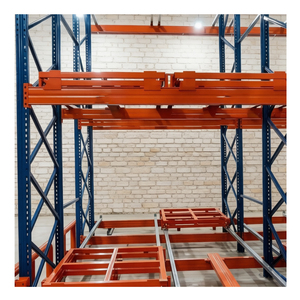
High-Density Dynamic Push-Back Pallet Cart Racking Systems
Telescopic rolling nested carts resting on inclined steel channels. Pallets are pushed rearward sequentially, combining high-density multi-lane storage with single-aisle access.
- 2 to 6 Pallets Deep
- Single Operating Aisle
- Gravity Roll Assist
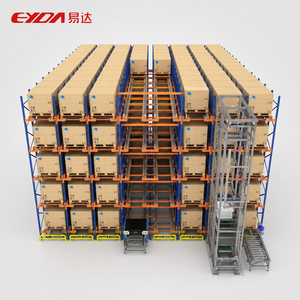
Industrial Anti-Rust Radio Shuttle High Space-Saving Pallet Rack
Intelligent semi-automated robotic shuttle cars running on specialized galvanised rails. Operators control movements via wireless remotes without entering storage lanes.
- FIFO / LIFO Programmable
- Ultra-Low Temperature (-25°C)
- LiFePO4 Power System
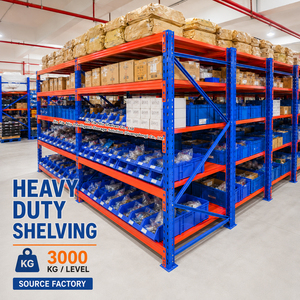
3000KG Custom Solid Steel Deck Racking for Hardware & Bins
Solid ribbed steel decks engineered for irregular cargo, parts totes, steel containers, and split-case picking. High point-load resistance across wide beam clearances.
- 3000kg Shelf Capacity
- Galvanized / Painted Deck
- Integrated Divisible Bays
Technical White Paper: Structural Mechanics & Steel Metallurgy in Heavy-Duty Racking
Industrial pallet racking is fundamentally an unbraced or semi-braced civil steel structure subjected to severe static loads, intermittent dynamic impact from material handling equipment (MHE), and lateral environmental forces such as seismic accelerations. For logistics directors, supply chain VPs, and civil structural engineers, choosing an OEM racking exporter is not merely a purchasing exercise—it is a critical safety and risk mitigation decision governed by rigorous international standards, including EN 15512 (European Racking Standard), RMI ANSI MH16.1 (Specification for the Design, Testing and Utilization of Industrial Steel Storage Racks), and AS 4084 (Steel Storage Racking Australia).
At Guangzhou Heda Shelves Co., Ltd., structural reliability starts at the molecular composition of the steel coil. We utilize premium hot-rolled and cold-rolled continuous carbon structural steel alloys, primarily Q235B (yielding up to 235 MPa with controlled phosphorus and sulfur impurities for excellent ductility) and Q355B / SS400 / ASTM A572 Grade 50 (yielding up to 355 MPa for high-bay upright frames exceeding 12 meters in vertical rise). By cold roll-forming profiles through multi-stage progressive tooling, our production lines introduce precise work-hardening along the section radii, increasing local moment-bearing yield without brittle cleavage fracture.
Under maximum rated pallet payload capacity, transverse horizontal rack beams must not exceed a vertical deflection ratio of L/200 according to US RMI specifications, or L/250 under stricter European EN norms. HEDA beams are precision cold-welded with interlocking box sections (dual C-profiles) to ensure torsional stability and prevent rotational racking roll-over under asymmetrical eccentric live loads.
Furthermore, upright columns are profiled with multiple compound bends (typically 8 to 14 facet cold bends). This profile geometry enhances the radius of gyration, elevating the column's Euler critical buckling limit ($P_{cr}$) without inflating dead-weight steel tonnage. The punched tear-drop, omega, or hexagonal diamond aperture slots maintain high shear edge-distances, resisting tearing forces when high-impact beam end connectors lock under seismic shaking.
Future Procurement Trends in Industrial Storage (2026–2030)
Global logistics operations are undergoing structural modernization, pivoting toward automated spatial efficiency, lifecycle carbon accounting, and resilience against supply shocks. International procurement directors are re-evaluating traditional low-density static shelving in favor of modular, adaptable, and automation-ready heavy-duty systems. Five macro procurement trends now define modern racking tenders:
1. Vertical Space Maximization (High-Bay & VNA Architectures): Industrial real estate lease costs have surged worldwide, particularly across North American, European, and Latin American transportation hubs. Buyers are elevating warehouse clearances from historical 6-meter thresholds to 12m–18m high-bay configurations. This shift mandates High-Precision Very Narrow Aisle (VNA) racking systems featuring cold-rolled floor guide rails or inductive wire guidance that interface with articulated reach trucks with sub-millimeter horizontal tolerances.
2. Rapid Growth of Pallet Shuttle Automation: High-density radio shuttle carts, capable of deep-lane buffering inside drive-in-style frameworks, represent the fastest-growing OEM category. Shuttles eliminate internal forklift transit lanes, dramatically decreasing chassis collision damage, reducing workplace injuries, and minimizing carbon footprint through automated battery energy cycling.
3. Cold Chain Logistics Expansion: Temperature-controlled distribution centres for pharmaceuticals, frozen seafood, and dairy are expanding rapidly across emerging economies. Warehousing frozen stock at -20°C to -30°C requires immense kilowatt-hour inputs. High-density semi-automated push-back, gravity flow, and shuttle systems condense thermal footprints, saving up to 40% in refrigeration energy while demanding heavy-duty hot-dip galvanized (HDG) or specialized low-temperature polyurethane powder coatings that resist sub-zero embrittlement and thermal peeling.
4. Total Cost of Ownership (TCO) Over Nominal Price: Sophisticated procurement teams evaluate the total cost of ownership rather than initial FOB container pricing. TCO includes freight packing density (calculating nested upright nesting within 40HQ maritime containers), structural lifespan under cyclic pallet loading, corrosion-resistance against coastal saline air, and interchangeability of modular beam levels without hot-work site cutting or structural welding.
Technological Evolutions Shaping Warehouse Racking Design
Modern racking has migrated from simple passive steel fabrication into digitally engineered, integrated mechatronic infrastructure. State-of-the-art roll-forming systems at Guangzhou Heda Shelves incorporate automated continuous hole-punching dies controlled by high-speed servo actuators, achieving dimensional punch pitch tolerances within ±0.1mm across continuous 12-meter upright upright spans. This mechanical precision is critical for the seamless vertical alignment of automated storage and retrieval systems (ASRS).
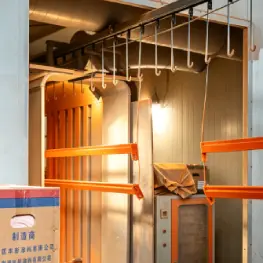
Moreover, surface finishing technology has advanced from standard liquid spray painting to a multi-stage closed-circuit chemical pre-treatment and electrostatic dry polymer deposition system. Steel components undergo acid pickling to remove mill scale, zinc phosphating to create an anti-corrosion chemical bonding matrix, deionized water rinsing, and thermal cure electrostatic polyester powder coating (60–80 microns). Tested against ASTM B117 salt spray protocols for over 500 hours without blistering, this coating ensures long-term operational resilience in humid, tropical, and maritime distribution hubs.
Why Global Importers Partner with HEDA Shelves
Established in 2001 in Guangzhou, China, HEDA Shelves provides true vertically integrated OEM & ODM manufacturing, eliminating trading markups and assuring full engineering traceability.
Audited CE & ISO Quality Systems
Certified under CE Certificate No. 2435-CPR-8605159 and ISO 9001:2015 No. 18624Q00169R0M (valid through 2027), ensuring continuous quality management, structural calculation transparency, and metallurgical traceability.
Free 3D & CAD Layout Engineering
Our senior structural team provides complimentary comprehensive AutoCAD layouts, realistic 3D spatial renderings, and rigorous beam deflection stress simulations customized to your local building codes and seismic zone parameters.
Container Packing & Port Ready Export
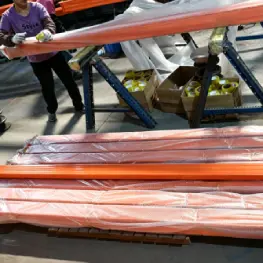
Serving over 120 global economies. Every container load is optimized using nesting algorithms, strapped with heavy steel strapping, moisture-wrapped, and tagged with barcoded manifests for rapid customs clearance.
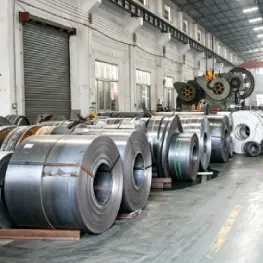
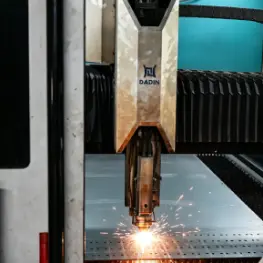
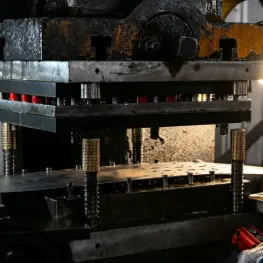
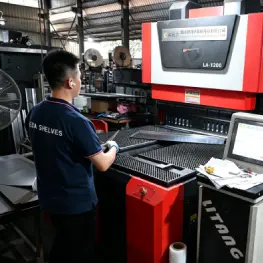
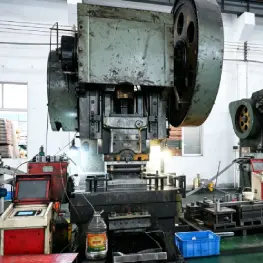
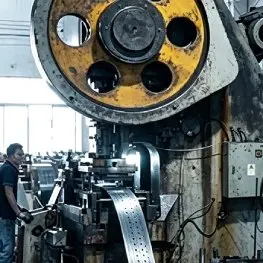
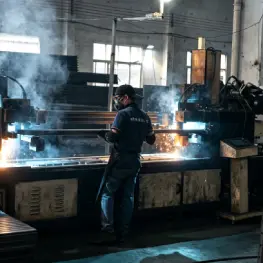
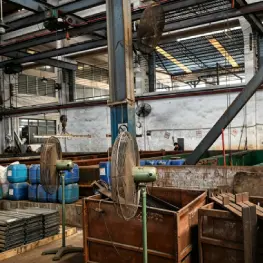
Certified Ten-Stage In-House Manufacturing Pipeline
From prime coil slitting to automated cold forming, robotic welding, and electrostatic powder coating, every stage is executed inside our 30,000m² facility.
Frequently Asked Heavy-Duty Racking Questions (FAQ)
Clear, technically rigorous answers addressing structural engineering, seismic zoning, maritime logistics, and custom OEM fabrication.
We compute local seismic acceleration factors (Ss and S1 parameters, or PGA) following IBC, Eurocode 8, or AS 1170.4 criteria. Based on your building slab concrete PSI and sub-base thickness, our engineers enlarge base plate footprints, apply heavy-duty anchor studs (M12 to M16 Hilti / mechanical wedges), and integrate spine and horizontal cross-bracing trusses to absorb lateral shear loads without inelastic frame collapse.
In heavy-duty warehouse applications, beam deflection under maximum rated uniform distributed load (UDL) is strictly restricted to L/200 under RMI ANSI MH16.1 specifications, or L/250 under European FEM 10.2.02 / EN 15512 norms (where L is the clear beam length). For example, a 2700mm beam carrying two 1000kg pallets cannot deflect more than 10.8mm (L/250) at mid-span under full load.
For interior dry warehouses, our multi-stage electrostatic polyester powder coating provides over 500 hours of ASTM B117 salt spray endurance. However, for coastal warehouses located near marine container terminals or outdoor installations, we strongly recommend Hot-Dip Galvanizing (HDG) per ISO 1461, yielding an 85+ micron thick metallurgical zinc-iron alloy barrier that offers cathodic self-healing protection.
Ocean freight costs are a substantial component of total landed procurement. HEDA custom bundles upright frames either knocked-down (bolted assembly on arrival) or fully pre-welded depending on labor vs freight cost trade-offs. Beams are stacked in interlaced bundles with corrugated protective spacers, allowing a standard 40-foot High Cube (40HQ) container to load between 24 to 26 metric tons of certified steel.
Yes. We regularly supply distributors and engineering contractors with custom OEM punch tooling. Whether you need standard teardrop (US pitch 2 inches), diamond 75mm European pitch, 50mm pitch, or custom proprietary hook apertures, our CNC punch tooling can be calibrated to manufacture drop-in compatible uprights and beams for existing facility extensions.
To deliver an accurate structural design, we request: (1) Warehouse clear height, column grid coordinates, and CAD floor plan; (2) Pallet dimensions (W×D×H) including load overhang and total gross pallet weight; (3) Forklift model, minimum turning aisle width requirement (AST), and maximum mast lift reach; (4) Desired inventory philosophy (FIFO vs LIFO); and (5) Local seismic/wind requirements.
Connect Directly with a HEDA Structural Racking Engineer
Eliminate middleman distributor margins. Submit your warehouse specifications today to receive a fully itemized structural proposal, 3D spatial layout, static calculation report, and comprehensive factory catalog.