Industrial Storage Systems & Custom OEM Heavy-Duty Racking
Explore our specialized range of certified structural racking, cantilever systems, tire racks, and adjustable storage platforms built to European and American logistics standards.
The Mechanics of Double Deep Racking: Maximizing Volumetric Efficiency
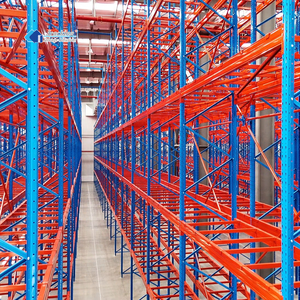
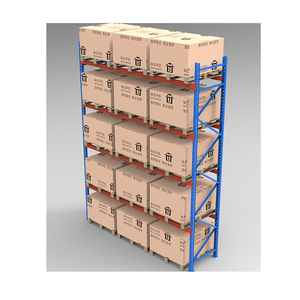
Double deep warehouse racking represents a critical mathematical balance between high-density compact storage and immediate pallet selectivity. By placing two pallet loads deep in back-to-back single rows or four pallets deep in center double rows, this layout eliminates 50% of the working access aisles required by classic selective racking configurations.
Volumetric Density & Space Ratio
In standard selective racking, floor area utilization generally averages 35% to 40% due to broad aisle spacing requirements (typically 3,200 mm to 3,800 mm for reach trucks). Double deep architecture elevates storage floor density to 55%–65% without the excessive capital expenditure of deep-lane automated shuttle systems or dense drive-in structural corridors.
- Reduces floor aisle count by approximately 45% across equivalent footprint.
- Accommodates multiple pallet heights up to 13.5 meters clear height.
- Optimizes 2 to 4 pallets per SKU, perfectly matching medium-batch inventory rotation.
MHE & Forklift Kinematics
Accessing the second-tier depth demands specialized material handling equipment (MHE): either specialized pantograph reach trucks (scissor extenders) or telescopic double-deep fork attachments. Our custom upright frames and heavy-duty step beams are engineered with specific safety margins to mitigate horizontal impact deflection during deep-reach insertion.
- Calculated for specialized Reach Trucks with stroke lengths up to 1,350 mm.
- Integrated beam-level bottom guide rails or camera positioning visual assist.
- Upright throat geometry optimized to prevent fork mast scuffing at height.
Structural Integrity & Steel Specs
Manufactured using premium cold-rolled Q235B and Q355B carbon steel coils sourced from certified tier-1 steel mills. Uprights feature continuous automated CNC punch-perforated multi-bend Omega sections that offer enhanced torsional resistance against lateral seismic forces and high dead-load stress states.
- Beam capacities engineered from 1,000 kg to 4,500 kg per loading level.
- Compliant with EN 15512:2020, ANSI MH16.1, and AS 4084-2012 structural standards.
- Certified 4-hook or 5-hook cold-forged connectors with mechanical spring-safety pins.
System Comparative Matrix: Why Global Procurement Managers Choose Double Deep
A granular analytical assessment comparing Double Deep pallet racking with alternative industrial storage archetypes reveals its compelling Return on Investment (ROI) profile for facilities juggling floor-lease inflation and pallet velocity:
Structural & Economic Comparison: High-Density Industrial Racking Systems
| Storage Racking System | Floor Area Utilization | Direct Selectivity | Capital Cost / Pallet Position | Stock Rotation Model | Ideal Inventory Profile |
|---|---|---|---|---|---|
| Custom Double Deep Racking | 58% ~ 65% (High) | 50% Direct Access | $35 - $60 (Low - Moderate) | FILO / Controlled Batch FIFO | 2 to 6 pallets per SKU, high volume distribution hubs |
| Standard Selective Pallet Racking | 35% ~ 42% (Low) | 100% Direct Access | $30 - $48 (Low) | Pure FIFO | Massive SKU count, 1-2 pallets per SKU, retail fulfillment |
| Drive-In / Drive-Through Racking | 68% ~ 78% (Very High) | 15% ~ 20% (Low) | $55 - $85 (Moderate) | LIFO (Drive-In) / FIFO | Homogeneous raw materials, beverage staging, blast freezers |
| Automated Radio Shuttle Racking | 75% ~ 82% (Maximal) | Lane Dependent (Batch) | $120 - $220 (High) | Dynamic FIFO / LIFO | Cold storage facilities, automated FMCG distribution hubs |
| Very Narrow Aisle (VNA) Racking | 50% ~ 58% (Moderate) | 100% Direct Access | $75 - $115 (High MHE Cost) | Pure FIFO | High ceiling warehouses requiring pure access with high roofline |
Direct OEM/ODM Fabrication Excellence from Guangzhou Heda Shelves
With an unbroken manufacturing legacy stretching back to 2001, our 30,000 square meter intelligent manufacturing base delivers industrial storage solutions that satisfy stringent seismic, corrosion, and load-bearing requirements worldwide.
Full-Cycle OEM/ODM Customization
We engineer custom upright profiles, specific hole pitches (50mm, 75mm, 76.2mm teardrop), box beam sections, stepped beam geometries, and heavy-duty column impact guards precisely aligned with your regional MHE and rack interface preferences.
- Private label fabrication and OEM color matching (RAL palette).
- Custom structural adaptations for non-standard EUR, GMA, or industrial skids.
- Integrated wire mesh decking, pallet support bars, and drum cradles.
10-Stage Surface Treatment
Corrosion mitigation is critical for longevity in high-humidity or cold-chain warehousing. Our automated finishing lines execute pre-degreasing, chemical acid pickling, zinc phosphating, multi-stage DI rinsing, and electrostatic thermoset epoxy polyester powder coating cured at 200°C.
- Dry powder coating film thickness: 60–90 microns.
- Cross-hatch adhesion tested per ASTM D3359 standards.
- Hot-Dip Galvanization (HDG) per ISO 1461 available for harsh freezer zones.
Verified Global Compliance & Certifications
Confidence in engineering begins with rigorous independent verification. HEDA Shelves holds active CE Certification (No. 2435-CPR-8605159), ISO 9001:2015 Quality Management System Certification (No. 18624Q00169R0M, valid to June 2027), and RoHS non-toxicity compliance.
- Finite Element Method (FEM) computer stress calculation for every rack order.
- Mill test certificates (MTC) supplied with raw coil metallurgical traces.
- Turnkey structural stamp approval support with local PE engineers.
Future Procurement Trends in Warehouse Racking & Storage
Industrial supply chain planners are moving past simple price-per-ton metrics toward holistic Total Cost of Ownership (TCO), automated integration flexibility, and lifecycle sustainability. The coming decade introduces four decisive macro shifts.
1. Autonomous MHE Compatibility
Double deep configurations are increasingly operated by automated guided vehicles (AGVs) and reach AMRs equipped with LiDAR. Future procurement specifications prioritize tighter millimetric manufacturing tolerances on upright verticality and laser-aligned guide paths.
2. Low-Carbon Steel & EPD Metrics
Global logistics REITs and multinational 3PLs require Environmental Product Declarations (EPDs). Sourcing now evaluates Electric Arc Furnace (EAF) low-carbon steel coils and non-toxic TGIC-free powder formulations to fulfill corporate ESG decarbonization quotas.
3. Hybrid Cold-Chain Scalability
Surging frozen food and biopharmaceutical demand is driving investments in high-density double deep racks engineered for -30°C conditions. Procurement combines hot-dip galvanized base frames with cold-resistant steel grades to counter micro-embrittlement.
4. Modular Fast-Track Assemblies
Volatile consumer trends penalize rigid infrastructure. Modern procurement teams demand boltless clip-in beam connections, modular splice configurations, and reconfigurable shelf-level elevations that adapt dynamically to shifting SKU profiles.
Technological & Metallurgical Development Trends
From advanced high-strength low-alloy (HSLA) steels to Internet-of-Things (IoT) real-time load displacement sensors, heavy-duty racking is transforming from static structural steel into an intelligent, sensor-monitored warehouse asset.
IoT Structural Health Monitoring
Novel installations integrate piezoresistive strain sensors and triaxial accelerometers into primary upright bases. These wireless arrays report real-time live structural loading, beam sag ratios, and accidental forklift impact anomalies directly to the WMS dashboard before hairline fractures propagate.
High-Tensile Cold-Forming Advances
Through modern multi-pass computer-controlled roll forming, thinner-gauge micro-alloyed steels achieve identical mechanical yield strengths (Fy ≥ 355–420 MPa) while decreasing gross deadweight by 12%–18%. This directly reduces shipping freight costs and container packing volume.
Nonlinear Dynamic Seismic Dissipation
In high-risk earthquake regions (such as the Pacific Rim and Central America), standard rigid anchors transfer shear forces directly to warehouse slabs. Modern R&D incorporates yielding hysteretic base isolators and friction dampener plates that absorb kinetic earthquake energy, preventing frame collapse.
Frequently Asked Questions on Custom OEM Double Deep Racking
Clear, engineering-backed answers addressing the most frequent commercial, structural, and operational questions asked by international buyers and warehouse planners.
Q1 What forklift mast specifications are required for double deep racking?
Double deep systems require a specialized reach truck equipped with either double-reach pantograph scissors or telescopic hydraulic extending forks. Because the reach mechanism projects the load outward up to 1,350 mm, the truck's residual load capacity decreases significantly at elevated heights. Engineers must verify that your forklift mast retains sufficient down-rated capacity to lift your maximum pallet weight at top beam elevations.
Q2 How does Double Deep compare to Drive-In racking in practical operations?
While Drive-In racking provides higher gross volumetric density (up to 75%), it suffers from extreme honeycombing losses, slow forklift lane navigation, and higher accidental rack impact rates. Double deep offers 50% instant selectivity, allows access to two pallet faces per lane per level, and requires reach trucks to maneuver only within wide main aisles, resulting in dramatically higher pallet turnover speeds.
Q3 What steel grades and structural certifications are utilized during manufacturing?
We primarily utilize hot-rolled and cold-formed Q235B and Q355B structural carbon steels, selected for optimal tensile elongation and weldability. Every batch of steel is tracked with authentic Mill Test Certificates (MTC). Our production adheres strictly to EN 15512, RMI (Rack Manufacturers Institute) MH16.1 specifications, with manufacturing facilities certified under ISO 9001:2015 and CE EN 1090 structural steel execution standards.
Q4 Can double deep systems be tailored to non-standard or mixed pallet dimensions?
Yes. As an authentic OEM manufacturer, we engineer custom beam lengths (e.g., 2,300 mm, 2,700 mm, 3,300 mm, 3,900 mm) and custom frame depths (e.g., 900 mm to 1,200 mm) to support diverse pallet styles including Euro (800x1200 mm), GMA/ISO (40x48 inches), Australian (1165x1165 mm), or industrial skids. Heavy-duty cross pallet support bars, wire decking, or drop-in front-to-back ties are customized to guarantee complete bottom perimeter stability.
Q5 What surface finish options ensure corrosion resistance in cold storage or humid maritime ports?
For standard temperature-controlled warehouses, our 10-stage automated electrostatic powder coating (epoxy polyester, cured at 200°C, 60–90µm) delivers outstanding scratch and rust resistance. For deep-freeze environments (-25°C to -30°C), coastal port facilities, or chemical fertilizer plants, we provide fully Hot-Dip Galvanized (HDG) components conforming to ASTM A123/ISO 1461, ensuring over 25 years of corrosion-free performance.
Q6 How do you package and protect structural components for intermodal sea container shipping?
Uprights are bundled with protective steel strapping, heavy corrugated edge guards, and vapor-phase corrosion-inhibitor (VCI) films. Beams are palletized in matched-count wooden-cradled crates to prevent impact deformation during open-ocean transit. Complete itemized packing lists matching assembly drawings are affixed to every bundle, streamlining customs clearance and job-site staging across destination ports.
Q7 What design inputs are necessary to initiate a free 3D CAD layout and structural quotation?
To produce an optimized CAD floor layout and seismic load calculation, we require: (1) Architectural building drawings showing clear ceiling height, column grid spacings, floor slab thickness, and door openings; (2) Pallet dimensions (W x D x H) including goods overhang and gross weight; (3) Forklift model details (lift height, closed mast height, aisle turning radius); and (4) Site seismic zone or local building code requirements.
Q8 What on-site installation support and engineering documentation are provided?
Every shipment is accompanied by detailed structural shop drawings, 3D exploded assembly diagrams, anchor installation torque protocols, and maximum safe-working-load capacity warning plaques. For large-scale international warehouse builds, HEDA Shelves deploys experienced structural installation supervisors or provides comprehensive live video engineering guidance.
Transform Your Warehouse Volumetric Efficiency Today
Partner directly with Guangzhou Heda Shelves Co., Ltd. for factory-direct pricing, certified structural reliability, and custom-engineered double deep racking systems tailored precisely to your supply chain profile.
Send an Inquiry