Featured Industrial Warehouse Storage Systems
Engineered to FEM 10.2.02 and EN 15512 safety codes. Explore our structural steel building systems, longspan shelving units, and high-bay pallet racking lines.
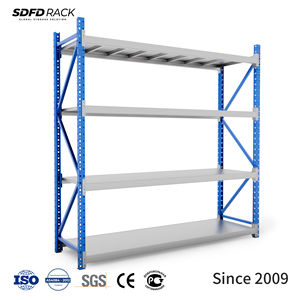
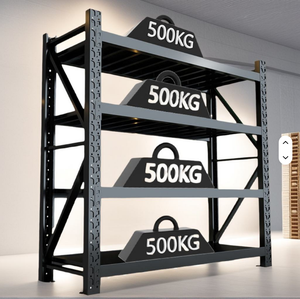
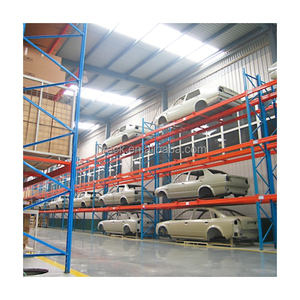
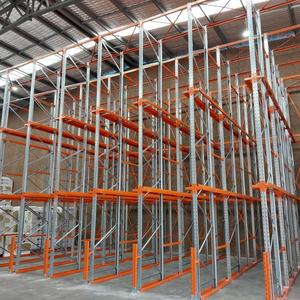
Structural Mechanics & Steel Metallurgy in Industrial Shelving
Procuring heavy-duty warehouse storage systems requires deep comprehension of thin-walled cold-formed structural members, load dissipation, and local yield limits.
Q235B vs. Q355B Hot-Rolled Slit Coils
Structural integrity begins at chemical alloy verification. While conventional retail racking relies on uncertified mild steel, our manufacturing incorporates certified Q235B (yield strength $f_y \ge 235 \text{ MPa}$) and high-load Q355B high-tensile steel ($f_y \ge 355 \text{ MPa}$). This structural variance allows profiles to withstand dynamic warehouse cycles, cyclic fork impact fatigue, and elastic deflection tolerances below $L/200$ across standard beam spans.
Cold-Formed Continuous Profiling
Upright columns undergo a 24-station automated rolling matrix. Rather than hydraulic press brake processing that induces uneven residual cross-sectional stress, progressive roll-forming yields precise 75mm or 50mm teardrop, diamond, and butterfly pitch perforations without work-hardening the web edges. This structural stability mitigates torsional-flexural buckling under combined axial and eccentric loads.
Seismic Dissipation & Slab Anchor Physics
Industrial installations in seismically volatile territories—such as Latin America's Pacific Rim, Central Asia, and Mediterranean corridors—demand finite element modeling (FEM) incorporating site-specific spectral acceleration coefficients ($S_s, S_1$). Seismic baseplates utilize heavy-gauge Q355 hot-dip plates fastened with wedge anchors certified to ACI 355.2, ensuring load-path continuity directly into the post-tensioned slab.
Enterprise Manufacturing Advantages: Guangzhou Heda Shelves Co., Ltd.
Founded in 2001, we deliver complete turn-key logistical manufacturing, supporting international wholesalers, global supply chains, and large-scale distribution centers.
Over two and a half decades of specialized manufacturing experience, resolving complex intralogistics constraints across more than 10,000 delivered projects worldwide. Dedicated structural engineering team for static analysis and seismic reviews.
Equipped with 12 automatic continuous roll-forming lines, automated laser cutting tables, Panasonic robotic welding cells, and an environmental electrostatic powder coating line achieving up to 30,000 tons of monthly throughput.
Full 9-stage pre-treatment cycle including spray degreasing, acid pickling, zinc phosphating, and deionized water rinsing prior to thermosetting epoxy-polyester powder application, guaranteeing exceptional salt spray and humidity durability.
Fully audited and accredited under ISO 9001:2015 (Cert No. 18624Q00169R0M) and European CE Standard EN 15512 (Cert No. 2435-CPR-8605159), ensuring documentation readiness for global customs, safety regulators, and insurance underwriters.
We provide zero-cost architectural CAD layouts, structural calculations, and 3D photorealistic renderings within 24 hours of inquiry, completely aligning with your aisle clear-heights, turning radiuses, and pallet load matrices.
Direct delivery to over 120 countries. Container load optimization ensures sea freight packing utilizes nested uprights and protected bundles, maximizing cubic volume and preventing maritime transit abrasion.
Future Procurement Trends: 2025–2030 Global Supply Outlook
Wholesale procurement is transitioning from transactional steel purchasing to integrated system lifecycle investments. Key strategic trends dictate procurement margins over the next decade.
1. Total Cost of Acquisition vs. Initial Freight
Leading third-party logistics (3PL) conglomerates are revising evaluation scorecards. While FOB ex-factory pricing remains an indexable baseline, container space nesting density, structural steel longevity without recoating, and localized modular expansion capabilities determine bottom-line financial yield across a 15-year facility operational lifespan.
2. Standardization Across Hybrid Fulfillment Centers
The rapid convergence of bulk warehousing with micro-fulfillment cross-docks requires hybrid shelving architecture. Operators no longer buy isolated racking profiles. Strategic buyers demand convertible frameworks that transition from manual longspan hand-pick tiers into pallet racking without replacing vertical column infrastructures.
3. Environmental Carbon Reporting (EPD & CBAM)
Cross-border procurement into European, Oceanic, and North American jurisdictions increasingly factors in the carbon footprint of raw steel coils. Our manufacturing processes utilize energy-efficient powder curing tunnels and recyclable raw steel chemistry, ensuring streamlined environmental compliance with upcoming CBAM carbon tax mechanisms.
Product Development & Engineering Innovation
Modern warehouse rack structures are evolving rapidly to support automation, autonomous mobile robots (AMRs), and smart structural telemetry.
Automation Readiness (ASRS & Radio Shuttles)
Traditional selective racking is increasingly complemented by semi-automated Radio Shuttle platforms and automated storage and retrieval systems (ASRS). Racking tolerances must contract from standard millimeters down to fractional thresholds ($\pm 1.0\text{mm}$) to guarantee seamless shuttle optical navigation along heavy cold-rolled guide rails.
High-Durability Galvanization Options
To counter severe environments found in cold storage freezers ($-30^\circ\text{C}$), coastal humidity, and agricultural chemical distribution, cold-formed components can be finished in continuous pre-galvanized zinc coatings (Z275) or submerged hot-dip galvanized tanks (ISO 1461), ensuring micro-crack protection at perforation intersections.
Integrated Sensor & Impact Diagnostics
Modern high-bay structures increasingly factor in bolt-on IoT collision telemetry sensors and upright deflection nodes. These early-warning devices immediately alert warehouse supervisors when a forklift collision exceeds structural threshold limits, drastically mitigating progressive collapse events.
Comprehensive Storage System Comparison Matrix
Evaluate system performance criteria to match clear height, throughput velocity, inventory turnover model, and warehouse floor footprint.
| Racking Typology | Space Utilization | Selectivity | Load Capacity / Tier | Rotation Model | Primary Industry Application |
|---|---|---|---|---|---|
| Selective Pallet Racking | 40% – 50% | 100% Direct | 1,000 – 4,500 kg | FIFO / LIFO | 3PL, FMCG, Retail Distribution, Multi-SKU |
| Drive-In / Drive-Thru | 70% – 80% | Low (Batch) | 1,000 – 2,000 kg | LIFO (Drive-In) / FIFO | Beverage, Cold Chain, Seasonal Raw Materials |
| Radio Shuttle System | 80% – 85% | Medium-High | 500 – 1,500 kg | FIFO / LIFO Flexible | Deep Cold Storage, Food Processing, Meat Exports |
| Heavy-Duty Cantilever | 50% – 60% | 100% (Linear) | 1,000 – 3,000 kg / Arm | FIFO / LIFO | Timber Yards, Steel Tubing, PVC Pipes, Sheet Metal |
| Multi-Tier Mezzanine Platform | 100% Floor Multiplier | 100% Picking | 300 – 1,000 kg / m² | High Velocity Pick | E-Commerce Picking, Auto Spare Parts, Garment Hubs |
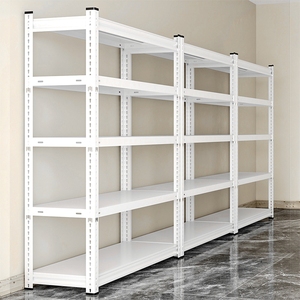
| Longspan Industrial Shelving | 45% – 55% | 100% Direct | 300 – 800 kg / Tier | Manual Cart Pick | Industrial Spare Parts, Retail Stockrooms, Hardware |
Wholesale Procurement & Technical Compliance FAQ
Critical engineering and trade answers for commercial buyers, civil contractors, logistics project managers, and sourcing directors.
Accelerate Your Warehouse Capacity with Engineered Precision
Connect directly with our senior racking engineering specialists. Request free CAD floor layout designs, structural calculations, and comprehensive manufacturer wholesale pricing.