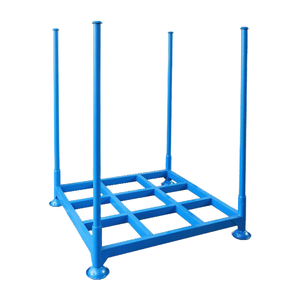
Warehousing Storage Heavy Duty Steel Multi-Level Tyre Cold Storage Stacking Metal Racks
Heavy Duty
Anti-Corrosion
Cold Storage
Source heavy-duty structural pallet racks, automated live-storage flow lanes, and push-through protection safety accessories manufactured to European EN 15512 and North American RMI standards.
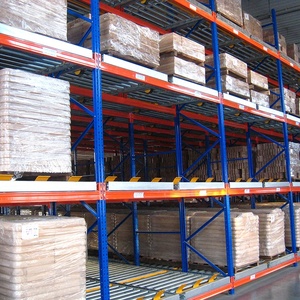
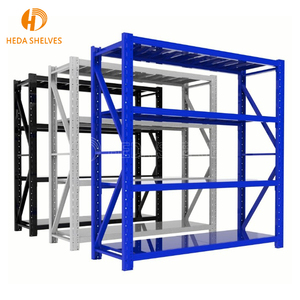
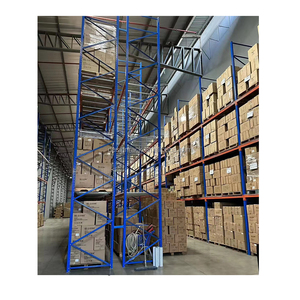
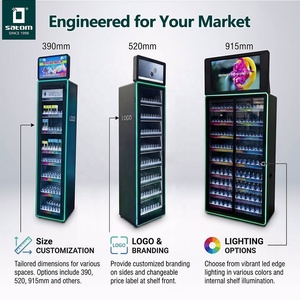
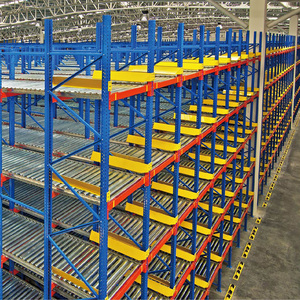
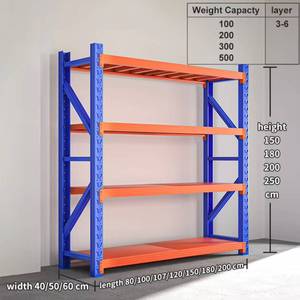
In high-density dynamic and selective pallet racking systems, warehouse safety protocols dictate rigorous containment against accidental pallet push-through. Push-through hazards occur when a forklift operator over-inserts a unit load beyond the rear support beam. In single-entry rows, this defect results in pallets plunging into empty pedestrian access ways or colliding with rear building perimeters. In back-to-back configurations, uncontrolled pallet penetration encroaches on the mandatory longitudinal flue space—a critical 75 mm to 150 mm vertical void required by NFPA 13 and EN standards for fire sprinkler penetration and smoke venting.
As a leading Chinese original equipment manufacturer (OEM), we fabricate four standard mechanical variants of pallet racking backstops, custom-tailored to the operational velocity, forklift mast type, and pallet geometry of international distribution centers:
| Containment Variant | Structural Profile | Offset Distance (Flue Clearance) | Primary Regulatory Application |
|---|---|---|---|
| Direct-Beam Flanged Stop | Pre-formed C-Channel or Tubular Steel Bolted directly onto the Beam Web | Flush to 50 mm (Direct beam mounting) | Selective Pallet Racking with standard GMA (40x48") or Euro pallets (800x1200mm). |
| Offset Spacer Bracket Stop | Heavy-duty boxed tube mounted via cantilevered heavy gauge standoff brackets | 75 mm to 150 mm customizable standoff | NFPA flue space preservation in high-density automated racking. |
| Framed Wire Mesh Containment | 8-gauge welded steel wire mesh anchored to upright frame extension posts | Full structural vertical span (up to 12 meters) | Loose carton falling protection in busy picking tunnels and pedestrian aisles. |
| Drive-In Pallet Ground & Rail Stops | Thickened hot-rolled steel weldments anchored directly to guide rails | End of bay track termination | Prevents drive-in/drive-thru carriage trucks from over-traveling beyond rear towers. |
Logistics engineering is experiencing a transition driven by higher rack elevations, high-throughput automated material flow, and stringent cross-border risk-compliance policies. Enterprise procurement teams are shifting away from standalone generic racks toward deeply integrated, smart safety solutions. Key supply chain procurement trends include:
Integration of infrared break-beam detection and micro-switches inside the stop flange. These systems immediately signal AGVs (Automated Guided Vehicles) and AMR stackers upon pallet contact, eliminating mechanical strain on rack uprights.
For installations in earthquake-prone regions such as Central America, the Pacific Rim, and southern Europe, push-through stops now employ slotted energy-absorption brackets capable of flexing to dampen seismic wave frequencies without snapping connection bolts.
Warehouses experiencing changing SKUs favor tool-free adjustable stops. Spring-loaded pin assemblies allow ground teams to reposition stop barriers in under 30 seconds when transitioning between non-standard wooden pallets and plastic containers.
Historically, warehouses relied on unengineered timber 2x4s or makeshift angle irons screwed to rear frame columns to act as pallet stops. This legacy technique led to widespread failures: brittle wood snapped under slight hydraulic forklift pressure, while flat structural angles distributed localized shearing forces directly into upright frame slots, causing upright twisting and racking collapse.
Modern Chinese manufacturing employs high-yield, cold-rolled Q235B and Q355B structural coil steel. With continuous automated roll forming and robotic CNC laser bracket punching, pallet stops now operate as integral structural diaphragm components. When properly fastened across upright columns, horizontal push-through stop beams increase the rack bay’s torsional stiffness and improve overall frame stability under dynamic forklift loading.
Direct from our 30,000 m² state-of-the-art Guangzhou manufacturing facility, we control the entire lifecycle from raw steel coil slitting to electrostatic thermosetting coating.
Fully compliant with EN 15512, ISO 9001:2015 (Certificate No. 18624Q00169R0M), and CE Marking (Certificate No. 2435-CPR-8605159). Mill test certificates and third-party SGS chemical composition tests accompany every shipment.
Our in-house team of structural engineers delivers free CAD floor layouts, detailed load calculation documentation, and 3D virtual walkthroughs within 24 hours of receiving your warehouse architectural drawings.
Every beam, upright frame, and push-through stop is bundled with protective plastic corner guards, wrapped in moisture-resistant film, and cataloged with clear color-coded container loading maps for rapid on-site sorting.
How we ensure millimeter-level dimensional accuracy and structural integrity across every component.
Certified Baosteel Q235B and Q355B coils undergo ultrasonic thickness inspection and yield stress tensile testing before slitting.
Continuous cold roll-forming lines shape custom profile stop channels with computerized punch alignment accurate to ±0.5 mm.
An 8-stage automatic immersion process including acid pickling, rust removal, and zinc-phosphate conversion prepares parts for coating.
Electrostatic thermoset polyester powder coating cured at 200°C creates an impact-resistant, high-gloss finish resilient against humidity.
Direct answers to engineering, regulatory, and purchasing inquiries encountered by warehouse operators and global importers.
Send our senior engineering team your warehouse dimensions, pallet weights, and forklift specifications. We will generate an itemized quote, structural load analysis, and complimentary 3D layout within 24 hours.
Send an Inquiry