Engineered Warehouse Racking & Storage Solutions
Explore standard and heavy-duty structural steel systems compliant with international structural codes (AS 4084, FEM 10.2.02, RMI MH16.1), precision roll-formed by certified Chinese manufacturing facilities.
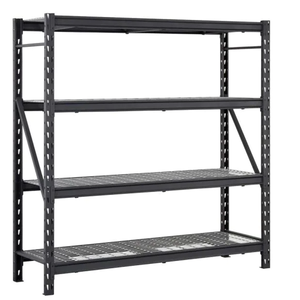
3 Layers Boltless Steel Racking Industrial Shelf Adjustable Stacking Assemble Shelving
- Load: 150-300 kg/tier (Uniform Load)
- Steel: Cold-rolled Q235B Profile
- Setup: Bolt-free snap-in rivet design
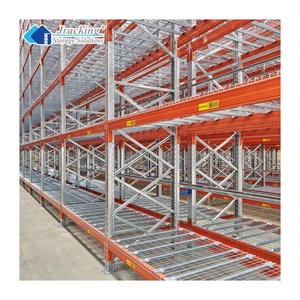
Jracking Industrial Shelving Warehouse Rack Heavy Duty Pallet Racking System
- Capacity: Up to 4,500 kg/beam level
- Pitch: 50mm / 75mm beam adjustability
- Standard: Australian AS 4084 compliant
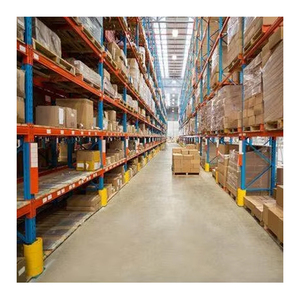
Industrial Inventory Bolt Less Racks Loading Shelves Heavy Duty Steel Shelf
- Structure: Box beam & omega uprights
- Finish: AkzoNobel electrostatic coat
- Stability: Seismic baseplates & shims
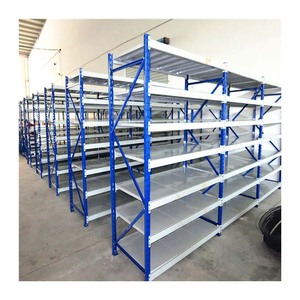
Mracking Light Duty Selective Shelf Metal Steel Warehouse Storage System
- Tier: 100-250 kg/deck capacity
- Decking: Steel sheet or wire mesh
- Application: E-commerce SKU sorting
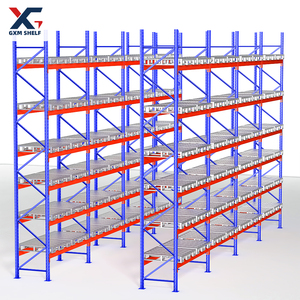
Industrial Shelves Pallet Rack Shelving Heavy Duty Warehouse Racking System
- Span: 2,300mm to 3,900mm clear width
- Depth: 1,000mm / 1,100mm Euro/US pallet
- Safety: 5-hook connector safety lock pins
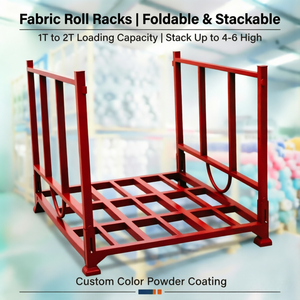
TER Professional Textile Industry Fabric Roll Rack Stackable Foldable Storage
- Design: 4-way forklift pocket entry
- Stack: 4-5 units high under full payload
- Benefit: Space recovery when folded flat
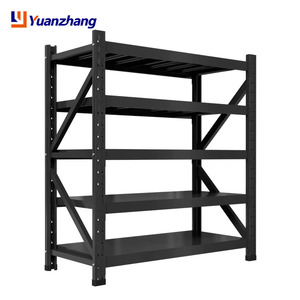
Custom Steel Heavy Duty Shelving 300 Kg/Layer 4 Tier Storage Metal Stacking Unit
- Capacity: Tested 300 kg certified beam level
- Corrosion: Matte black ripple powder coat
- Configuration: Free-standing starter & adder
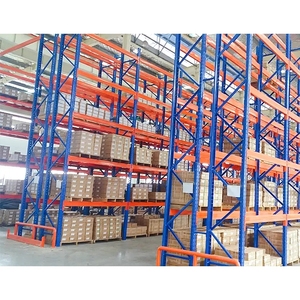
Steel Racking Solutions Heavy Duty Storage Shelves Pallet Racking System
- Uprights: Heavy gauge 90x70 / 120x95 section
- Bracing: Bolted K/D truss pattern bracing
- Certification: ISO 9001 / CE / RoHS audited
Strategic Engineering Prowess from China's Top Racking Manufacturers
Procuring warehouse racking directly from Chinese manufacturing giants provides global supply chains with an unmatched balance of metallurgical consistency, finite-element structural design, and economies of scale. Guangzhou Heda Shelves Co., Ltd. leads this discipline through end-to-end vertical integration.
Verified International Certifications
Industrial racking systems operate under severe dynamic loads. HEDA maintains rigorously audited international certifications including CE Certificate No. 2435-CPR-8605159, ISO 9001:2015 No. 18624Q00169R0M (valid through 2027), and strict compliance with RoHS environmental directives for coating chemistry.
Free 3D Layout & Structural Calculations
Eliminate costly installation misfits before cutting steel. Our structural engineering department provides complimentary architectural CAD floor plans, full 3D BIM-compatible renderings, and precise load calculation reports detailing deflection ratios (L/200 standard), seismic floor-anchor shearing loads, and slab capacity verification.
Export-Optimized Container Packaging
Sea freight efficiency is directly governed by container packing density. HEDA engineers bundle structural components with bespoke steel banding, protective corner guards, and modular wooden dunnage. Every bundle is tagged with barcoded SKU labels matching the export manifest to speed customs processing.
Inside the 10-Stage Advanced Manufacturing Cycle
Structural reliability starts with raw coil chemistry and ends with continuous robotic powder polymerization. Our 30,000 m² Guangzhou manufacturing complex executes all ten stages in-house to maintain dimensional tolerances within ±0.5mm across all production runs.
Certified Baosteel & Shougang Q235B / Q355B hot-rolled strip steel with verified mill test certificates.
High-speed CNC slitting lines ensure uncurled edges and micrometer-calibrated width uniformity.
Automated punching matrices generate teardrop, diamond, or butterfly slots at exact 50mm / 75mm pitches.
Multi-station cold roll formers shape upright omega columns and interlocking box beams with continuous web ribs.
CO2 / Argon shielded robotic arms weld beam connector claws and baseplates with deep metallurgical penetration.
Automated shot blasting and mechanical deburring eliminate slag, sharp burrs, and mill scale.
Immersion tanks strip residual cutting oils and trace oxides to prime the bare steel crystal structure.
Nano-phosphate chemical conversion layer forms an anti-corrosion barrier and enhances powder adhesion.
Gema automatic powder spray guns apply 60-90μm epoxy-polyester powder baked at 200°C curing temperature.
Load testing, magnetic coating thickness audit, and heavy export seaworthy steel strapping packing.
Future Sourcing Trends in Warehouse Racking & Intralogistics
As global supply chains navigate supply volatility, rising land costs, and accelerated automation, industrial racking procurement is transitioning from commodity buying to strategic lifecycle asset management.
1. Total Cost of Ownership (TCO) vs. Raw Steel Purchasing
Procurement directors increasingly scrutinize TCO over upfront FOB price. Factors such as steel yield strength (Q355B vs inferior recycled scrap steel), galvanization thickness for coastal distribution hubs, and beam connector fatigue lifespans govern real operational cost. Racks engineered with higher section modulus allow longer column spans without vertical sag, drastically lowering beam count requirements, forklift impact maintenance costs, and facility insurance premiums.
2. Hybrid Automation & Shuttle-Ready Structural Upgrades
Facilities are designing manual selective racking systems that can seamlessly integrate automated four-way radio shuttles or Autonomous Mobile Robots (AMRs) in future phases. Chinese factories are leading this trend by fabricating dual-purpose upright profiles with pre-punched continuous alignment guide rails, precision runner tracks, and reinforced pallet entry guides that support both conventional counterbalanced forklifts and semi-autonomous shuttle bots.
3. Carbon Accounting, CBAM Compliance & Green Steel
With cross-border environmental regulations like the European Union Carbon Border Adjustment Mechanism (CBAM) expanding globally, the carbon footprint of structural steel has become an active procurement metric. Top-tier Chinese manufacturers are implementing closed-loop electric arc furnace (EAF) sourcing, VOC-free thermoset powder formulations, and solar-powered manufacturing plants, issuing verifiable Scope 1, 2, and 3 carbon declaration dossiers alongside shipments.
4. Modular Mezzanines Over Brownfield Real Estate Expansion
With commercial warehousing lease rates at record highs worldwide, logistics operators are prioritizing volumetric cubic utilization over horizontal building expansion. Multi-tier rack-supported and structural steel mezzanines manufactured in China provide up to 300% floor space multiplication with floor loading ratings between 300 kg/m² and 1,000 kg/m², avoiding local municipal zoning permits required for physical warehouse footprint extensions.
Comparative System Engineering & Operational Efficiency
Analyze how leading warehouse racking architectures perform against critical operational parameters including storage density, SKU accessibility, capital expenditure, and forklift fleet requirements.
| Racking Architecture | Space Utilization | Stock Rotation | SKU Selectivity | Aisle Clearance | Forklift Requirement |
|---|---|---|---|---|---|
| Selective Pallet Racking | 40% - 50% | FIFO / LIFO Flexible | 100% Direct Access | 3.0m - 3.8m Standard | Standard Counterbalance / Reach |
| Double Deep Racking | 55% - 65% | Strict LIFO | 50% Immediate Access | 2.8m - 3.2m | Pantograph Deep-Reach Truck |
| Drive-In / Drive-Through | 70% - 80% | LIFO (Drive-in) / FIFO (Thru) | Low (Bulk SKU Batches) | Dedicated Drive Bays | Narrow Chassis Counterbalance |
| Radio Shuttle Automation | 80% - 90% | Automated FIFO or LIFO | Medium-High per Bay | 2.6m - 3.0m Transfer | Conventional Forklift + Shuttle Unit |
| Gravity Pallet Flow | 75% - 85% | Guaranteed Auto FIFO | One SKU per Flow Lane | Dedicated In / Out Aisles | Standard Lift at Ends |
| Heavy Cantilever Racking | Custom Linear | Variable Direct | 100% for Oversized | Column Span Dependent | Side Loader / Multi-directional |
| Multi-Tier Mezzanine | 200% - 300% Vertical | Manual Piece / Carton | 100% Bin-Level Pick | Integrated Staircases | Pedestrian Pickers / Vertical Lifts |
Essential Questions Answered for Global Warehouse Buyers
Authoritative technical guidance compiled by our chief structural engineers covering structural standards, seismic safety factors, steel grade verification, and customs logistics.
How do Chinese factories engineer racks for high seismic zones?
Structural compliance in seismic zones (such as Central America's Ring of Fire, New Zealand, or the US West Coast) requires dynamic finite element calculations. We analyze floor slab compressive strength (fc), ground acceleration parameters (Ss, S1), and building site class. Based on these inputs, we specify enlarged ductile baseplates (minimum 10-16mm thick), high-tensile Hilti or wedge anchors (M12-M16), welded heavy-gauge upright column inserts, and heavy cross-bay back bracing to dissipate ground shock energy.
Which steel grades are specified, and how is quality verified?
We strictly utilize domestic prime structural hot-rolled coil grades Q235B (yield strength ≥ 235 MPa, ultimate tensile 370-500 MPa) and Q355B (yield strength ≥ 355 MPa, comparable to European S355JR and ASTM A572 Grade 50) sourced directly from Baosteel. Every production batch is accompanied by genuine 3.1 Mill Test Certificates (MTC) detailing carbon, manganese, phosphorus, and sulfur content along with yield, elongation, and Charpy impact testing results.
What coating treatment is best for tropical humidity or cold chain?
For standard distribution facilities, our 9-stage electrostatic polyester powder coating delivers 60-90μm thickness with 500+ hours salt spray resistance (ASTM B117). For sub-zero blast freezers (-30°C) or coastal warehouses with high ambient saline humidity, we recommend Hot-Dip Galvanizing (HDG) to ISO 1461 standards, creating a metallurgical zinc-iron alloy layer ≥ 65-85μm that provides cathodic self-healing corrosion protection.
What exact inputs are required to receive a full CAD engineering layout?
To generate an optimized proposal within 24 hours, our engineering office requires: 1) Architectural building CAD drawing indicating clear internal ceiling height, column grid coordinates, fire exits, and overhead sprinkler levels; 2) Pallet specifications (width, depth, overall height including cargo overhang, and gross pallet weight); 3) Forklift fleet characteristics (turning radius, mast collapsed height, and maximum lift height); and 4) Operational throughput profile.
How are sea freight containers packed to avoid damage and port delays?
Racking components are long, heavy, and susceptible to transit vibration if packed loosely. Upright frames are pre-assembled or nested KD (knock-down) into standardized bundles strapped with 1.2mm high-tensile steel banding. Beams are stacked with interlocking wooden spacer blocks preventing paint scuffs. Small hardware (bolts, safety pins, floor shims) is packed in reinforced wooden crates labeled by zone. Detailed container loading lists match shipping marks precisely.
What installation support is provided for remote international sites?
Every shipment is accompanied by a full 3D assembly manual, numbered component layout schematics, torque specifications for all bolted connections, and step-by-step video tutorials. For medium projects, our project engineers host real-time video guidance sessions with local rigging contractors. For major installations exceeding 50 containers, HEDA dispatches senior bilingual installation supervisors directly to the client facility to oversee plumb calibration, anchoring, and final load sign-off.
Connect with China's Premier Racking Engineering Team
Whether you are expanding a 1,000 m² regional warehouse or outfitting a 50,000 m² automated e-commerce distribution center, get factory-direct pricing, certified structural engineering calculations, and complimentary 3D layout designs.