Heavy Duty
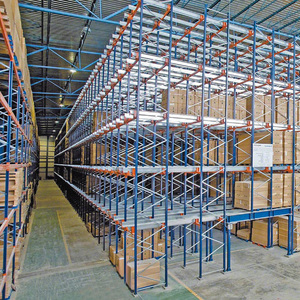
Engineered with cold-rolled Q235B/Q355B steel, intelligent rail navigation, and multi-tier failsafe automation. Select from our certified radio and multidirectional shuttle solutions.
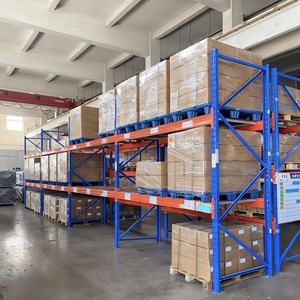
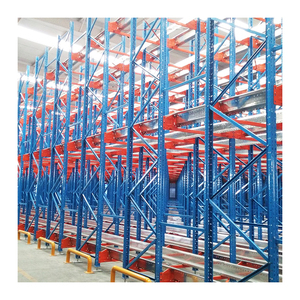
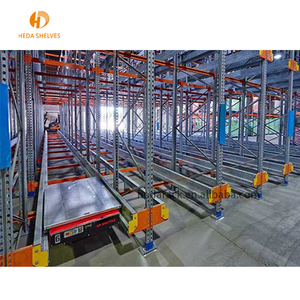
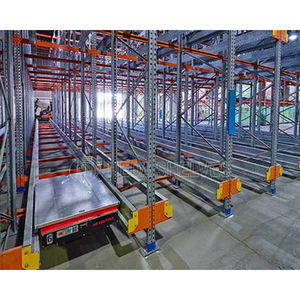
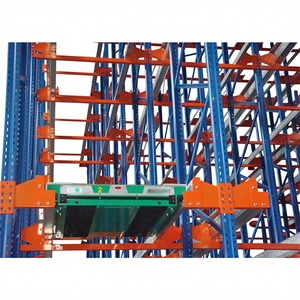
Modern industrial supply chains face escalating real estate costs, tighter fulfillment windows, and stringent energy efficiency goals. While conventional Selective Pallet Racking offers 100% immediate accessibility, its floor space efficiency rarely exceeds 40% due to broad forklift aisle requirements. Drive-In racking improves volumetric storage but introduces structural fatigue risks, forklift collision vulnerabilities, and severe operational throttling due to prolonged travel times inside rack tunnels.
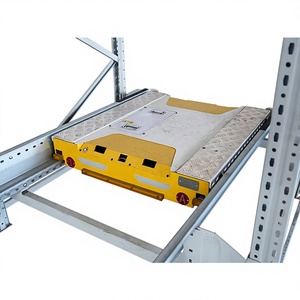
Pallet Shuttle Automation completely decouples storage density from material handling transit times. A self-powered automated cart maneuvers autonomously inside high-precision, cold-rolled guide rails, carrying pallet loads of up to 1,500 kg at travel speeds exceeding 1.2 m/s. Forklifts operate exclusively at lane thresholds, reducing operational handling time by up to 60% and nearly eliminating impact hazards against structural upright columns.
| Evaluation Parameter | Selective Pallet Rack | Drive-In Rack | Radio Pallet Shuttle | 4-Way Automated Shuttle |
|---|---|---|---|---|
| Storage Density Efficiency | 35% – 45% (Aisle dependent) | 60% – 70% | 80% – 88% | Up to 92% |
| Retrieval Logistics Logic | 100% Direct Selective Access | Strictly LIFO | Configurable FIFO or LIFO | Full Matrix Smart 3D Sorting |
| Forklift Mast Collision Risk | Moderate (Peripheral only) | Critical (Inside tunnel driving) | Extremely Low (External picking) | Zero (Fully automated vertical lift) |
| Cold Storage Energy Cost | High (Refrigerating wide aisles) | Medium | Low (Minimal cooled volume) | Ultra-Low (Compact volumetric AS/RS) |
| Labor Throughput Velocity | High picking, low density | Sluggish (Driver caution required) | High (Autonomous shuttle transit) | Continuous Unmanned 24/7 Cycle |
Whether configuring automated cold stores down to -30°C or central fulfillment buffers handling high-velocity SKUs, pallet shuttle architectures provide the highest volumetric footprint return on investment (ROI) within an operational depreciation timeline of 18 to 36 months.
Global supply chain executives and intralogistics procurement leads are shifting purchasing criteria toward scalable, energy-positive, and algorithmically connected warehousing hardware.
Traditional lead-acid power sources are obsolete. Modern RFQ specifications demand fast-charging supercapacitors and LiFePO4 batteries featuring thermal management systems that enable 24/7 operations in sub-zero cold rooms with 5-minute autonomous recharge cycles.
Procurement teams increasingly reject siloed automation. Today's shuttle solutions require standardized open API interfaces to seamlessly interact with Autonomous Mobile Robots (AMRs) and automated forklifts at picking stations without secondary staging buffers.
Global infrastructure tenders require verifiable Environmental Product Declarations (EPDs). Enterprise purchasers demand high-yield, low-carbon certified steel profiles produced in low-emission mills with solvent-free electrostatic powder coatings.
Hardware procurement contracts now integrate IoT telemetry. Modern shuttle fleets transmit continuous vibration, wheel wear, and torque metrics over secure industrial 5G/Wi-Fi to trigger automated maintenance alerts prior to mechanical downtime.
From single-channel radio remote units to fully autonomous three-dimensional matrix ecosystems, warehouse automation hardware continues to undergo rapid architectural advancements.
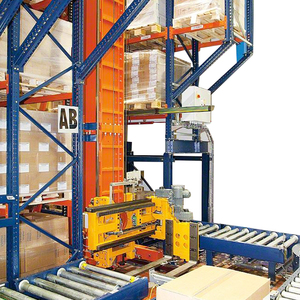
The industry is rapidly advancing from 2-way linear shuttles to 4-way systems operating on orthogonal grid matrices. Supported by high-speed vertical reciprocating lifts, 4-way shuttles can change tiers dynamically, enabling complete warehouse level-shifting, dynamic lane rebalancing, and unconstrained matrix pallet routing.
Next-generation shuttles utilize optical laser time-of-flight (ToF) sensors and machine-vision scanning to identify damaged wooden pallet skids, structural deflections, or misaligned freight in real time. Dynamic optical positioning overrides basic rail count sensors, preventing mid-lane track jamming.
Specialized engineering focuses on extreme cold-storage longevity (-30°C to -45°C) and hazardous environments. Innovations include hermetically sealed planetary drive gears, moisture-shedding anti-condensation circuits, and food-grade synthetic lubricants that prevent mechanical seizure.
Every structural profile and shuttle drive undergoes stringent quality control at our 30,000 m² factory, ensuring micron-level rail alignment and international compliance.
Certified high-tensile Q235B/Q355B coils cut with high-precision fiber lasers.
Continuous automated CNC punch lines and progressive multi-station roll forming.
Dual-torch robotic arm welding and uniform seam grinding for structural durability.
Multi-stage chemical surface degreasing, phosphating, and electrostatic polymer baking.
Full mechanical tolerance inspection, rail load simulation, and container bundling.
For more than two decades, Guangzhou Heda Shelves Co., Ltd. has delivered turnkey intralogistics systems worldwide, adhering strictly to EN 15512, RMI, and ISO manufacturing benchmarks.
Certified to CE standard EN 1090/EN 15512 (Certificate No. 2435-CPR-8605159) and ISO 9001:2015 (No. 18624Q00169R0M). Every project includes structural calculation documents verified by professional structural engineers.
Our 300+ engineering team provides complete warehouse simulations within 24 to 48 hours. Receive detailed spatial calculations, pallet capacity counts, and forklift clearance analysis before manufacturing begins.
Export components are barcoded, bundled with protective wrapping, and packed with computerized weight distribution plans to maximize 40ft HQ container cube volume and simplify customs clearance.
From factory pre-assembly testing to bilingual video technical guidance, component traceability, and on-site supervisor dispatch, we ensure seamless commissioning across any international jobsite.
Key technical, commercial, and operational considerations to evaluate prior to issuing tenders for automated pallet shuttle racking systems.
Unlike standard static racking, pallet shuttle installations with high-bay configurations require strict concrete floor floor tolerances. Floors should typically meet DIN 18202 Table 3 Group 4 specifications (or FM2 flat-floor standards per TR34). Unlevel slabs induce rail warping, which increases shuttle drive friction, triggers premature wheel assembly wear, and causes sensor alignment errors.
Standard shuttle carriers are engineered to handle GMA (48×40 in), Euro (1200×800 mm), and Industrial (1200×1000 mm) pallets. If your facility runs multiple pallet footprints, our engineering department designs multi-rail cross-profiles equipped with multi-point optical centering sensors to ensure stable load positioning along common travel channels.
Yes. By specifying the structural uprights, rail gauges, and bracket tolerances to AS/RS automated tolerances during the initial build, a semi-automated radio shuttle installation (serviced by traditional forklifts) can be retrofitted later with vertical lifts, transfer cars, and central WCS orchestration.
Cold chain shuttle units are fitted with high-efficiency heating elements around critical electronic control boards, cryogenic-grade synthetic lubricants, and IP65-sealed optical components. LiFePO4 battery modules are designed with insulated casings to prevent rapid capacity loss in sub-zero environments.
Every shuttle cart is equipped with redundant safety systems: front and rear ultrasonic and laser obstacle sensors, physical collision bumpers with emergency power cutoffs, anti-drop rail grippers, and end-of-rail mechanical track stoppers that prevent track overruns.
Although the initial capital expenditure for shuttle systems is higher than Drive-In racking, the ROI is generally achieved within 18 to 24 months. This is driven by 30% higher storage density, elimination of forklift structural damage, and a 50% to 65% reduction in forklift operating hours and associated labor overhead.
Submit your facility dimensions, floor layout, and pallet specifications. Our senior structural engineers will prepare an optimized 2D/3D CAD layout, load capacity calculations, and a factory-direct commercial proposal within 24 hours.
Inquire Now