Adjustable
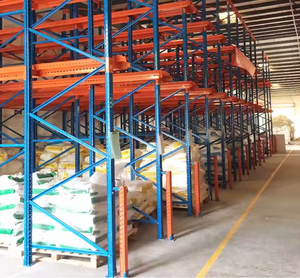
Adjustable Drive-Through Industrial Pallet Racking System
Q235B / Q355B Steel
500-1500kg/Pallet
FIFO Accessible
Manufactured to European EN 15512 and FEM 10.2.02 standards. Designed for extreme cubic volume utilization, robust forklift impact absorption, and cold-chain thermal efficiency.
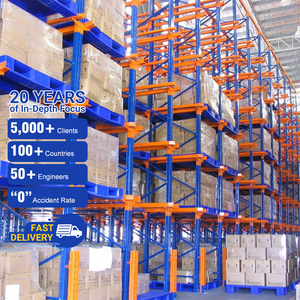
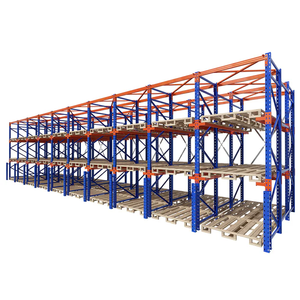
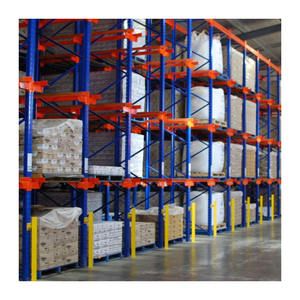
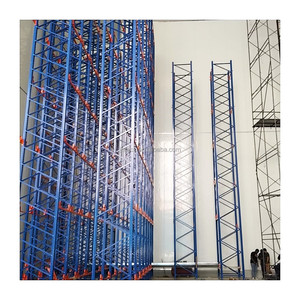
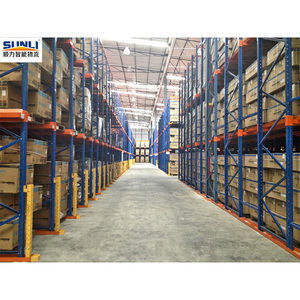
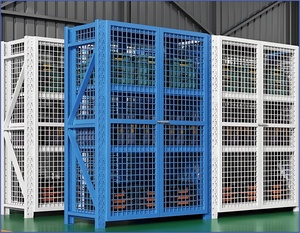
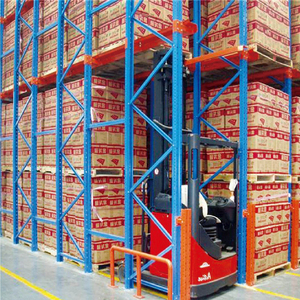
In modern supply chain optimization, volumetric efficiency frequently conflicts with SKU selectivity. Drive-In and Drive-Through racking architectures resolve this dynamic by eliminating intermediate operational aisles, delivering up to an 80% reduction in wasted floor footprint compared to conventional selective pallet rack configurations.
A continuous three-dimensional structural block is engineered where lift trucks directly enter storage lanes. In a Drive-In system, the lane operates on a Last-In, First-Out (LIFO) principle with a single loading and unloading access point. Conversely, a Drive-Through system incorporates dual-end accessibility to establish a continuous First-In, First-Out (FIFO) flow channel, making it suited for cold-storage environments, pharmaceutical manufacturing, and fast-moving consumer goods (FMCG) distribution characterized by batch expiration parameters.
| Kinematic Parameter | Standard Selective Rack | Drive-In Racking (LIFO) | Drive-Through Racking (FIFO) | Radio Shuttle Matrix |
|---|---|---|---|---|
| Floor Area Utilization | 35% – 40% | 65% – 75% | 60% – 70% | 80% – 85% |
| Volume Utilization Ratio | 40% | Up to 80% | Up to 75% | Up to 90% |
| Stock Rotation Logic | 100% Random Access | LIFO (Strict Batch) | FIFO (Strict Rotation) | FIFO & LIFO Flexible |
| Forklift Lane Travel | Aisle Travel Only | Enters Internal Bay | Enters Internal Bay | Operates at Face Only |
| Damage Vulnerability Index | Low (Beam Protected) | Moderate–High | Moderate–High | Extremely Low |
| Capital Expenditure Ratio | 1.0x (Baseline) | 1.25x – 1.45x | 1.35x – 1.55x | 2.4x – 3.2x |
Because Drive-In systems omit conventional horizontal load-bearing crossbeams spanning across aisles, upright frames are subjected to asymmetric biaxial bending and torsional stresses. To counterbalance the removal of transverse load ties, our engineering department incorporates reinforced structural overhead portal cross-ties, heavy-gauge top-plane horizontal portal bracing, and rear vertical diagonal tension bracing. Pallets rest upon continuous cold-rolled cantilever support rails formed from high-yield Q235B or Q355B structural steel, precision-punched to secure an interlocking load path that prevents lane spreading under maximum operational loading conditions.
Founded in 2001, Guangzhou Heda Shelves Co., Ltd. controls 30,000 square meters of precision manufacturing facilities, delivering engineering-grade warehouse solutions certified by world-recognized bodies.
For more than two decades, HEDA Shelves has bridged the divide between industrial cold-formed steel manufacturing and turnkey system engineering. Operating out of our modern facility in Guangzhou, China, our 300+ structural engineers, precision machine operators, and certified quality control inspectors support an annual throughput capacity surpassing 360,000 metric tons.
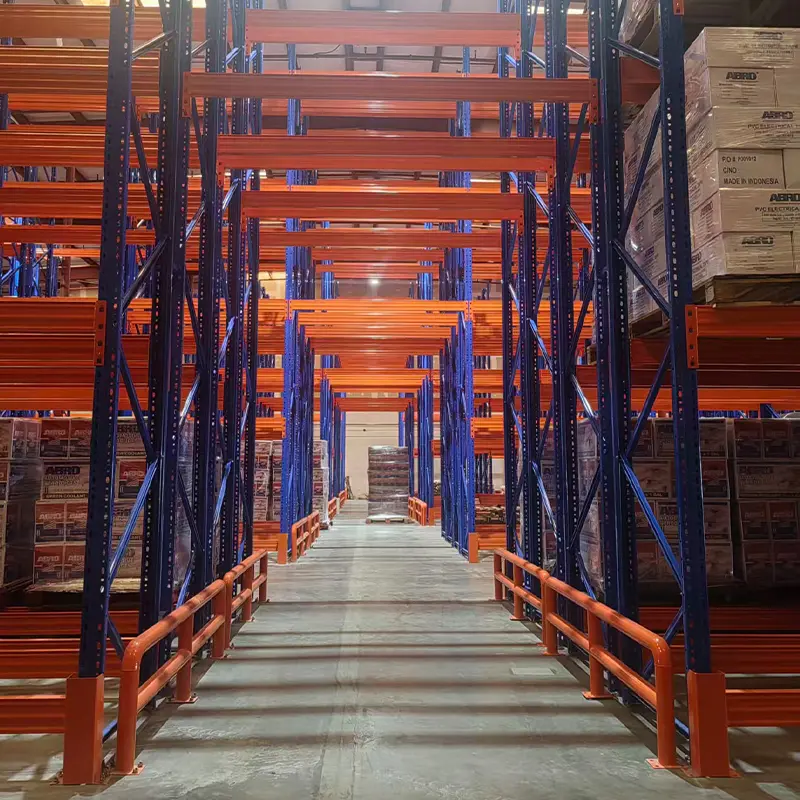
Every structural upright column, guide arm, and horizontal portal frame undergoes mill-certified precision processing to eliminate dimensional tolerances and residual mechanical tension.
Global warehouse real estate appreciation, decarbonization mandates, and labor constraints are reshaping how procurement officers, 3PL directors, and civil engineers specify high-density storage assets.
Refrigerated and frozen food logistics represent the fastest-growing sector for drive-in racking. Because cooling an unoccupied cubic meter of air incurs ongoing electrical overhead, facilities are transitioning from wide-aisle designs to ultra-deep drive-in channels (8 to 14 pallets deep). This achieves maximum thermal density and cuts refrigeration power draw by 22% to 35% per stored pallet unit.
Advancements in micro-alloyed structural sheet steels (such as high-tensile Q355B and automotive-grade structural alloys) allow HEDA engineers to reduce cross-sectional material thickness while increasing torsional resistance and yield limits. This structural optimization lowers deadweight load on concrete floor slabs, decreases international shipping container weights, and cuts total import duties.
Forward-thinking logistics facilities are increasingly procuring "Shuttle-Convertible Drive-In Racks." By roll-forming cantilever support rails that accommodate both standard wooden GMA/EUR pallets and motorized radio shuttle carriers, facilities can procure cost-effective drive-in systems today and upgrade to semi-automated shuttle channels later without replacing primary vertical upright frames.
Historic drive-in racking systems carried an industry reputation for operator vulnerability and localized damage. Recent structural design innovations engineered by HEDA Shelves address and resolve these operational challenges.
To eliminate pallet snagging when lift trucks place loads inside deep channels, entry points are fitted with flared, heavy-gauge steel funnel entries. These guide shoes correct pallet misalignment up to 45mm, guiding the pallet base onto the load rails and reducing destructive impact shock to cantilever support arms.
Because forklift outriggers operate mere inches from vertical uprights, entry columns absorb continuous kinetic friction. HEDA integrates cold-formed wrap-around upright reinforcers up to 1,200mm high, bolted to solid ductile cast-steel baseplates with M16 chemical anchor bolts, preserving vertical load stability during impact events.
Using 3D Finite Element Analysis (FEA) software, our structural design team models dynamic horizontal seismic wave propagation ($S_s, S_1$) across multi-tier portal frameworks. Bracing topologies are dynamically calculated to ensure structural ductility ratios conform with ASCE 7-22, Eurocode 3, and Chile NCh2369 earthquake standards.
Essential structural, financial, and logistical criteria addressed by our senior project engineering desk.
Drive-In racking is indicated when your SKU-to-pallet ratio is low, but aggregate inventory volume per SKU is high (typically 20 to 100+ pallets per SKU), and inventory moves under strict batch processing. Common applications include cold storage, beverage packaging, bulk raw materials, and agricultural commodities. If individual pallet selectivity is required at all times, selective racking or radio shuttle automation is the proper structural choice.
We do not use generic off-the-shelf column profiles for high-seismic locations. Our structural engineering department analyzes local ground acceleration coefficients ($a_g$, $S_{DS}$), subsoil classes, building ductility demands, and slab thickness. We increase column section widths (up to 120mm profile faces), specify high-yield steel (Q355B), integrate heavy box-section portal roof ties, and double-anchor reinforced baseplates with high-tensile anchors to absorb seismic shear forces.
Standard indoor warehousing is well-protected by our multi-stage electrostatic polyester powder coating cured at 200°C, providing superior scratch and chemical resistance. However, for facilities within 5km of ocean shorelines, open-air transit yards, or sub-zero refrigeration cold rooms with condensation cycles, we recommend our hot-dip galvanized finish (HDG, conforming to ASTM A123 / ISO 1461) with zinc coatings exceeding 65–85 microns for multi-decade corrosion defense.
Standard practice under FEM 10.2.02 and EN 15620 mandates a minimum total clearance of 75mm (preferably 100mm) between the widest point of the forklift chassis/load and the inner faces of the pallet support arms. In addition, floor guide rails (structural angle iron 100×75×8mm or raised tubular steel) must be anchored along both channel flanks to prevent operator steering drift while navigating inside deep storage bays.
Because Drive-In structures consolidate massive pallet tonnage over concentrated footplates without wide distribution beams, point loads often exceed 60 to 140 kN per upright column. The facility floor slab should be a reinforced concrete slab on grade with a minimum compressive strength of $f'_c \ge 25\text{ to }30\text{ MPa}$ and a crack-free slab thickness of 180mm to 250mm, finished to FF/FL flatness tolerances to prevent mast wobble at elevated lifts.
All HEDA export shipments are consolidated under a systematic container loading blueprint. Heavy structural uprights are nested with protective corrugated foam spacers and secured with heavy-duty steel strapping. Support rails, beams, and ties are bundle-banded with dedicated lifting slings, while small hardware (bolts, leveling shims, base plates, safety pins) is sealed in moisture-barrier wooden cases. Every bundle features bilingual, color-coded tag labeling matched to container packing lists for simplified customs inspection.
Yes. Upon receipt of your warehouse layout, building clear height, pallet dimensions, and target capacities, our technical team generates full AutoCAD layout drawings, 3D structural perspective renderings, and structural calculation reports detailing moment of inertia, slenderness ratios, and load capacities. This engineering package can be submitted directly to your local building department, third-party structural consultant, or insurance underwriter for formal sign-off.
Standard production for 1 to 5 container loads (approx. 40ft HQ) ranges between 15 and 25 working days from engineering drawing approval and deposit receipt. Expedited schedules can be coordinated for fast-track projects utilizing our stock coil inventory of standard Q235B steel. Ocean shipping transit depends on the destination port (e.g., 18–28 days to Pacific/Caribbean Americas, 14–22 days to European hubs, and 7–12 days within Southeast Asia).
Send your building dimensions, pallet specifications, and forklift parameters. Our senior structural designers will deliver a complimentary 2D CAD floor plan, 3D visualization, and structural calculation within 24 hours.