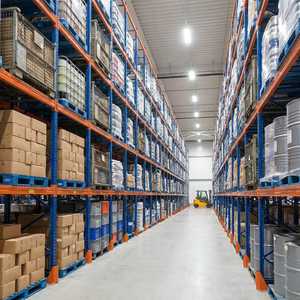
 Standard Selective
Warehouse Steel Storage Rack Steel Pallet Heavy Duty Adjustable Selective System
- 50mm Pitch
- Q235B Steel
- Direct Access
Select from specialized high-density uprights, automated shuttle interfaces, and certified narrow-corridor storage frames calibrated for rigorous dynamic load tolerances.
Standard Selective
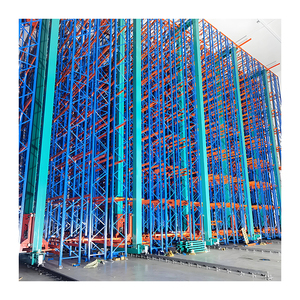 Semi-Automated
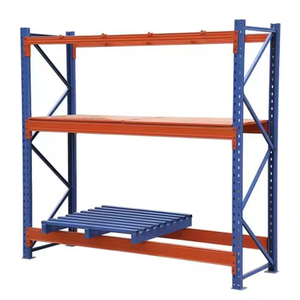 Structural Q235
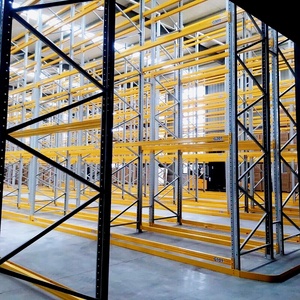 Narrow Aisle
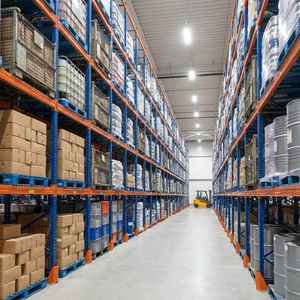 High Load Bearer
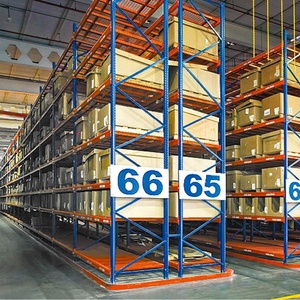 VNA System
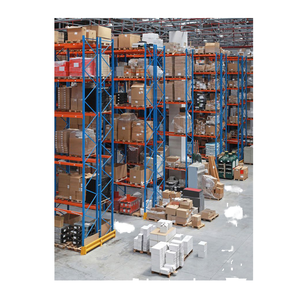 High Density
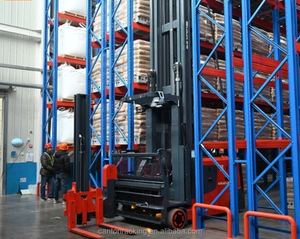 Max Capacity
Narrow Pallet Racking (commonly referred to as Very Narrow Aisle, or VNA racking) represents the convergence of high-density spatial economy and rapid inventory accessibility. Unlike conventional selective systems that require operating aisle widths spanning 3,200 mm to 3,800 mm to clear counterbalance lift equipment, a calibrated narrow aisle configuration condenses operating corridors down to between 1,600 mm and 1,900 mm. This engineering intervention frees up to 45% of redundant floor footprint, transforming unproductive transition corridors into active, revenue-generating pallet locations.
Achieving this structural density requires strict compliance with European standard EN 15512:2020 (Steel static storage systems - Adjustable pallet racking systems - Principles for structural design) and FEM 10.2.02 tolerances. As upright frames extend vertically up to 15 meters or higher to capture unutilized overhead cubic space, axial compression, global buckling moments, and second-order P-Delta structural effects escalate exponentially. Every upright section manufactured in our CE-certified facility uses premium Q235B or Q355B cold-rolled structural steel, precision cold-formed with modified 11-to-13 fold omega section geometry to maximize torsional rigidity.
In narrow aisle configurations exceeding 10 meters, floor levelness tolerances dictate functional safety. A dynamic mast deviation of just 2 millimeters at base level amplifies into a dangerous 30-40 millimeter lateral sway at top pick levels. Procurement teams must integrate Superflat industrial floor requirements (DIN 18202 Group 4 or Concrete Society TR 34 Free Movement / Defined Movement classes DM1/DM2) alongside rack deflection calculations.
| Storage Topology | Aisle Width (mm) | Direct Selectivity | Vertical Utilization | Material Handling Method | Ideal Inventory Dynamics |
|---|---|---|---|---|---|
| Narrow Aisle (VNA) | 1,600 – 1,900 | 100% (Instant) | Up to 15,000 mm | Turret Truck / Man-Up Stacker | High SKU density, medium-to-fast movement |
| Standard Selective | 3,200 – 3,800 | 100% (Instant) | Up to 9,000 mm | Counterbalance / Reach Truck | Broad SKU mix, low initial budget |
| Drive-In Racking | Non-Aisle / Lane | Low (LIFO / FIFO by lane) | Up to 11,000 mm | Standard Reach / Counterbalance | Homogeneous bulk batches, seasonal surges |
| Automated Shuttle | Deep-Lane Interface | Programmatic FIFO/LIFO | Up to 14,000 mm | Autonomous Shuttle + Lift Unit | Ultra-high density, cold storage facilities |
The industrial warehouse racking landscape is experiencing a paradigm shift driven by e-commerce SKUs, land acquisition costs, and industrial automation. Cross-border EPC contractors, logistics integrators, and plant directors are revising their procurement criteria, shifting from basic cost-per-pallet models to multi-dimensional lifecycle engineering assessments.
Buyers are migrating toward micro-alloyed structural steels (such as cold-rolled Q355B with niobium/vanadium traces) that permit lower profile mass while yielding higher dynamic flexural ratings. This reduces shipping deadweight in 40ft High Cube containers while lowering seismic mass coefficients.
Narrow racking layouts are no longer engineered solely for manually steered turret trucks. Contemporary procurements require dual-tolerance configurations compatible with Autonomous Mobile Robots (AMRs), automated guided vehicles (AGVs), and stacker cranes with optical targeting.
With environmental mandates tightening in North America and the EU, heavy electrostatic polyester powder coatings (70–90 microns) executed without TGIC additives and cured with multi-stage non-phosphate zirconium pre-treatments are setting the baseline for corrosion protection.
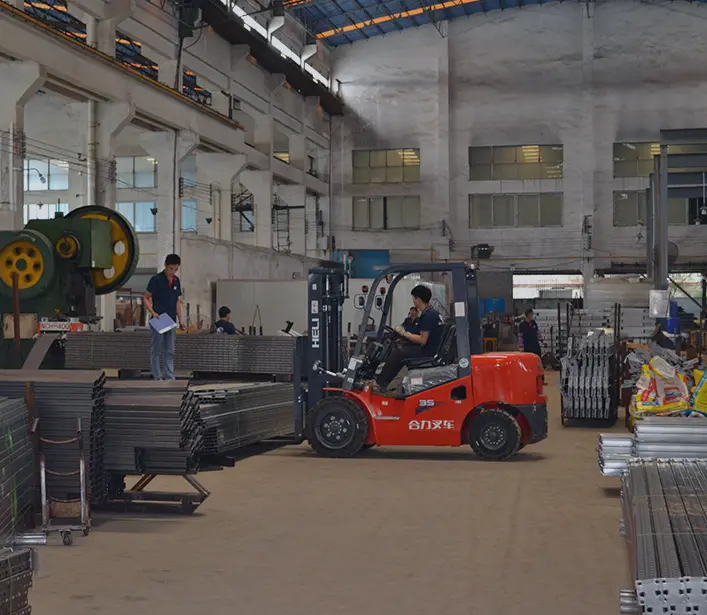
Sourcing directly from Guangzhou Heda Shelves Co., Ltd. (founded in 2001) gives warehouse operators an integrated production partner backed by over two decades of structural engineering experience. Operating from a fully-equipped 30,000 m² heavy-manufacturing plant backed by more than 300 skilled technical personnel, our facility processes over 30,000 metric tons of certified steel monthly.
Every beam, upright frame, cross-bracing run, and baseplate assembly undergoes a ten-stage production sequence: automated raw material tensile testing, CNC steel cutting, precision column punching, 18-station multi-roll continuous cold forming, robotic CO2 shielded welding, degreasing, acid pickling, zinc phosphating, and electrostatic polymer baking.
This vertical integration ensures consistency across dimensional clearances, slot tolerances, and structural weld integrity. It protects overseas buyers from racking distortion, installation mismatches, and premature coating failure in demanding industrial environments.
Detailed technical, engineering, and logistics guidance for industrial buyers planning narrow pallet racking projects.
Corridor clear dimensions depend on the chosen Material Handling Equipment (MHE). Man-Down Turret Trucks and articulated forklifts operate within corridors of 1,600 mm to 1,900 mm. Man-Up High-Lift Order Pickers generally need 1,500 mm to 1,750 mm clear width. An additional 100 mm to 150 mm operating clearance on each side of the pallet load must be engineered into cross-beam layouts to accommodate guided steer lines and prevent frame impact.
Narrow aisle configurations use one of two primary guidance systems: mechanical steel guide rails or wire guidance (inductive guide loops). Mechanical guidance uses heavy continuous angle steel (typically 100×75×8mm or 120×80×10mm) anchored directly into the slab along the rack run, complete with flared entry horns at aisle entry points. Inductive wire guidance relies on a high-frequency wire saw-cut into the center of the concrete slab, which sends signals to the truck's automated steering sensors.
Our structural team requires: (1) Architectural floor plans indicating building clear height, column centers, and utility clearances; (2) Concrete slab specification including slab thickness, compressive strength (e.g., C25/30 or C30/37), rebar mesh positioning, and sub-base compaction; (3) Pallet parameters, specifically front-width, depth, overall load height (including wooden skid), and maximum deadweight; (4) Forklift specifications including collapsed mast height, maximum reach elevation, and turn-radius data.
Yes. When engineering for high-risk seismic zones (such as Latin America's Pacific Rim, Southern Europe, or Southeast Asia), we run dynamic finite element modeling (FEM) tailored to the project's seismic zone parameters (such as Peak Ground Acceleration and ground type). Structural countermeasures include enlarged footplates, high-shear expansion anchors, heavy-gauge diagonal bracing nodes, and reinforced top-tie beams that tie adjacent rack rows together.
Uprights are nested and bundled in steel-strapped clusters cushioned with protective corrugated wrap to prevent scuffing. Cross beams are palletized with protective spacers to preserve beam connector fingers and lock clips. Every shipping container (40ft GP/HQ) is systematically packed using 3D container packing software to optimize cubic fill and total deadweight limits, supported by numbered loading lists to simplify on-site sorting and customs clearance.
Send us your building dimensions, pallet sizes, and throughput targets. Our engineering department will deliver a compliant 2D CAD layout, 3D render, and structural load analysis within 24 hours.